
Tampa Bicycle & E-Bike Accident Lawyer

Our Commitment To Excellence






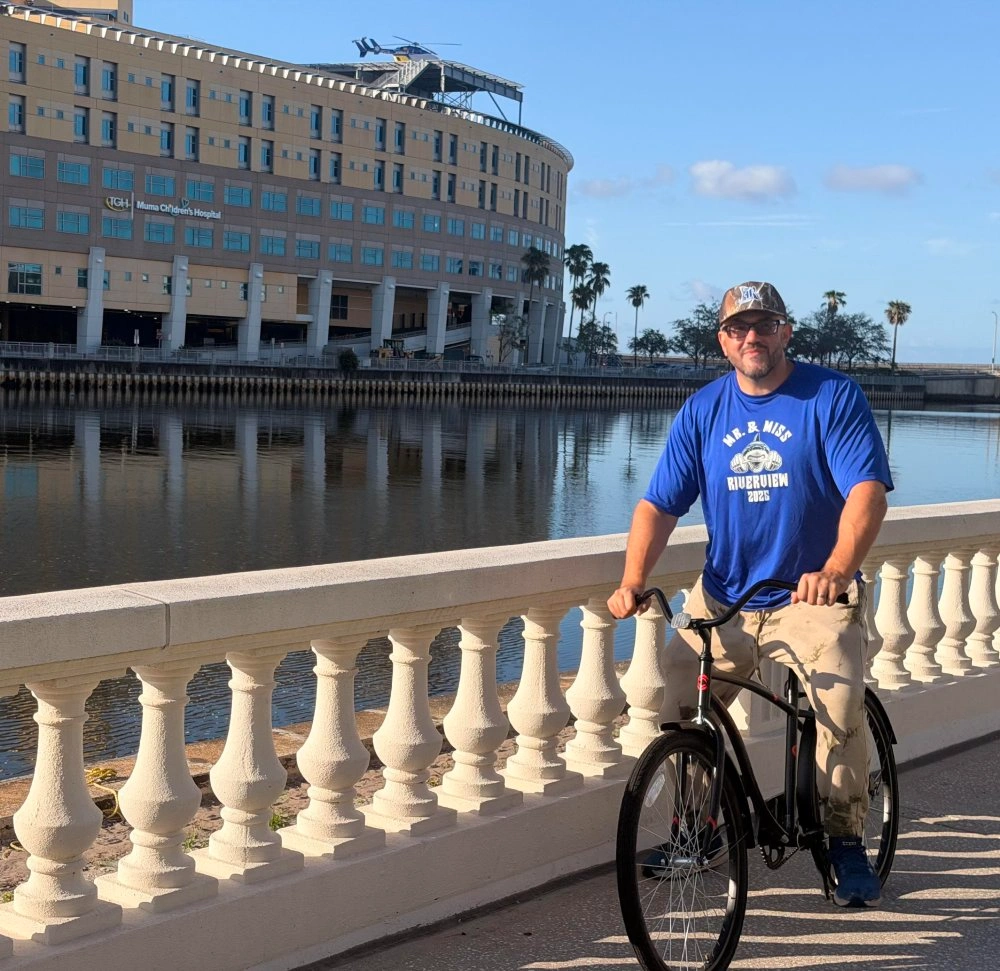
Santini Personal Injury & Car Accident Law represents people injured in bicycle and e-bike crashes in Tampa and throughout Hillsborough County. Attorney Frank Santini investigates not only driver fault, but also road ownership, bicycle-facility design, e-bike classification, local restrictions, signal and marking data, video and GPS evidence, available insurance, and the condition of the precise location where the collision occurred.
Tampa does not have one uniform type of bicycle network. The City’s Bike Routes map and inventory identify:
- 21 miles of separated and low-stress bike lanes;
- 92 miles of multi-use paths and trails;
- 8 miles of neighborhood greenways; and
- 83 miles of high-stress bike lanes.
That means Tampa reports nearly four times as many miles of high-stress bike lanes as separated and low-stress bike lanes. That does not mean every facility labeled “high stress” is inherently unsafe. It does mean that the words “the bicyclist was in a bike lane” tell only part of the story. A rider in a protected, two-way cycle track faces different turning and signal conflicts than someone in a painted lane beside a six-lane arterial.
Tampa’s local bicycle and e-bike issues also fit a broader statewide pattern. Santini Research, the research division of Santini Personal Injury & Car Accident Law, published FLHSMV Data Analysis: Bicycle Deaths Up Nearly 50% in Florida Since COVID to examine recent changes in Florida bicycle injuries and fatalities. After the firm received repeated calls involving children hurt while riding e-bikes, Attorney Santini wrote Small Riders, Fast Machines: A Parents’ Guide to E-Bike Risks and Safer Riding, focusing on child riders, increasingly powerful electric devices, and why the machine’s legal classification matters. Our Florida E-Bike Accident Lawyer resource addresses how e-bike classification, roadway and trail rules, insurance coverage, and crash evidence can affect an injury claim.
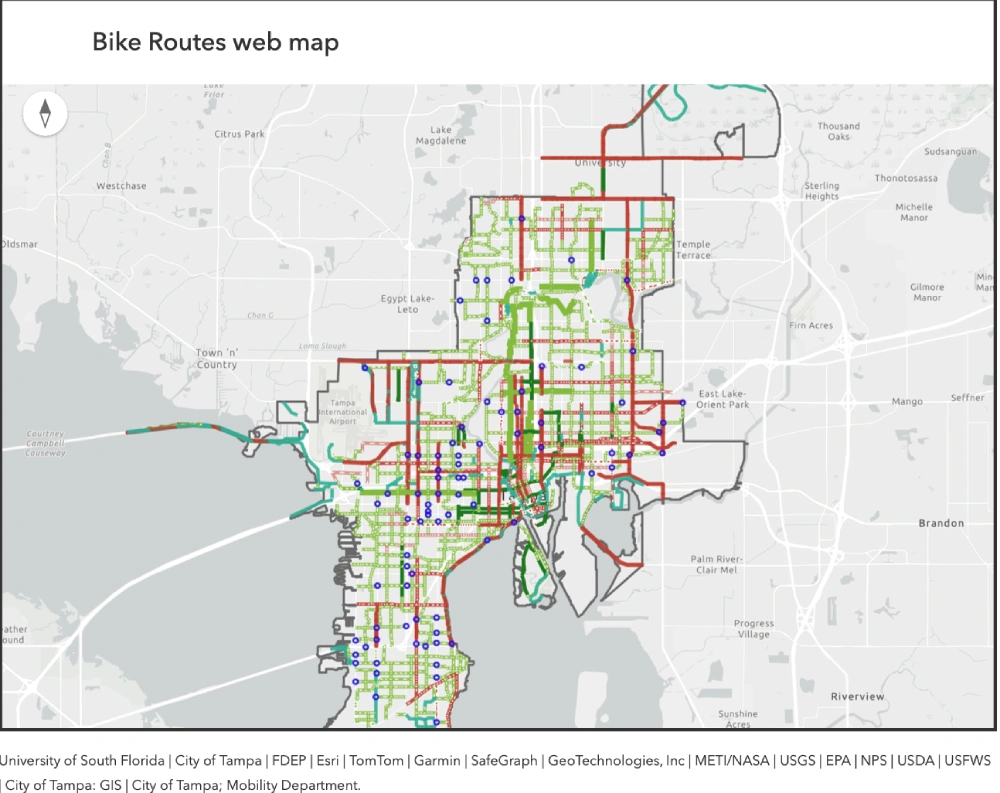
City of Tampa Bike Routes map showing low-stress and high-stress bicycle facilities, along with difficult crossings and difficult connections.
How Tampa Classifies Bicycle Routes by Stress Level
Tampa’s official Bike Routes map does more than show where bicycle facilities exist. The City classifies lower-stress routes as more appropriate for riders of all ages and abilities, while moderate- and high-stress routes are better suited to more experienced riders. Its map separately identifies multi-use paths, separated or low-stress bike lanes, neighborhood greenways, low-stress shared roadways, sidewalk connections, trails, moderate- and high-stress shared roadways, high-stress bike lanes, difficult connections, and difficult crossings.
Tampa’s bicycle environment also changes dramatically from one part of the City to another. Tampa’s adopted Comprehensive Plan describes older neighborhoods such as Hyde Park, Ybor City, Tampa Heights and West Tampa as having developed around walking, bicycling and streetcars, while later auto-oriented development directs more traffic onto arterials where walking and bicycling can be substantially more difficult. That is another reason the location and actual bicycle facility matter more than simply saying a crash occurred “in a bike lane.”
A Bicycle Crash Inside Tampa May Be on a Road Tampa Does Not Own
A Tampa mailing address or location inside City limits does not necessarily mean the City of Tampa owns or maintains the road.
In the City’s Vision Zero analysis of deadly and life-altering crashes from 2014 through 2018, 73% of severe bicycle crashes occurred on non-City-owned roads. The same analysis found that wide, fast major arterials, generally four to six lanes with speed limits of at least 40 mph, accounted for 58% of all deadly and life-altering injury crashes. The City described the highest tier of its High Injury Network as primarily state-owned. See the City of Tampa Vision Zero Action Plan.
The City’s historical High Injury Network table illustrates the jurisdictional issue:
| Selected Tampa corridor | Limits in City table | Jurisdiction | Bicycle-involved killed or severe-injury crashes, 2014–2018 |
| Hillsborough Avenue | N. Hoover Boulevard to N. 50th Street | State | 14 |
| Nebraska Avenue | E. Bougainvillea Avenue to E. Floribraska Avenue | State | 8 |
| Busch Boulevard | N. Florida Avenue to N. 40th Street | State | 5 |
| Fowler Avenue | N. Nebraska Avenue to N. 52nd Street | State | 4 |
| N. 15th Street | Hillsborough Avenue to Martin Luther King Jr. Boulevard | City of Tampa | 2 |
These are historical baseline figures, not current annual crash counts. The City used the data to identify and prioritize its High Injury Network, and its appendix cautions that some crashes can appear on more than one corridor.
Road ownership matters after a crash because the responsible agency may possess:
- traffic-signal timing and phasing records;
- maintenance and inspection records;
- construction or resurfacing plans;
- prior safety complaints or traffic studies;
- pavement-marking and sign plans; and
- records concerning known sight-distance or turning conflicts.
The City provides separate interactive maps for road ownership, speed limits, road-maintenance responsibility, bike lanes, and functional road classification. Those maps can be a useful starting point, but an important case may require confirming jurisdiction through project plans, right-of-way records, and agency correspondence.
First Determine Whether the Machine Is Legally an E-Bike
A product does not become a Florida e-bike merely because a seller describes it that way.
Under Fla. Stat. § 316.003, an electric bicycle must have fully operable pedals, a seat or saddle, and an electric motor of less than 750 watts. It must also fit within one of Florida’s three classes:
- Class 1: pedal assistance that ends at 20 mph;
- Class 2: throttle or motor propulsion that ends at 20 mph; or
- Class 3: pedal assistance that ends at 28 mph.
A 1,000-watt machine does not satisfy Florida’s statutory definition simply because it has pedals and is marketed as an “e-bike.” A device outside the definition does not automatically become a motorcycle; its specifications may instead place it in another category, including a motorized scooter, moped, motorcycle, or other vehicle.
For a qualifying statutory e-bike, Fla. Stat. § 316.20655 generally gives the rider the rights and duties of a bicyclist and allows the e-bike wherever bicycles are allowed. A driver’s license, registration, title, and motor-vehicle financial-responsibility coverage are not required merely because someone is operating a statutory e-bike. Local governments and the agencies controlling particular sidewalks, paths, or trail systems may nevertheless impose additional restrictions.
For a detailed explanation of whether a device marketed as an “e-bike” is indeed a legal Florida e-bike, see the section titled “When does a Modified E-bike Stop Being a Legal E-bike” on our Florida E-Bike Accident Lawyer page.
Where Can You Ride an E-Bike on Tampa’s Riverwalk, Bayshore and MacDill Trail?
Tampa’s current park rules are unusually useful here. The City’s Greenways FAQ says electric bicycles are allowed on City trails and that the trail speed limit is 15 mph.
| Tampa facility | Privately owned statutory e-bike | Important distinction |
| Tampa Riverwalk | City’s published materials indicate yes, subject to trail rules and any lower posted restriction. | Tampa expressly identifies the Riverwalk as part of its Greenways and Trails System. Shared Lime/Spin e-bikes and scooters are prohibited there. |
| Bayshore Boulevard Linear Park Trail | City’s materials indicate yes, subject to trail and posted rules. | Fascinatingly, Tampa’s own trail page calls Bayshore a 10-foot-wide sidewalk, while the City’s Greenways FAQ expressly identifies it as a bike trail. A separate three-mile on-road bike lane runs northbound from Rome Avenue to Gandy Boulevard. Shared Lime/Spin devices are prohibited on Bayshore Boulevard. |
| MacDill Trail at Gadsden Park | Yes, under the City’s general e-bike trail rule, unless otherwise posted. | It is a 1.47-mile asphalt trail with two loops. The City specifically warns that Gadsden Park becomes a high-traffic area on weekends because of Interbay Little League. |
As you can see from the table, privately owned e-bikes and shared rental e-bikes do not necessarily follow the same Tampa rules. Tampa specifically prohibits its shared e-bikes and scooters on the Tampa Riverwalk, Bayshore Boulevard and 7th Avenue. Likewise, the City’s Shared Micromobility Program page says its operators must be at least 16 and possess a driver’s license or permit.
Did Tampa adopt a 10-mph e-bike speed limit on its trails? No. Tampa considered an ordinance in late 2025 that would have imposed a 10-mph limit and fines for conduct including stunts, excess passengers and certain group riding. The proposal generated news coverage before the final vote, but the Tampa City Council unanimously rejected it on December 18, 2025. Tampa’s currently published park rules continue to state a 15-mph trail limit unless otherwise posted
Can You Ride a Bicycle or E-Bike on a Tampa Sidewalk?
Florida generally allows a legal e-bike wherever an ordinary bicycle is allowed, but Tampa has a local sidewalk restriction.
As discussed above, by a legal or statutory electric bicycle, we mean that the device fits the definition of a Florida e-bike and is not legally a motorcycle or another motor vehicle. This distinction matters because Fla. Stat. § 316.1995 generally prohibits operation of device classified as motorcycle or motor vehicle on a sidewalk or bicycle path, except when crossing at a permanent or authorized temporary driveway or when another statutory exception applies.
Even if a device is a statutory e-bike, Tampa Code § 25-185 prohibits riding a bicycle or e-bike on a sidewalk within a business district and where signs prohibit sidewalk riding. “Business district” has a specific definition under Fla. Stat. § 316.003: at least 50% of the highway frontage for a distance of 300 feet or more must be occupied by buildings in business use. Downtown Tampa’s Central Business District is an obvious place where many blocks will qualify as a business district, and the City calls East 7th Avenue the “main commercial thoroughfare” of Ybor City.
Where sidewalk riding is permitted, Fla. Stat. § 316.2065 requires a bicyclist to yield to pedestrians and give an audible warning before overtaking and passing them.
Why Cleveland Street E-Bike Crashes Require a Close Look at the Conflict Point
Attorney Frank Santini has reviewed e-bike cases involving riders struck at conflict points along Cleveland Street in Tampa; locations where a motor vehicle’s path crosses the bicyclist’s path, such as a turn, side street or other crossing movement. Cleveland Street also has an extensive City safety-project history. Tampa designated Cleveland Street as part of its High Injury Network and reported 80 crashes from 2021 through May 2024, with 40% resulting in injuries.
In 2024, Tampa converted one travel lane into a parking-protected bicycle lane and built the City’s first protected intersection at Cleveland Street and South Hyde Park Avenue. The protected-intersection design keeps riders separated from motor vehicles as they approach the intersection and gives them a dedicated path through the crossing. The City’s earlier project presentation specifically discussed reducing high-speed turns, improving sight lines and reducing the time bicyclists are exposed to vehicle conflicts.
A protected lane therefore does not end the investigation after a Cleveland Street crash. The critical evidence may be where the separation ends or is interrupted: the rider’s direction, the driver’s turning movement, signal phase, pavement markings, parked vehicles and sight lines, separators, construction conditions, and available GPS or video data can all matter.
The Cleveland Street Quick Build does not cover all of Cleveland Street; the City’s identified project limits run from the railroad crossing west of Willow Avenue to Parker Street. A crash elsewhere on Cleveland must be analyzed based on the facility actually present at that location.
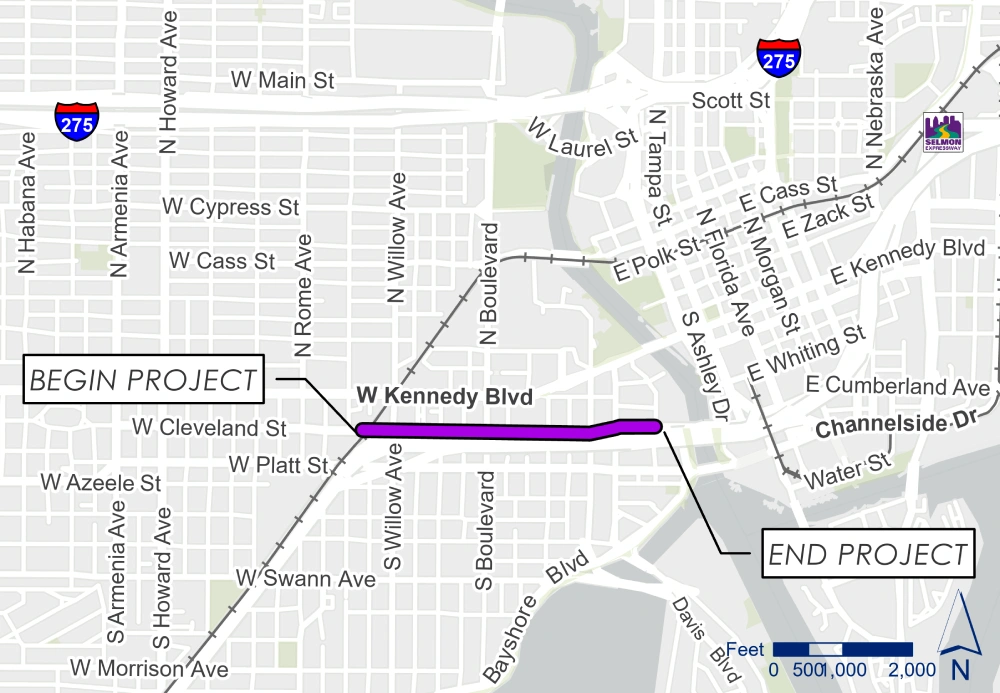
City of Tampa map of the Cleveland Street Quick Build project, showing the protected bicycle-lane corridor and project limits from west of Willow Avenue to Parker Street.
Evidence to Preserve After a Tampa Bicycle or E-Bike Crash
Some of the most useful evidence can disappear quickly. When possible, preserve:
- Witnesses and nearby video. Obtain contact information and promptly identify businesses, homes, parking facilities, buses, vehicles, and traffic cameras that may have recorded the collision.
- Signals, signs, markings, and construction conditions. Photograph the scene from both approach directions, including bicycle signals, turn arrows, green conflict markings, separators, temporary traffic controls, parked vehicles, landscaping, and sight obstructions.
- GPS and ride data. Preserve Strava, Garmin, Apple Watch, phone, bike-computer, or other data that may show route, direction, timing, and sometimes speed.
- The bicycle or e-bike itself. Do not repair, modify, discard, or reset it before documentation. Preserve the permanent class label, manufacturer and model information, motor wattage, controller settings, assisted-speed capability, and any modifications.
What Compensation Can I Recover After a Bicycle or E-Bike Crash?
A Tampa bicycle or e-bike claim may include the cost to repair or replace the bicycle, e-bike, helmet, electronics, or other damaged property; reasonable past and future medical expenses; lost income and diminished future earning capacity; and compensation for pain, suffering, disability, disfigurement, mental anguish, inconvenience, and loss of enjoyment of life. The available recovery depends on the evidence, injuries, insurance coverage, and allocation of fault. Under Fla. Stat. § 768.81, damages are reduced by the injured person’s share of fault, and a claimant found more than 50% responsible for his or her own harm generally cannot recover in a covered negligence action.
Why Tampa Bicycle and E-Bike Cases Require Location-Specific Analysis
A serious Tampa bicycle or e-bike case may require determining:
- whether the rider was in a roadway, painted bike lane, protected cycle track, sidewalk, crosswalk, or trail;
- whether the road was owned and maintained by the City, County, State, or another agency;
- whether the machine actually met Florida’s e-bike definition;
- whether City trail, shared-fleet, sidewalk, or site-specific rules applied;
- what signal phase and turning movement controlled the crossing;
- whether ongoing construction changed the facility; and
- what video, GPS, device, governmental, and insurance evidence is available.
Those questions cannot be answered by simply describing the event as a “car versus bicycle accident.”
Santini Personal Injury & Car Accident Law represents injured bicycle and e-bike riders in Tampa and throughout Florida. Attorney Frank Santini also directs continuing research through Santini Research into Florida bicycle and e-bike crash trends, device classification, insurance coverage, roadway design, and the local rules that affect riders.
Primary sources reviewed for this page: Florida Statutes Chapters 316, 627, and 768; Tampa Code Chapter 25; City of Tampa Bike Routes and Transportation Maps; City of Tampa Vision Zero Action Plan; Tampa Greenways and Trails rules; Tampa Shared Micromobility Program materials; Tampa E-Bike Voucher Program materials; and City Green Spine project information.
Schedule A Consultation
Fields marked with an * are required
Let Us Get You Started In The
Right Direction
Fields marked with an * are required
Riverview Office
7269 Bucks Ford Dr.
Riverview, FL 33578

Call Us Today 813-437-9627
Tampa Office
9270 Bay Plaza Blvd Suite 618
Tampa, FL 33619
© Copyright 2026 Santini Personal Injury & Car Accident Law. All Rights Reserved.
Disclaimer | Site Map | Privacy Policy
*Images are obtained under license from Canva and other third-party stock image providers, with attribution included where required.
Digital Marketing By 