






×

(908) 329-2003

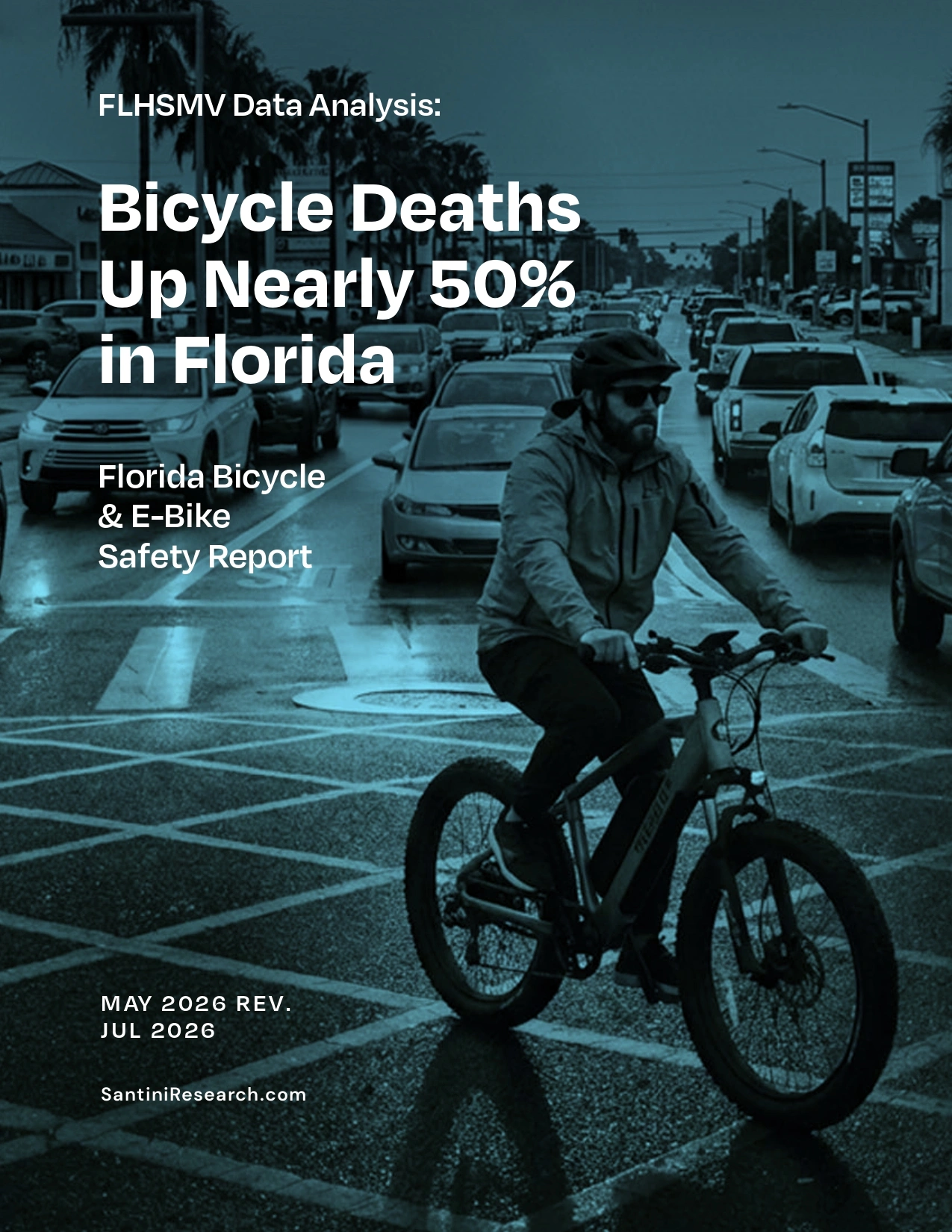
FLHSMV Data Analysis: Bicycle Deaths Up Nearly 50% in Florida Since COVID

Home /  Reports /  FLHSMV Data Analysis: Bicycle Deaths Up Nearly 50% in Florida Since COVID

Our Commitment To Excellence

FLHSMV Data Analysis: Bicycle Deaths Up Nearly 50% in Florida Since COVID

Florida’s Bicycle Fatalities Have Shifted Dramatically Since COVID

Florida’s bicycle crash data shows a clear post-COVID shift in both scale and severity. Compared to the 2017–2019 baseline, statewide bicycle injuries increased approximately 32%, while fatalities rose nearly 50%.

The increase is not evenly distributed across the state. Instead, the highest injury and fatality rates are concentrated in a distinct cluster of coastal counties led by Monroe and Pinellas Counties. These counties combine heavy recreational riding environments, robust trail systems, tourism exposure, and rapidly expanding e-bike usage.

The pattern points away from random fluctuation and toward a structural shift in how, where, and how often people are riding.

The E-Bike Surge Changed Florida’s Roads

U.S. e-bike sales more than quadrupled between 2019 and 2022, with imports continuing to climb in 2025. While Florida does not yet publish comprehensive statewide e-bike sales data, local infrastructure and ridership reports strongly suggest the surge hit Florida particularly hard.

In Pinellas County, ridership more than doubled after St. Petersburg transitioned its municipal bike-share system to a fully electric fleet. Trail systems across the state reported substantial increases in post-COVID usage, while local governments and health agencies began implementing new e-bike guidance and restrictions.

Florida’s crash reporting systems currently combine many e-bike incidents with traditional bicycle crashes, meaning the statewide “bicycle” category likely reflects a significant e-bike component.

Florida Is Operating Without Clear E-Bike Crash Data

Despite the rapid expansion of e-bikes, Florida has historically lacked a dedicated statewide e-bike crash tracking framework.

That is beginning to change.

The recently enacted 2026 E-Bike Act requires law enforcement agencies to begin collecting more detailed micromobility crash data, including:

  • E-bike classification
  • Rider age
  • Driver’s license status
  • Crash timing information

This new reporting system will eventually provide a clearer understanding of how e-bikes are influencing statewide injury and fatality trends.

Until then, researchers must rely on indirect indicators such as timing, geography, severity trends, and local infrastructure data.


The Geographic Pattern Is Not Random

The counties posting the highest injury rates are not simply Florida’s largest urban centers.

Instead, the highest rates are concentrated in coastal and leisure-oriented counties such as:

  • Monroe
  • Pinellas
  • Collier
  • Sarasota
  • Martin
  • Volusia
  • Palm Beach

These counties share several characteristics:

  • High recreational riding activity
  • Extensive trail infrastructure
  • Older demographics
  • Tourism-heavy economies
  • Large numbers of non-resident riders

The data suggests that e-bikes are layering onto already active cycling environments, increasing overall exposure and potentially increasing crash severity.


Crashes Are Becoming More Severe

The rise in fatalities is especially significant because fatality rates increased faster than injury rates statewide.

Florida is not simply seeing more bicycle crashes; it is seeing more severe crashes, including many incidents involving Florida bicycle accident cases.

Among counties with meaningful crash volume, Monroe County stands apart with the highest post-COVID fatality rate. Pinellas County also remains a major outlier due to its combination of high crash volume and elevated fatality rates.

The trend appears across multiple regions and county types, suggesting the shift is structural rather than isolated.


Local Spotlights

Monroe County: Constrained Geography and Heavy Visitor Exposure

Monroe County posts the dataset’s highest injury rate and highest meaningful fatality rate.

The county’s geography creates unusually high rider exposure through:

  • Heavy tourism traffic
  • Extensive bicycle usage
  • The Overseas Heritage Trail system
  • High visitor cycling activity

Local agencies have already begun responding with dedicated e-bike safety guidance and path speed restrictions.


Pinellas County: The High-Volume Coastal Model

Pinellas County provides one of the strongest large-county signals in the dataset.

The county combines:

  • Massive trail usage
  • High bicycle demand
  • Significant e-bike adoption
  • Dense interactions between roadways and trail systems

After St. Petersburg transitioned to a fully electric bike-share fleet, ridership more than doubled. Pinellas now represents one of the clearest examples of how expanding e-bike exposure may be reshaping statewide crash trends.


Why This Matters Now

Florida’s bicycle casualty surge is geographically concentrated, structurally consistent, and increasing in severity.

At the same time, the state is still operating without complete e-bike-specific crash data. Policymakers, local governments, and the public are making decisions within a partial-data environment.

If current trends continue, Florida is not simply seeing more bicycle crashes.  It is seeing more severe and more lethal crashes concentrated in the exact regions where riding patterns have changed most dramatically.


FLHSMV Data Analysis: Bicycle Deaths Up Nearly 50% in Florida Since COVID

Coastal Counties Hit Hardest

May 2026
SantiniResearch.com

Key Findings

What bicycle crash data from FLHSMV tells us about the rise of bike accidents and which Florida counties have more bike accidents and fatalities per capita.

Prepared from state and county-level FLHSMV bicycle injury/fatality data compared against state and county population benchmarks from the University of Florida Bureau of Economic and Business Research.

Core study window: 2017–2019 (pre-COVID baseline) vs. 2022–2025 (post-COVID core).

Florida’s bicycle crash data shows a clear post-COVID shift in scale, severity, and geography, with fatalities rising nearly 50% statewide.

Key Findings:

  • Fatalities Are Surging: Florida bicycle deaths have risen nearly 50% since COVID, with injuries up 32% over the same period.
  • Crashes Are Getting More Severe: Adjusted for population, fatality rates are rising faster than injury rates, indicating that crashes are not just more frequent, but more dangerous.
  • The Pattern Is Geographic and Not Random: The highest per capita injury rates are concentrated in a cluster of coastal, leisure-heavy counties led by Monroe and Pinellas, not simply Florida’s largest urban centers.
  • The Data Points to E-Bikes: While state crash reports do not yet isolate e-bikes, the timing, geography, and severity trends strongly align with the rapid expansion of electric bicycles across Florida.

Methodology Note: This analysis measures the absolute injury burden per resident, not risk per rider or miles traveled.

This is not random.  The increase is geographically concentrated and structurally consistent.

What Changed After COVID: The E-Bike Surge
The New Data Framework: Florida’s First True E-Bike Crash Tracking System
Implication for This Study
Bicycle Deaths and Injuries Surge Across Florida
Geographic Distribution: The Coastal Concentration
High Injury-Rate Counties: Where Scale Meets Risk
Severity Trends
Local Spotlights
Pinellas County: The High-Volume Coastal Model

Why This Matters Now

Florida’s post-COVID bicycle crash surge is not random.  It is geographically concentrated, structurally consistent, and accelerating in severity.

The strongest signals are not coming from the state’s largest urban centers, but from a distinct cluster of coastal counties led by Monroe and Pinellas, areas where e-bike adoption, trail infrastructure, and rider exposure have expanded rapidly.

At the same time, Florida is operating without clear e-bike-specific crash data. That gap is only now beginning to close as the state prepares to implement its first formal micromobility crash tracking system.

Until that data arrives, policymakers, local governments, and the public are making decisions in a partial-data environment.

Compared with the pre-COVID baseline, injuries are higher and fatalities increased even faster.

Understanding these trends is increasingly important for riders, policymakers, and anyone evaluating bicycle injury claims in Florida.

If current trends continue, Florida is not simply seeing more bicycle crashes.  It is seeing more severe and more lethal ones concentrated in the exact regions where riding patterns have shifted most dramatically.


Frank Santini
About The Author

Frank Santini

Frank Santini, Esq., is a highly accomplished personal injury attorney and the founder of Santini Personal Injury & Car Accident Law, specializing in personal injury law. A summa cum laude graduate of Stetson University College of Law, Frank is licensed in Florida and New Jersey and has earned recognition as a Rising Star” by Super Lawyers and high ratings from Martindale-Hubbell.
Education: Graduated cum laude from Muhlenberg College in Allentown, PA
Graduated summa cum laude from Stetson University College of Law
Professional Associations: Member of The Florida Bar
New Jersey Bar Association
Pennsylvania Bar Association
Experience: Founder of Santini Personal Injury & Car Accident Law, representing personal injury clients with dedication and expertise.

View all posts by Frank Santini →

Subscribe for Santini Research Reports