
Riverview Bicycle & E-Bike Accident Lawyer

Our Commitment To Excellence






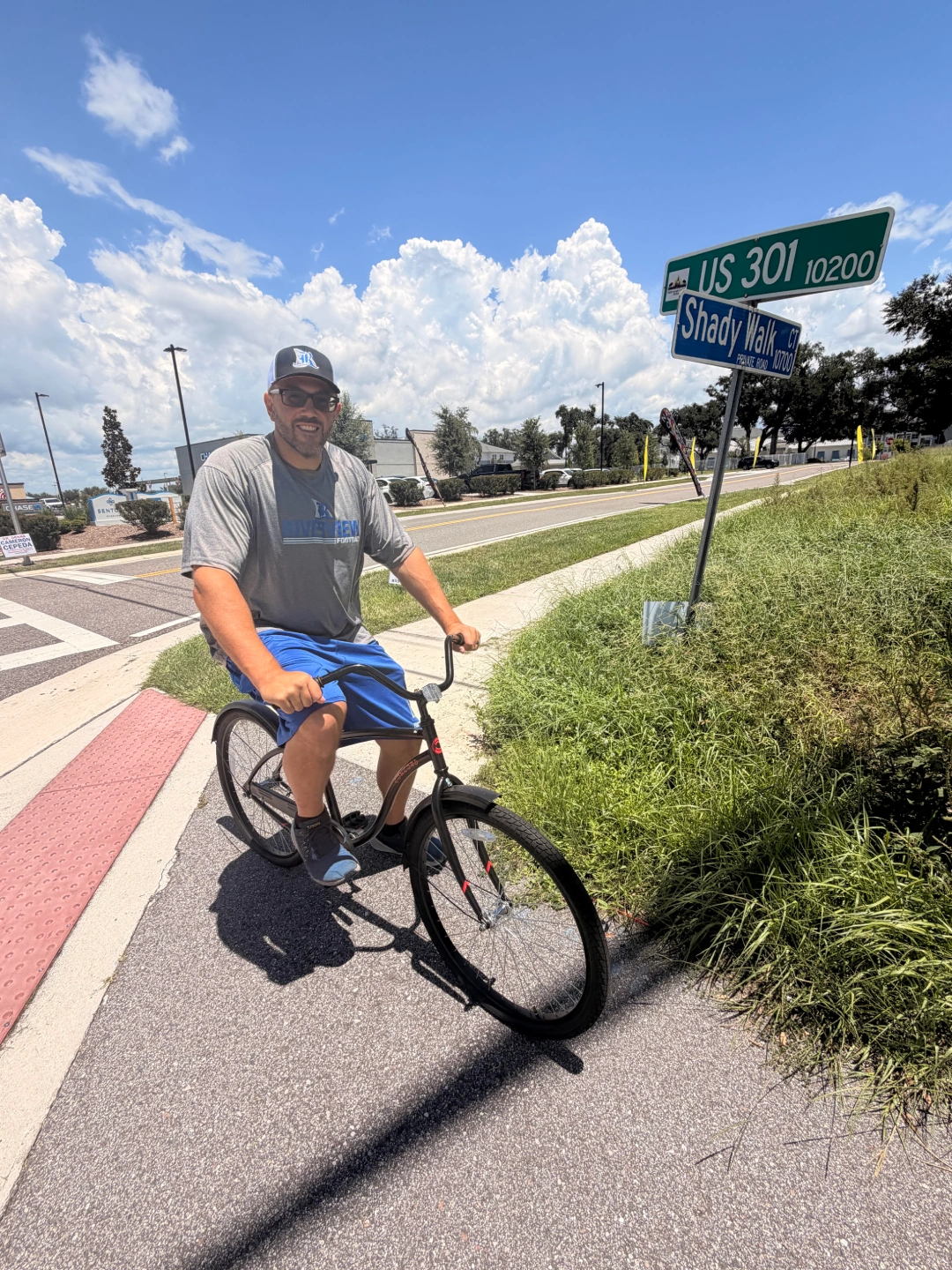
Attorney Frank Santini on the US 301 shared-use path in Riverview, where bicyclists and e-bike riders repeatedly cross commercial driveways.
Riverview Bicycle & E-Bike Accident Attorney
Riverview is not a traditional bicycle city with a continuous network of protected bike lanes. Local riders often piece together routes using neighborhood bike lanes, wide shared-use paths, sidewalks, and a handful of designated recreational trails.
Bike safety concerns have surfaced at Riverview public meetings. That concern is showing up in Riverview’s own planning process. During the May 5, 2026 Riverview Community Plan Update virtual meeting, a resident wrote in the public chat, “More cycling lanes… it’s very dangerous to ride bikes,” providing a firsthand example of a resident telling local planners that safer bicycle infrastructure remains a concern.
The concerns raised in Riverview are part of a broader statewide safety issue that Santini Personal Injury & Car Accident Law has also encountered in its e-bike cases. Those observations helped lead the firm’s research division, Santini Research, to publish FLHSMV Data Analysis: Bicycle Deaths Up Nearly 50% in Florida Since COVID, examining recent changes in Florida bicycle injuries and fatalities. After receiving repeated calls involving children injured while riding e-bikes, Attorney Frank Santini also wrote a white paper about what Parents Should Know about E-bike safety for their kids, which examines the risks posed by increasingly powerful E-bikes. For riders and families dealing with an actual collision, our Florida E-Bike Accident Lawyer resource explains how device classification, roadway and path rules, insurance coverage, and crash evidence can affect a claim.
Those legal and safety questions become very concrete on US 301 in Riverview. What many people casually call the “wide sidewalk” on the east side of US 301 is identified by FDOT as a paved shared-use path designed for bicycle and pedestrian travel. It separates riders from through traffic on US 301, but that separation repeatedly disappears at business entrances, side streets, and other locations where motor vehicles cross the rider’s path.
Santini Personal Injury & Car Accident Law represents people injured in bicycle and e-bike crashes in Riverview and throughout Hillsborough County, including collisions involving US 301, driveways, intersections, bike lanes, sidewalks, and shared-use paths. Attorney Frank Santini offers free consultations and investigates not only driver fault, but also the specific roadway or trail rules, e-bike classification, available insurance, video and GPS evidence, and, when relevant, FDOT records governing the location where the crash occurred.
Attorney Frank Santini regularly rides bicycle routes in Riverview and South Hillsborough County and has researched the Florida statutes, FDOT roadway data, access-management rules and Hillsborough County trail regulations that apply to those routes.
Riverview Does Not Have Its Own City Bicycle Ordinances
One point causes unnecessary confusion: Riverview is not an incorporated city.
The Riverview Community Plan is part of Hillsborough County’s unincorporated comprehensive-planning system. There is no City of Riverview government passing a separate Riverview traffic or e-bike code.
That means the rules affecting a Riverview rider can come from several different levels: Florida traffic law; Hillsborough County ordinances; FDOT rules and traffic-control devices on state facilities; CDD rules governing district-owned or managed trails and amenity property; HOA or other private-property rules; and site-specific rules governing individual parks and preserves.
That last category matters. A bicycle or e-bike that is perfectly lawful on US 301 may be prohibited on a nearby nature-preserve trail.
Bicycle and E-Bike Routes Around Riverview and South Hillsborough
US 301 Between Big Bend Road and Boyette Road
There is a wide path, officially referred to as a shared-use facility, along US 301 that provides a useful north-south riding corridor between the Big Bend and Boyette areas.
FDOT documents an existing 12-foot paved shared-use path along the northbound/east side of US 301 near the Big Bend corridor and north to south of Whitt Road. The adjoining FDOT project continues from Whitt Road through the Boyette/Gibsonton Drive area. The US 301/Big Bend Road intersection is currently being reconstructed under a separate FDOT project scheduled for completion in late 2027.
A rider can make this a shorter 6-to-8-mile ride or extend it through surrounding neighborhoods and connecting bike facilities.
But again, the width of the path should not create a false sense that it is separated from motor-vehicle traffic. Every driveway that crosses the path is effectively a miniature intersection.
That is one of the most important things riders, and drivers, need to understand about US 301.
US 301 from SR 674 toward Ambleside
One route Attorney Santini rides begins around the commercial area at US 301 and SR 674 near Ace Hardware and Walmart and heads north on US 301 toward the Ambleside area. Here is an example of the route on Google Maps.
Depending on the turnaround and neighborhood loops added to the ride, it is an easy way to build approximately 20 miles.
Importantly, riders may think of the wide pavement along this section of US 301 simply as a “sidewalk.” On the east side of this portion of US 301, however, FDOT actually constructed a 12-foot multi-use/shared-use path between SR 674 (Sun City Center Boulevard) and Balm Road. That distinction can matter both for route planning and when analyzing the law after a crash.
The path solves one problem, riding immediately beside fast-traveling traffic, but creates another. A rider traveling continuously along the path crosses numerous business entrances, shopping-center driveways and side streets. A driver exiting a business may be looking left and right for a gap in highway traffic while the bicycle or e-bike is approaching from a completely different sight line.
US 301 to Paseo Al Mar and Waterset
Another option is to ride US 301 north to Balm Road/Paseo Al Mar Boulevard, turn west and follow the route over I-75 toward Waterset. Here is an example of that route.
Attorney Santini regularly rides the bike lanes on the public streets through Waterset.
There is an important legal distinction inside Waterset. The public streets and bike lanes are not necessarily governed by the same rules as CDD-owned recreational property. Waterset has three Community Development Districts and more than 14 miles of community trails. The currently posted Waterset Central CDD amenity policy expressly prohibits golf carts, motorcycles, ATVs/off-road vehicles and motorized scooters on District property, but does not expressly list electric bicycles. Riders should therefore pay attention to which facility they are using and to posted rules rather than assuming every Waterset path has the same status as a public bike lane.
Another convenient starting area is the SouthShore Sportsplex at 6110 Waterset Boulevard in Apollo Beach. Google Maps location. Hillsborough County operates the Sportsplex at that address.
Why the US 301 Shared-Use Path Can Feel Safe, Until You Reach a Driveway
There is a basic paradox of shared-use paths along major corridors like US-301.
While riding between intersections, a separated path can feel substantially safer than sharing pavement with cars traveling 45 or 55 mph. But the separation disappears every time a vehicle crosses the path to enter or leave a business.
FDOT’s own engineering guidance recognizes this problem. The 2026 FDOT Design Manual states that closely spaced driveways increase conflict points. It also warns that larger driveways designed to accommodate trucks and buses can increase bicyclist and pedestrian exposure to vehicles.
Driveway angle matters too. FDOT says a driveway should be as close to 90 degrees as practical. A heavily skewed driveway can increase the distance a bicyclist must spend exposed to conflicting traffic and can restrict a road user’s sight angle, making another road user, and the size of a safe gap, harder to perceive.
This is why a map showing a bicycle path does not tell the whole safety story. The number, spacing, geometry and control of the places where cars cross that path may matter as much as the existence of the path itself.
FDOT’s own design work on a portion of US 301 recognizes these conflict points. Its project documents call for special-emphasis crosswalks at side streets and major driveways and a review of wrong-way signing and pavement markings throughout the corridor.
We Checked FDOT’s Actual Access-Management Data for US 301
FDOT identifies this portion of US 301 as Roadway ID 10010000, US 301/SR 43, on the State Highway System. The federal-aid inventory identifies the corridor as an Urban Principal Arterial and part of the National Highway System.
We then checked FDOT’s authoritative Access Management TDA dataset, which comes from FDOT Roadway Characteristics Inventory Feature 146. That dataset assigns State Highway System segments an access class based on FDOT’s access-management system.
The result is surprisingly specific:
| US 301 segment | FDOT Access Class |
| Milepost 0.000 to 15.693 | Class 3 |
| Milepost 15.693 to 24.800 | Class 5 |
FDOT pavement records independently identify milepost 15.693 as Boyette Road/Gibsonton Drive.
That means US 301 between Big Bend Road and Boyette Road is within an Access Class 3 corridor.
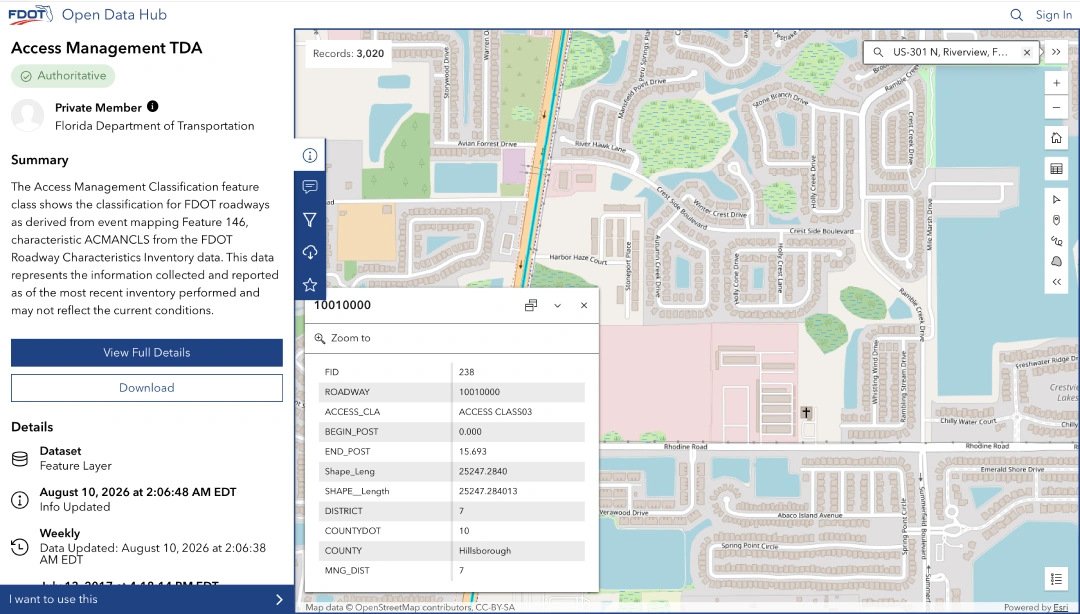
FDOT Access Management data for US 301 (Roadway 10010000) showing Access Class 3 from milepost 0.000 to 15.693 near Boyette Road / Gibsonton Drive.
Why should a bicyclist or e-bike rider care?
FDOT’s Feature 146 handbook explains that the access classification governs standards such as driveway separation and median-opening separation. For Access Class 3, the table identifies minimum connection spacing of 660 feet when the posted speed exceeds 45 mph and 440 feet when the posted speed is 45 mph or less.
That does not mean every existing driveway closer than 660 or 440 feet is illegal. Older connections can predate current standards, and Florida’s rules expressly contemplate grandfathered, nonconforming and otherwise permitted connections.
What it does tell us is something much more useful: FDOT itself treats this portion of US 301 as a relatively access-controlled arterial where the location and spacing of connections are important transportation-safety issues.
FDOT Requires More Than a Strip of Pavement at New Commercial Driveways
Florida Administrative Code Chapter 14-96 goes even deeper.
For State Highway System driveway applications, FDOT requires applicants to identify physical features affecting motorized and nonmotorized traffic circulation and sight distance. The rule specifically identifies such things as trees, walls, fences, gates and utility poles. Where bicyclists and pedestrians are present, access is supposed to be designed to be safe and convenient while minimizing conflicts with other modes.
Despite the “grandfathered” rule, FDOT can also revisit an existing permitted driveway if it develops into a current or potential safety or operational problem. The rule expressly permits an engineering study to consider crashes, a traffic-conflicts analysis, and the effect of the connection on adjacent nonmotorized facilities in the roadway right-of-way.
That can matter after a serious bicycle collision because the question may extend beyond “Did the driver yield?” An investigation can also ask what FDOT approved at that driveway, what geometry was required, whether sight-distance issues were identified, what signs or markings were supposed to exist, and whether the connection has previously generated safety concerns.
Who Has the Right of Way When a Car Crosses the US 301 Path?
There isn’t one statute that answers every driveway collision.
The exact geometry and traffic-control devices matter.
| Crash situation | Florida law that may matter |
| Driver exits a business driveway | §316.125 requires a driver entering/crossing a highway from a driveway to yield to immediately hazardous approaching highway traffic. In a business or residential district, subsection (2) also requires a driver emerging from a driveway to stop before driving onto a sidewalk or sidewalk area and yield to nearby vehicles and pedestrians constituting an immediate hazard. |
| Vehicle crosses a sidewalk/bicycle path to use a driveway | §316.1995 generally prohibits motor vehicles from driving on bicycle paths and sidewalks but expressly allows crossing them at permanent or duly authorized temporary driveways. The driveway exception does not itself decide who was negligent in a collision. |
| Path user faces a STOP sign or other official control | §316.074 requires drivers of vehicles to obey applicable official traffic-control devices. Because a statutory e-bike is treated as a vehicle to the same extent as a bicycle, a rider should not assume being on the path gives an unconditional right to continue through a stop-controlled crossing. |
| Driver overtakes a bicycle and then turns right across it | §316.151 says a driver overtaking a bicycle before making a right turn at an intersection onto a highway, public/private roadway or driveway may turn only if the bicycle is at least 20 feet from the intersection and sufficiently distant for the driver to turn safely. |
| Human-powered bicycle is on a sidewalk/crosswalk | §316.2065 gives a person propelling a human-powered vehicle on a sidewalk or crosswalk the rights and duties of a pedestrian under the same circumstances, while also requiring the cyclist to yield to pedestrians and signal audibly before passing them. |
| Both rider and motorist may have made mistakes | Florida follows a modified comparative fault. In negligence actions covered by §768.81, a claimant’s (the person injured) damages are reduced by fault, and a party found more than 50% responsible for his or her own harm generally cannot recover. |
There is an additional issue on US 301 that can matter after a crash: how the particular paved facility at the collision point is classified under Florida traffic law. FDOT describes the US-301 east-side facility as a “shared-use path,” but that engineering label does not by itself determine whether the facility also falls within Chapter 316’s statutory definition of a bicycle path, sidewalk, or sidewalk area. Florida defines a bicycle path as a path open to bicycle travel that is physically separated from motorized traffic, while a sidewalk is the portion of a street between the roadway and adjacent property lines intended for pedestrian use. Because Fla. Stat. § 316.125(2) specifically imposes stop-and-yield duties on a driver before driving onto a “sidewalk” or “sidewalk area” across a driveway, the precise location, configuration, intended use, signs, and markings at the crash site should be examined rather than assuming FDOT’s engineering terminology alone resolves which statutory provisions apply.
Can You Ride an E-Bike on a Riverview Bicycle Path or Sidewalk?
First determine whether the machine is legally an electric bicycle under Florida law.
Parents should also be conscious of the fact that some devices marketed as “e-bikes” could be considered “motorcycles” or another class of vehicle entirely, if they do not fit the definition of an e-bike under Florida law. An alleged “e-bike” with a 1,000-watt motor and no operable pedals, for example, falls outside the statutory e-bike definition. Florida requires an electric bicycle to have fully operable pedals, a seat or saddle and an electric motor of less than 750 watts. Class 1 provides pedal assistance that ceases at 20 mph; Class 2 can propel the bicycle without pedaling but assistance must cease at 20 mph; and Class 3 provides pedal assistance that ceases at 28 mph.
A driver license, vehicle registration, title and financial-responsibility coverage are not required for e-bikes that fit within the statutory classes defined above. Florida also does not impose a statewide rule requiring a Class 3 rider to be 16 or possess a learner’s permit; local governments may separately enact minimum-age or photo-identification requirements.
Florida law generally permits a true statutory electric bicycle to be ridden on a sidewalk wherever an ordinary bicycle is permitted. Fla. Stat. § 316.20655 gives an electric bicycle the rights and duties of a bicycle, allows e-bikes wherever bicycles are allowed, and expressly preserves a local government’s authority to adopt an ordinance regulating or prohibiting e-bike operation on sidewalks. As discussed earlier, Riverview is unincorporated and therefore has no municipal code or city ordinances of its own; the relevant local government is Hillsborough County. We have not identified a Hillsborough County ordinance imposing a countywide prohibition on statutory e-bikes using ordinary public sidewalks in unincorporated Hillsborough County. An e-bike rider on a sidewalk remains subject to the duties applicable to bicyclists, including yielding to pedestrians and giving an audible warning before passing. The classification is critical, however: this assumes the machine actually meets Florida’s definition of an electric bicycle and is compliant with one of the three statutory e-bike classes. A product marketed as an “e-bike” that falls outside that definition does not automatically receive bicycle rights. Depending on its specifications, it may instead be a motorized scooter, moped, motorcycle, or another type of vehicle. If the device is legally a motorcycle or other motor vehicle, Fla. Stat. § 316.1995 generally prohibits riding it on a sidewalk or bicycle path, except when crossing at a permanent or duly authorized temporary driveway or when another specific statutory exception applies.
Separate rules can apply in County parks, preserves, trails, or other specially managed property, and the answer changes depending on which Riverview trail you choose.
Where Can You Actually Ride an E-Bike on Trails Near Riverview?
Hillsborough County’s Conservation & Environmental Lands Management Department, or CELM, permits Class 1 pedal-assist e-bikes in County parks but prohibits Classes 2 and 3. That does not make every CELM trail a Class 1 trail: the underlying trail must first permit bicycles.
| Riverview-area location | Conventional bicycle | Class 1 e-bike | Class 2/3 e-bike | Why |
| Bell Creek Nature Preserve | No | No | No | County trail map designates the public trails Hiking Only. |
| Alafia Scrub Nature Preserve | No | No | No | Official County map designates public trails Hiking Only. |
| Triple Creek Nature Preserve | No | No | No | Official County map designates the public trails Hiking Only. |
| Balm Boyette South | Yes | Yes | No | County designates this entrance for mountain biking and describes approximately 25 miles of MTB trails; SWAMP (Tampa Bay area mountain bike club) says this trail permits Class 1 but prohibits Classes 2 and 3, which aligns with CELM rules. |
Evidence to Preserve After a Riverview Bicycle or E-Bike Crash
Evidence to Preserve After a Riverview Bicycle or E-Bike Crash
Some of the most useful evidence can disappear quickly after a bicycle or e-bike collision. When possible, preserve:
- Witnesses and nearby video. Get witness contact information and identify businesses, homes, vehicles, or traffic cameras that may have captured the crash before recordings are overwritten.
- GPS and ride data. Preserve Strava, Garmin, Apple Watch, phone, or other ride data that may show the rider’s route, direction, timing, and sometimes speed.
- The bicycle or e-bike itself. Do not discard, repair, modify, or reset the device before it can be documented. For an e-bike, preserve the manufacturer label, model information, motor wattage, class designation, settings, and any modifications.
- Signs, markings, and sight lines. Photograph the crash location from both the rider’s and driver’s approach, including STOP signs, crosswalks, path markings, landscaping, parked vehicles, driveway geometry, and anything that may have affected visibility.
What Can I Be Compensated For After a Bicycle or E-Bike Crash?
After a Riverview bicycle or e-bike crash, recoverable damages depend on the injuries, proof, insurance coverage, and fault. A claim may include the cost to repair or replace the bicycle, e-bike, helmet, or other damaged personal property; reasonable past and future medical expenses; lost wages and loss of future earning capacity; and damages for pain, suffering, disability, disfigurement, mental anguish, inconvenience, and loss of enjoyment of life. Florida’s Standard Jury Instructions in Civil Cases recognize these categories of personal-injury and property damages. Fla. Stat. § 768.0427 separately governs the evidence and amounts recoverable for medical expenses.
Why Local Riverview Bicycle and E-Bike Cases Require More Than Generic Traffic-Law Analysis
A serious Riverview bicycle or e-bike collision may require answering questions such as:
Was the rider in the roadway, a bicycle lane, a sidewalk or a shared-use path? Who controlled that facility? Was the e-bike actually within Florida’s statutory definition? Was the crossing governed by a STOP sign? Was the motorist entering the highway, leaving it, or turning across the bicycle after overtaking it? Was the driveway built under an FDOT connection permit? What did the approved plans require? Was the driveway angle or sight line important? Was the commercial connection modified after it was originally permitted?
Those questions cannot be answered from the phrase “car versus bicycle accident.”
Santini Personal Injury & Car Accident Law represents injured bicyclists and e-bike riders in Riverview, Brandon and throughout Florida. Attorney Frank Santini also conducts ongoing research into Florida bicycle, e-bike and micromobility law and the transportation systems in which these collisions occur.
Last reviewed: August 12, 2026.
Primary sources reviewed for this page: Florida Statutes Chapter 316; Florida Administrative Code Chapter 14-96; FDOT Roadway Characteristics Inventory and Access Management data; FDOT Design Manual; Hillsborough County CELM policies and official trail maps.
Schedule A Consultation
Fields marked with an * are required
Let Us Get You Started In The
Right Direction
Fields marked with an * are required
Riverview Office
7269 Bucks Ford Dr.
Riverview, FL 33578

Call Us Today 813-576-3209
Tampa Office
9270 Bay Plaza Blvd Suite 618
Tampa, FL 33619
© Copyright 2026 Santini Personal Injury & Car Accident Law. All Rights Reserved.
Disclaimer | Site Map | Privacy Policy
*Images are obtained under license from Canva and other third-party stock image providers, with attribution included where required.
Digital Marketing By 