
Riverview Truck Accident Lawyer
Our Commitment To Excellence




Riverview Truck Accident Attorney
Santini Personal Injury & Car Accident Law represents people injured in tractor-trailer and commercial-truck crashes in Riverview, on I-75, U.S. 301, Big Bend Road, and throughout Hillsborough County. Truck-crash investigations can require looking beyond the driver. We examine the motor carrier, freight broker, driver-qualification and hours-of-service records, electronic logging and vehicle data, maintenance records, cargo and permit records, FMCSA information, available insurance, and other potentially responsible parties.
In one Riverview-area hit-and-run tractor-trailer case, Attorney Frank Santini used dash-cam footage and oversized-load permit records to identify the trucking company after the license plate could not be read. That type of evidence can be critical when a commercial vehicle leaves the scene or liability is disputed.
Representing Truck Accident Victims in Riverview, FL
In August 2020, a utility truck driver was killed on U.S. Highway 301 in Riverview when they failed to slow down in time to avoid a collision with the rear of a FedEx delivery truck. The utility truck was much smaller than the tractor-trailer, and while the utility truck driver sustained fatal injuries, the driver of the FedEx truck was virtually unharmed. A personal injury lawyer knows this is just one example of how accidents involving large commercial trucks and smaller vehicles pose much greater risks to the occupants of the vulnerable in the slighter vehicles.
Truck accident cases not only tend to involve more significant damage to property and personal injury than those seen in accidents involving typical passenger cars, but these incidents also tend to raise more complex questions regarding fault and recovering compensation for damages. Santini Law Firm has the experience and professional resources you want on your side, no matter how your recent truck accident occurred. You may have more grounds for seeking recovery from your losses than you realize at first, but you could also face unexpected procedural challenges that you will not know how to address on your own. Our team can provide comprehensive legal counsel through all stages of your recovery efforts.
How Do You Prove Who Was at Fault for a Truck Accident in Riverview
Every driver has a duty of care to follow the rules of the road, operate their vehicle responsibly, and heed posted speed limits and traffic signals at all times. This duty of care extends to commercial truck drivers; in fact, they are expected to hold to a higher standard of responsible driving due to the fact that driving is their primary job duty. Their vehicles are also inherently more dangerous than the majority of other vehicles on the roads, and when a truck driver is negligent, the results can be devastating.
Your first legal challenge in the aftermath of a truck accident in Riverview is proving liability for the accident. You must identify the party responsible for causing the accident and then prove exactly how they caused it. Most of the truck accidents and other motor vehicle crashes reported in the Riverview area result from failure to use reasonable care in specific situations. A few common examples of negligence that can cause truck accidents include:
- Distracted driving. All drivers are required to pay attention to their surroundings at all times. Throughout the United States, distracted driving consistently ranks as a top-reported cause of vehicle crashes. Cell phone use behind the wheel is the most frequently seen example of distracted driving in the Riverview area and surrounding communities.
- Moving violations. All drivers, including commercial truck drivers, must obey posted road signs and traffic signals at all times. Moving violations like illegal turns, failure to stop for stop signs or red lights, and failure to yield the right-of-way where appropriate are just a few examples of moving violations that might cause serious truck accidents.
- It’s relatively common for Riverview area drivers to see other drivers slightly exceeding the speed limit, especially on US Highway 41 and Gibstonton Drive. However, posted speed limits are not suggestions, and any level of speeding is inherently dangerous. Speeding reduces the time and distance a driver has to slow down or stop in time to avoid a crash. Speeding is a major contributing cause behind the number of fatal crashes reported in the state each year.
- Improperly loaded cargo. Every commercial truck must be packed correctly to ensure the vehicle remains balanced on the road. Because large tractor-trailers and most other commercial vehicles sit taller off of the road surface than standard passenger vehicles, they have higher centers of gravity and are, therefore, more vulnerable to tipping or rolling over in certain situations.
- Truck driver error. Commercial truck drivers must possess the requisite experience and training to handle their vehicles safely. Whenever a commercial truck driver is negligent, they can easily cause tremendous damage, and it is possible for their employer to share fault for their error depending on exactly how and why the accident occurred.
- Overworked or tired truck drivers. There have been and continue to be too many truck accidents in Riverview, Florida, and throughout the country due to truck drivers who are pushed to the limit by their employers. Florida law and Federal law specifically require certain amounts of sleep for truck drivers and limit the amount of consecutive time they can be on the road. In Florida, companies with commercial truck drivers must obey Florida Statute Section 316.302.For trucking companies and drivers that drive across state lines, they must also adhere to federal laws and regulations.
These are just a few of the most commonly cited types of negligence responsible for serious truck accidents throughout the United States each year. It’s possible for a truck driver to bear sole responsibility for a crash, and it is also possible for fault to fall to a third party. In some cases, a trucking company or other employer will bear fault for the actions of their employee under the legal concept of vicarious liability.
Vicarious liability applies whenever a truck driver causes an accident and their employer (typically the name of the company on the truck) shares fault in some way. For example, if a truck driver was driving under the influence (DUI) and their employer never conducted a proper background check that would have revealed their past DUI convictions, the employer is likely to face vicarious liability for the accident. Your Riverview truck accident attorney can explain how vicarious liability could apply to your case and how any such issues regarding liability could impact your recovery.
Dash cam footage from a Riverview truck accident investigation in Hillsborough County, Florida. Although the tractor-trailer’s license plate was not visible, Attorney Frank Santini used details visible in the footage, including an oversized-load banner and construction equipment being hauled, to help identify the trucking company after a hit-and-run crash on southbound I-75 near Exit 250.
What the dash cam footage shows
The dash cam footage shows traffic slowed or stopped on Interstate 75 southbound in Riverview, Hillsborough County near Exit 250. A flatbed tractor-trailer is visible hauling a piece of heavy construction equipment with an oversized-load banner displayed on the rear of the trailer. In this case, the tractor-trailer’s license plate was not clearly visible from the footage. However, the video showed important identifying details, including the oversized-load signage, the type of equipment being hauled, and markings associated with the truck.
Attorney Frank Santini and his team used those details to continue investigating after the truck was not initially identified. Because oversized loads in Florida generally require special permitting, Santini Personal Injury & Car Accident Law contacted the Florida Department of Transportation permit department. That investigation helped narrow down the hauling company, identify the responsible parties, and bring a claim that ultimately resulted in a substantial settlement for the client.
Can a Freight Broker Be Liable for a Florida Truck Accident?
In many truck accident cases, the liability investigation should not stop with the truck driver or the company name printed on the cab. A freight broker may also be involved. The FMCSA describes a broker as the “middle person” between a shipper and a motor carrier: brokers arrange the transportation of property, but they generally do not operate the truck, employ the driver, or physically transport the cargo.
That does not mean a broker’s role is irrelevant. When a broker is involved, it selected the motor carrier, reviewed its insurance, checked its operating authority, issued the rate confirmation, communicated delivery expectations, and had access to safety information before the truck was ever placed on the road. In serious truck crash cases, the freight broker’s access to that information is highly relevant. When a broker chooses a carrier with red flags, the broker’s own conduct may become part of the liability investigation. Examples of red flags about a trucking company that a freight broker would be aware of include poor safety history, out-of-service violations, a conditional or unsatisfactory safety rating, expired authority, inadequate insurance, or signs of a reincarnated “chameleon” carrier.
At Santini Personal Injury & Car Accident Law, a truck accident investigation may include reviewing broker-related evidence such as the load tender, rate confirmation, broker-carrier agreement, bill of lading, dispatch communications, onboarding documents, insurance verification, FMCSA safety records, and communications between the broker, shipper, and motor carrier. Broker liability is not automatic. The injured person still has to prove that the broker’s conduct contributed to the crash. But after the Supreme Court’s May 2026 decision in Montgomery v. Caribe Transport II, LLC, negligent-selection claims against freight brokers may be available to injured Florida crash victims when the claim concerns motor vehicle safety. The Supreme Court held that this type of negligent-hiring claim is not preempted by the FAAAA, a federal law, because it falls within the statute’s safety exception.
For a deeper explanation of this issue, read our article on freight broker liability after a truck crash.
Can a freight broker be liable for a truck accident?
A freight broker may be part of the liability investigation if the broker selected or arranged the motor carrier that caused the crash. Broker liability is not automatic. The key question is whether the broker’s own conduct contributed to the crash, such as by selecting an unsafe carrier despite red flags.
It is also possible for intentional and illegal actions behind the wheel to cause a commercial truck accident. The most common examples of such actions are DUI and reckless driving. When these accidents happen, at-fault drivers not only face liability for the damages they inflict on others but also criminal prosecution from the state. Penalties for criminal conviction almost always increase significantly when a defendant has caused serious bodily injury or death to another person. For example, in the case of DUI, causing serious bodily harm can mean the difference between a misdemeanor or felony DUI charge.
Dash cam footage from a Riverview truck accident investigation in Hillsborough County, Florida. Although the tractor-trailer’s license plate was not visible, Attorney Frank Santini used details visible in the footage, including an oversized-load banner and construction equipment being hauled, to help identify the trucking company after a hit-and-run crash on southbound I-75 near Exit 250.
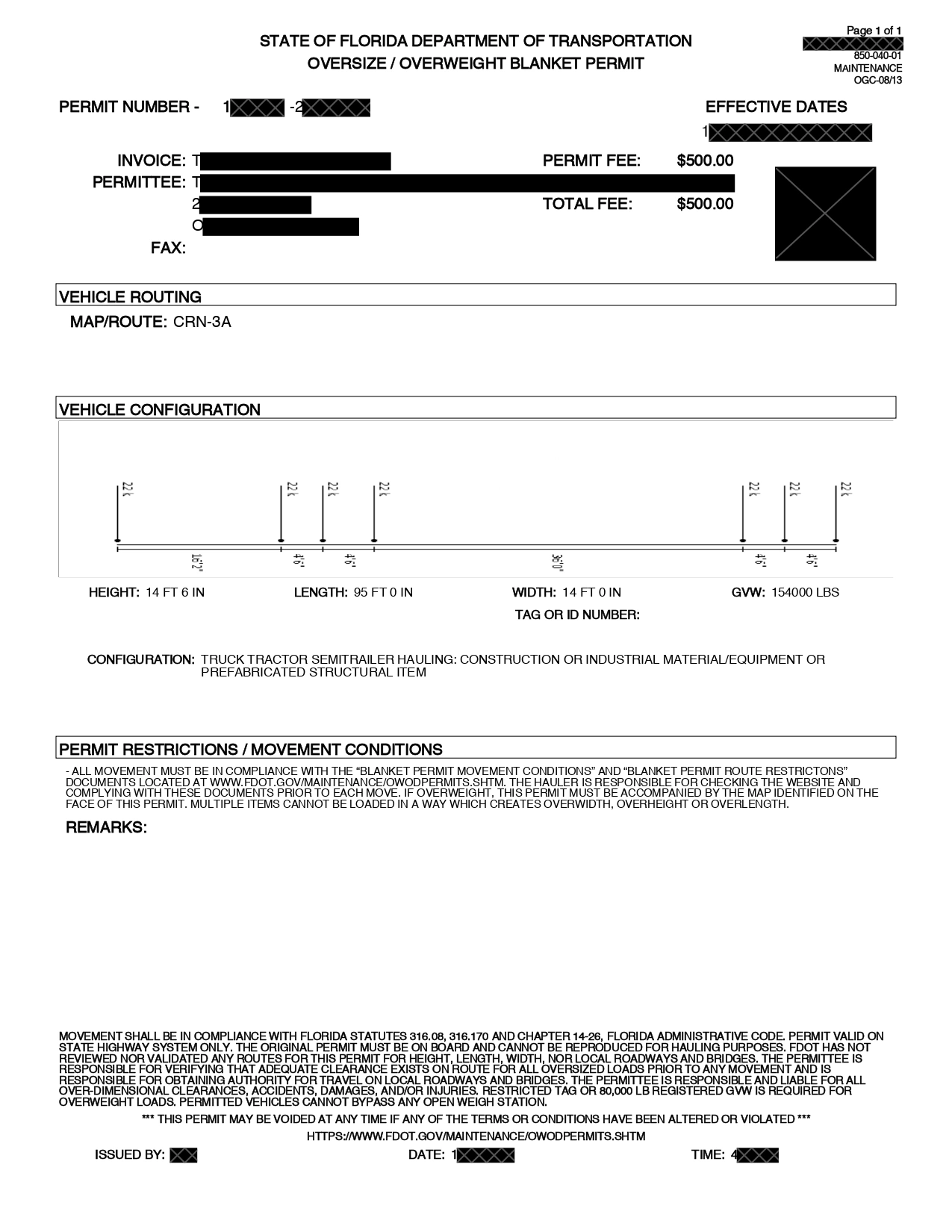
In oversized-load truck accident cases, permit records can become important evidence. Florida oversized loads may require special permitting, and those records can help confirm the hauling company, permitted vehicle configuration, load dimensions, route information, and movement restrictions. In this case, Santini Personal Injury & Car Accident Law used details visible in dash cam footage, including the oversized-load banner, construction equipment, and truck markings, to contact the Florida Department of Transportation permit department and continue the investigation after the truck was not initially identified.
FMCSA and Florida Trucking Regulations That Can Help Prove Fault
Truck accident cases are different from ordinary car accident claims because commercial trucks are governed by detailed state and federal safety rules. In Florida, commercial motor vehicle owners and drivers operating in interstate commerce are subject to 49 C.F.R. Parts 382–386 and 390–397, and Florida also applies many of those federal rules to intrastate commercial vehicles, subject to specific exceptions. When a tractor-trailer, flatbed, dump truck, delivery truck, or other commercial vehicle causes a crash, Santini Law looks beyond the crash report and investigates whether the driver, motor carrier, loader, freight broker, maintenance company, or permit holder violated trucking safety rules.
Hours-of-service and fatigue rules. For property-carrying commercial vehicles, 49 C.F.R. §395.3 generally requires 10 consecutive hours off duty before driving, limits driving after the 14th consecutive hour after coming on duty, limits driving time to 11 hours, requires a 30-minute interruption after more than 8 hours of driving time, and restricts driving after 60 hours in 7 days or 70 hours in 8 days, depending on the carrier’s schedule. A truck accident investigation should request the driver’s electronic logging device data, supporting documents, dispatch records, trip records, tolls, fuel receipts, and communications to determine whether the driver or company pushed beyond legal limits. Federal rules require certain carriers to use registered ELDs, keep backup copies of ELD records for 6 months, and prevent alteration or erasure of original hours-of-service data.
Driver qualification and hiring records. Motor carriers may not require or permit an unqualified driver to operate a commercial motor vehicle. Federal driver-qualification rules address age, physical qualification, valid licensing, disqualification status, and road-test requirements. Carriers must also investigate a driver’s prior 3-year driving history and safety performance history, and they must maintain a driver qualification file that includes the employment application, motor vehicle records, road-test documentation, annual review materials, and medical certification records.
Drug and alcohol testing. 49 C.F.R. Part 382 establishes alcohol and controlled-substance testing programs designed to prevent crashes and injuries involving commercial motor vehicle drivers. After certain serious crashes, the employer must test surviving drivers for alcohol or controlled substances when the crash involves a fatality, or when the driver receives a qualifying citation and the crash involves immediate medical treatment away from the scene or disabling vehicle damage requiring a tow. The alcohol-test window and controlled-substance-test window are time sensitive. Federal rules also prohibit alcohol use while performing safety-sensitive functions, within 4 hours before safety-sensitive functions, and for certain drivers after a crash before post-accident testing is completed.
Truck inspection, repair, and maintenance. Under 49 C.F.R. §396.3, every motor carrier must systematically inspect, repair, and maintain all commercial motor vehicles under its control, including safety-related parts such as brakes, suspension, axles, wheels, rims, steering systems, and other parts and accessories that affect safe operation. Drivers must prepare vehicle inspection reports when defects or deficiencies are discovered, and carriers must repair safety-related defects before allowing the vehicle back on the road. Commercial motor vehicles also must pass periodic inspections at least once every 12 months, and inspection reports must be retained and available for inspection.
Cargo securement and flatbed loads. Federal rules require commercial vehicle cargo to be properly distributed and adequately secured, and drivers must inspect cargo and securement devices within the first 50 miles and again after changes in duty status, 3 hours of driving, or 150 miles, whichever comes first. Cargo must be secured to prevent it from leaking, spilling, blowing, falling, or shifting in a way that affects stability or maneuverability. For heavy vehicles, equipment, and machinery weighing 10,000 pounds or more, such as front-end loaders and construction equipment, 49 C.F.R. §393.130 requires specific securement, including a minimum of four tiedowns to restrain movement in the lateral, forward, rearward, and vertical directions.
Oversized and overweight loads in Florida. Florida law provides that an oversize or overweight vehicle or load may not be operated on a public road unless the owner or operator first obtains the required special permit from the appropriate jurisdiction. In an oversized-load truck accident, permit records can become key evidence. They may help identify the hauling company, the permitted route, vehicle configuration, movement restrictions, and whether the truck should have been operating in that location at that time.
Client Story: How Attorney Frank Santini Found a Hit-and-Run Tractor-Trailer After the Plate Was Not Visible
A 35-year-old woman was driving southbound on I-75 in Hillsborough County near Riverview during rush hour. She was wearing her seatbelt and was stopped for traffic in the right lane near Exit 250, preparing to exit the interstate. A Ram pickup stopped behind her. Moments later, a flatbed tractor-trailer hauling heavy construction equipment struck the Ram pickup and kept going. The force pushed the Ram into the rear of our client’s vehicle.
At first, she thought she was okay. In the days that followed, she developed soreness in her neck and upper back. She went to urgent care, underwent diagnostic studies, and was diagnosed with strains. She later treated with a chiropractor and physical therapist. When her pain worsened, she underwent cervical and thoracic spine MRIs. Surgery was eventually recommended, but she chose less aggressive treatment and continued to live with pain. Importantly, she had not received medical treatment for her neck or back in the prior five to ten years.
The Florida Highway Patrol investigated but could not identify the tractor-trailer. Attorney Frank Santini did not stop there.
Santini Law obtained dash cam footage from the pickup truck that was struck by the big rig. The video did not show the truck’s license plate, but it showed critical details: an oversized-load banner on the back of the trailer, distinctive lettering on the truck, an Ocala, Florida marking, and a John Deere 644K wheel loader on the flatbed. The load dimensions and banner suggested that the truck likely needed an over weight over dimension permit.
Attorney Santini and his team studied the footage, identified the clues, and contacted the Florida Department of Transportation permit department. Because oversized loads require special permitting in Florida, FDOT was able to use the information that Attorney Santini and his team discerned from the dash cam footage to narrow down the hauling company and locate blanket permit records. The attached redacted permit reflects the redacted FDOT oversize/overweight blanket permit record for the hit and run tractor trailer that was located.
Even though law enforcement had been unable to locate the hit-and-run tractor-trailer, Santini Personal Injury & Car Accident Law identified the driver and trucking company, brought a claim against them, and ultimately secured a substantial settlement for the client.
Past results do not guarantee future outcomes. Every truck accident case depends on its own facts, available evidence, insurance coverage, medical proof, and applicable law.
What Kind of Compensation Can I recover after a Truck Accident in Riverview?
Any commercial truck crash has the potential to cause tremendous harm to all parties involved. If a large truck collides with a smaller passenger vehicle, the occupants of a smaller vehicle are likely to suffer far worse injuries than the driver of the truck. The risk of serious bodily harm or death is much higher from a commercial truck accident than from a standard passenger vehicle accident, but it is also likely that a victim will face a host of economic losses that may not be immediately obvious.
If you can prove another truck driver’s negligence or misconduct behind the wheel caused your recent truck accident, you have the right to seek compensation for all damages resulting from their actions. Recovery from a truck accident is likely to begin with an auto insurance claim, much like you could expect after most other types of vehicle accidents. Florida upholds the no-fault standard for vehicle accidents, meaning drivers are expected to use their own auto insurance to pay for their initial medical bills after an accident, regardless of fault. However, the injured driver and passengers of the smaller vehicle have the right to pursue legal recourse against an at-fault driver if they sustained serious bodily harm and their insurance cannot compensate their damages.
Let us pause for a moment and acknowledge an often misunderstood area of car and truck accident law in Riverview regarding passengers. Many folks are already aware that if they are in a vehicle that is struck by a negligent semi-truck, all of the individuals in the smaller vehicle, including passengers, have a right to bring a claim against the at-fault truck driver, his company, and the insurance company. However, Riverview residents should also be aware that even if the driver of the vehicle they are physically in is at fault and not the truck driver, as a passenger you still have the right to bring a lawsuit and recover money against the driver of the vehicle you are in, even if you know that driver personally. Many folks do not want to take this path because they do not want to sue a friend or family member, but you should know that the majority of the time their car insurance will cover your damages.
Before you can proceed with your recovery efforts, you must identify every type of economic harm you suffered and establish causation between your claimed damages and the defendant’s negligence or misconduct. After recovering as much compensation as you can through an insurance claim, your Riverview truck accident lawyer can assist you with the calculation of the remaining economic damages you may be able to recover from the at-fault driver. These economic damages typically include:
- Vehicle repair costs. If the tractor-trailer truck driver hits your vehicle and insurance cannot fully repay your repair or replacement costs, the remainder can be cited as economic damages in a civil suit. You also have the right to claim compensation for any other property losses incurred because of the defendant’s actions.
- Medical treatment costs. Drivers in the state must have at least $10,000 in personal injury protection (PIP) with their personal auto insurance policies. Bodily injury insurance can be added to a policy with an additional premium cost, and this can help to pay for medical expenses following an accident. However, if you suffered serious bodily injury in your recent truck accident due to another driver’s actions, any medical treatment costs you incur that are not covered by auto insurance can be added as economic damages to your personal injury claim against the truck driver and truck driving company.
- Lost income. Similar to medical expenses, PIP coverage can compensate you for income you are unable to earn after a truck accident in Riverview. However, once you have exhausted your insurance coverage, you will need to seek compensation for any remaining lost income from the at-fault driver with your personal injury claim. Additionally, if you were permanently injured in the accident and will not be able to work again in the future, the defendant could also face liability for your lost earning potential.
The average truck accident victim in Riverview should be able to accurately assess their immediately recognizable economic losses, but calculating the long-term financial impact of a serious accident is likely to be far more challenging. When you have a seasoned Riverview truck accident attorney representing you, they are able to identify every available channel of compensation that you could claim in a civil suit. Additionally, state law allows a vehicle accident victim to seek compensation for pain and suffering.
How much insurance should a truck have in Florida?
Do not assume every large truck has a $750,000 insurance policy just because it is a commercial vehicle. The required insurance depends on the truck’s weight, cargo, carrier type, and whether the truck is subject to federal financial responsibility rules.
Under Florida law, commercial motor vehicles operated on Florida roads must carry combined bodily injury and property damage liability insurance of at least $50,000 for vehicles with a gross vehicle weight of 26,000 pounds or more but less than 35,000 pounds; $100,000 for vehicles with a gross vehicle weight of 35,000 pounds or more but less than 44,000 pounds; and $300,000 for vehicles with a gross vehicle weight of 44,000 pounds or more.
However, Florida also requires commercial motor vehicles that are subject to U.S. Department of Transportation financial responsibility rules under 49 C.F.R. Part 387 to carry the federal minimums. For many for-hire interstate trucking companies hauling nonhazardous property in vehicles with a gross vehicle weight rating of 10,001 pounds or more, the federal minimum is $750,000. That minimum can increase to $1 million or $5 million for certain hazardous materials, oil, or other higher-risk cargo.
In short, the size, cargo, route, and purpose of the truck can all affect how much insurance the trucking company is legally required to carry. The required minimum is not always the same as the actual amount of insurance available, so a truck accident investigation should identify every policy, excess policy, motor carrier, broker, shipper, owner, and other potentially responsible party.
What Can I Recover for Pain and Suffering in a Riverview, Florida Truck Accident Case
You might find it difficult to assign a monetary value to intangible damages like physical pain and psychological distress resulting from a personal injury in Riverview, but your attorney can provide valuable guidance on this aspect of your recovery. Under Florida’s personal injury statutes, there is no cap or limit on the amount of pain and suffering compensation a plaintiff may claim from a defendant in a truck accident case or any other type of vehicle accident case. This means you have the right to seek as much as you deem appropriate to reflect the severity of the harm done to you and the complications you face in the future because of the accident.
Your Riverview truck accident attorney can help determine appropriate pain and suffering compensation to seek from the defendant who injured you. Your attorney might seek a large lump sum to reflect the severity of permanent harm you suffered, or they may seek an amount based on your projected recovery time if you are expected to make a full recovery from your injuries in the near future. Many truck accident victims in the Riverview area who suffer severe injuries eventually recover more in pain and suffering compensation than they secure for their economic damages.
What to Expect From Your Riverview Truck Accident Attorney
It’s technically possible for a truck accident victim to pursue compensation for their damages on their own, but facing this complex series of legal proceedings without an attorney’s help can be extremely challenging. Even if you managed to succeed with an auto insurance claim and successfully file a personal injury suit on your own, you would be unlikely to achieve the same results you could expect if you had a seasoned Riverview truck accident attorney handling your case. Additionally, you would be forced to contend with the pain of recovering from your injuries while also managing strict filing deadlines and other procedural issues involved in your case.
When you choose Santini Law Firm to represent your truck accident claim in Riverview, you will have a compassionate legal advocate readily available to provide guidance and support through each step of your proceedings. Our firm has cultivated a strong local reputation as a leading choice for personal injury counsel in the Riverview area, and we have successfully helped many truck accident victims maximize their recoveries as much as state law allows.
At our firm, you do not pay unless our Riverview truck accident lawyer recovers a settlement or trial verdict for you.
You have a limited time in which to pursue recovery after a truck accident or any other vehicle accident. You must file an auto insurance claim very soon after an accident, typically only a few days, and you will contend with the statute of limitations if you intend to pursue a personal injury claim against the at-fault driver. It’s imperative to secure legal representation you can trust in a timely manner, so contact Santini Law Firm today and schedule your free case review with a Riverview truck accident attorney.
Riverview, FL Truck Accident Resources
- Who is Liable in A Truck Accident in Florida?
- Common Causes of Commercial Truck Accidents in Florida
- Who is Liable in A Truck Accident in Florida?
Riverview Truck Accident FAQs
What should I do after a truck accident in Riverview or Hillsborough County?
After a truck accident, get medical care, report the crash, take photos or video if you can do so safely, and preserve any dash cam footage. Try to document the truck’s company name, USDOT number, MC number, license plate, trailer number, cargo, load markings, and any identifying details on the cab or trailer. In Florida, a long-form crash report is required for crashes involving injury, complaints of pain or discomfort, a vehicle that must be towed, or a commercial motor vehicle.
Truck accident evidence can disappear quickly. Driver logs, dispatch records, GPS data, dash cam footage, maintenance records, broker documents, load records, and electronic control module data may need to be preserved before they are overwritten or deleted.
Does Florida no-fault insurance apply if I was hit by a semi-truck?
Yes. Florida PIP/no-fault insurance can still apply even if the crash involved a semi-truck, tractor-trailer, dump truck, flatbed, or other commercial vehicle. But, just because PIP/no-fault insurance is involved does not foreclose your rights against the trucking parties.
PIP generally provides up to $10,000 in medical and disability benefits and $5,000 in death benefits, and it requires initial medical care within 14 days after the crash. Medical benefits generally pay 80% of reasonable covered medical expenses, and disability benefits generally pay 60% of lost gross income or earning capacity.
Again, PIP is only the starting point. In a serious truck accident, the injured person may also have a claim against the truck driver, motor carrier, freight broker, shipper, loader, maintenance company, or another responsible party.
What if my neck or back pain started days after the truck crash?
Delayed neck, back, and upper-back pain can still be important. Many people feel “okay” at the scene because of adrenaline, shock, or the nature of soft-tissue and spine injuries. In Florida, the 14-day PIP rule makes prompt medical evaluation especially important, even if symptoms seem manageable at first. PIP medical reimbursement can be limited to $2,500 if there is no emergency medical condition determination, but it can reach up to $10,000 when an emergency medical condition is properly determined by an authorized provider.
For truck accident claims, medical timing, diagnostic imaging, prior medical history, and consistent treatment records can become important because insurance companies often argue that delayed pain is unrelated, preexisting, or degenerative.
Can I sue the trucking company if my own PIP insurance pays first?
Yes. PIP benefits do not prevent a claim against the at-fault truck driver or trucking company. PIP may pay some early medical bills and wage loss, but a truck accident claim can pursue damages beyond your own no-fault/PIP, including future medical care, lost earning capacity, pain and suffering, and other damages when Florida’s tort threshold is met.
For pain, suffering, mental anguish, and inconvenience damages in a Florida motor vehicle case, the injury generally must involve significant and permanent loss of an important bodily function, permanent injury within a reasonable degree of medical probability, significant and permanent scarring or disfigurement, or death.
How long do I have to file a truck accident lawsuit in Florida?
You have two years from the date of the accident to file a truck crash lawsuit in Florida. This two-year deadline applies for both personal injury and wrongful death truck accident cases.
That does not mean you should wait. Some trucking evidence has much shorter practical timelines. For example, motor carriers must retain records of duty status and supporting documents for at least 6 months, while accident registers must be maintained for 3 years.
Who can be liable in a Florida truck accident besides the truck driver?
A Florida truck accident case may involve more than the driver. Potentially responsible parties can include the motor carrier, truck owner, trailer owner, maintenance company, cargo loader, shipper, freight broker, permit holder, vehicle manufacturer, parts manufacturer, or another negligent driver.
The investigation should look at who controlled the driver, who selected the carrier, who loaded the cargo, who maintained the truck, who owned the tractor and trailer, whether the driver was qualified, whether the truck was properly inspected, and whether federal or Florida commercial vehicle safety rules were violated. Florida applies many federal commercial motor vehicle safety regulations to both interstate and intrastate commercial vehicles, subject to specific Florida exceptions.
What if the truck was from another state?
A truck from another state can still be responsible for a crash in Florida. Florida law, Florida insurance issues, Florida court deadlines, local crash evidence, and Florida comparative fault rules may still matter if the crash happened here.
If the truck was operating in interstate commerce, federal motor carrier safety rules may also be important. Florida law also makes many federal commercial vehicle regulations applicable to commercial motor vehicles operating on Florida public highways, including rules in 49 C.F.R. Parts 382–386 and 390–397.
What if the truck driver says I stopped suddenly or I was partly at fault?
Arguments about who was at fault are common in truck accident cases. The trucking company or insurer may claim that the injured person stopped too quickly, changed lanes, failed to avoid the crash, or contributed to the collision.
Florida’s modified comparative fault law can make disputed liability especially important in truck accident cases. If an injured person is found to be more than 50% responsible for causing the crash, that person generally cannot recover damages in a Florida negligence case, except in medical negligence cases. In other words, the difference between being partly at fault and being more than half at fault can determine whether an injured driver can recover compensation at all.
Evidence such as dash cam footage, traffic-camera footage, ECM data, braking data, following distance, roadway conditions, witness statements, lane position, and driver logs can help push back against unfair blame-shifting.
What if the truck left the scene or the license plate was not visible?
A hit-and-run truck crash can still be investigated. A license plate is helpful, but it is not the only way to identify a truck. Investigators may use dash cam footage, nearby surveillance video, USDOT markings, company lettering, trailer numbers, cargo type, route information, weigh station records, toll records, dispatch records, witness photos, and permit records.
This is especially important when the truck was hauling an oversized load, construction equipment, or other identifiable cargo. In those cases, Florida DOT permit records may help narrow the possible carriers even when the plate is not visible.
What if the truck was hauling an oversized load or construction equipment?
Oversized-load cases require a deeper investigation. In Florida, an oversize or overweight vehicle or load may not enter or operate on a public road unless the owner or operator first obtains the required special permit from the proper jurisdiction.
For flatbeds hauling heavy construction equipment, federal cargo securement rules may also matter. 49 C.F.R. §393.130 applies to heavy vehicles, equipment, and machinery that operate on wheels or tracks and weigh 10,000 pounds or more, including front-end loaders and similar equipment. The rule requires heavy equipment to be restrained against movement in the lateral, forward, rearward, and vertical directions using a minimum of four tiedowns.
In these cases, the investigation should request the oversize permit, route information, load dimensions, escort requirements, travel restrictions, tie-down records, inspection records, and dash cam footage.
Are I-75 truck accidents near Riverview different from other Tampa Bay crashes?
They can be, especially when the design of the road, the exit ramp, traffic congestion, or nearby construction helps explain how the crash happened. Riverview truck accidents often involve I-75 traffic near Big Bend Road, Gibsonton Drive, U.S. 301, the Selmon Expressway, Brandon, and the fast-growing South Hillsborough corridor. Those details matter because crashes near exits and on-ramps often involve sudden slowdowns, merging traffic, lane changes, trucks trying to reach delivery routes, and drivers reacting to congestion.
For example, there are several I-75 exits near Riverview and Brandon, including Exit 246 for Big Bend Road, Exit 250 for Gibsonton Drive, Exit 254 for U.S. 301, and Exit 256 for the Selmon Expressway. In a truck accident case, the exact location can affect the investigation. A crash before an exit may raise questions about stopped traffic, following distance, lane position, distracted driving, speed, braking, and whether the truck driver was paying attention to traffic slowing ahead.
FDOT also completed I-75/Big Bend Road interchange improvements in 2025 after citing rapid South County growth and traffic congestion.
Those local facts do not prove fault in any specific crash, but they explain why ramp traffic, construction history, lane changes, congestion, merging patterns, and truck routing can matter in a Riverview truck accident investigation.
Who investigates a truck accident on I-75 near Riverview?
It depends on the exact location and response. A crash on I-75 may involve the Florida Highway Patrol, while other crashes may involve the Hillsborough County Sheriff’s Office or another local agency. The crash report is important because a Florida long-form crash report must include information such as the date, time, location, vehicles, parties, witnesses, investigating officer, and insurance information.
Florida crash reports containing personal identifying information are confidential for 60 days, but they may be made immediately available to parties involved in the crash, their legal representatives, insurers, insurance agents, law enforcement agencies, and certain other authorized entities.
Schedule A Consultation
Fields marked with an * are required
Let Us Get You Started In The
Right Direction
Fields marked with an * are required
Riverview Office
7269 Bucks Ford Dr.
Riverview, FL 33578

Call Us Today 813-576-3209
Tampa Office
9270 Bay Plaza Blvd Suite 618
Tampa, FL 33619
© Copyright 2026 Santini Personal Injury & Car Accident Law. All Rights Reserved.
Disclaimer | Site Map | Privacy Policy
*Images are obtained under license from Canva and other third-party stock image providers, with attribution included where required.
Digital Marketing By 