
Hillsborough County Bicycle Injury and Fatality Analysis
Our Commitment To Excellence






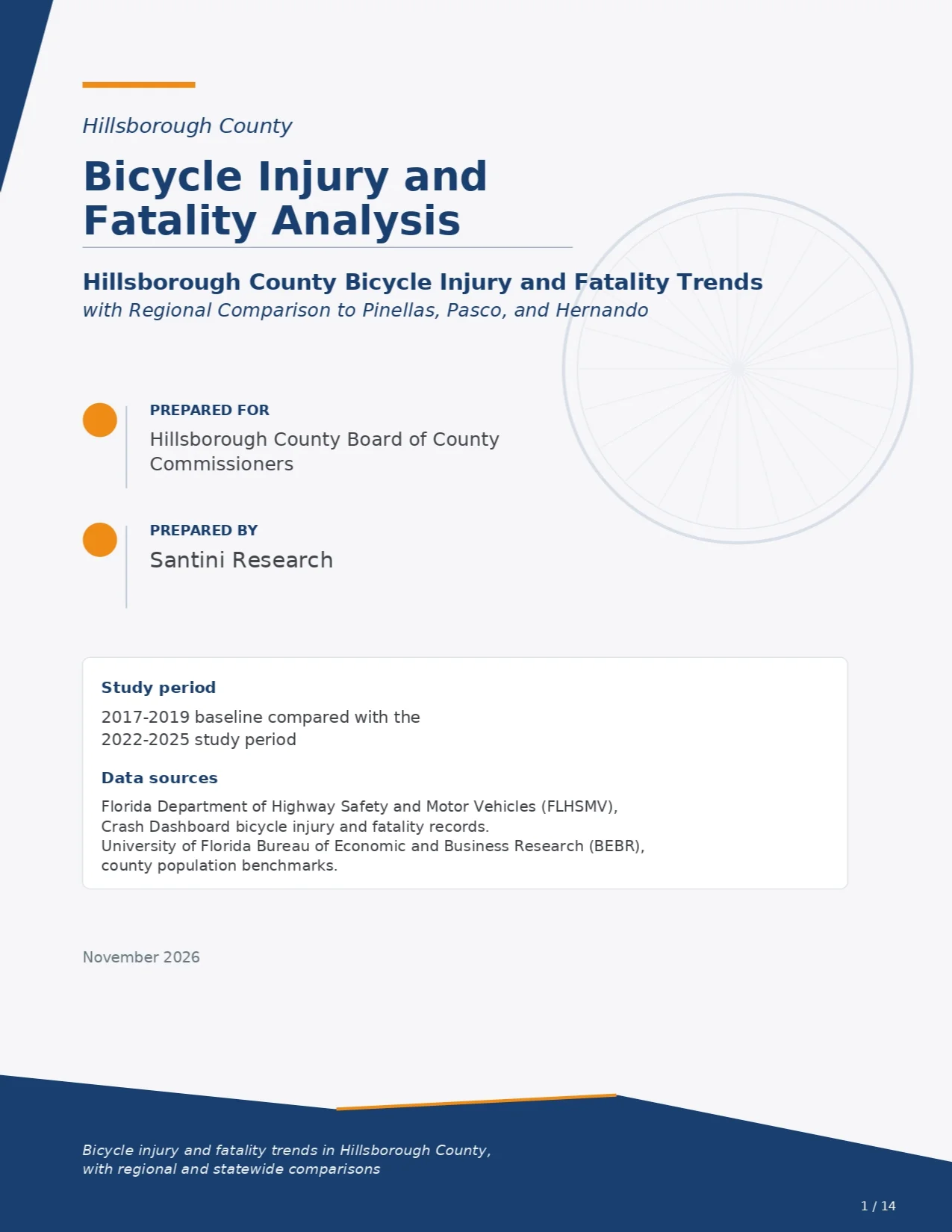
Hillsborough County Bicycle Injuries and Fatalities: 2017–2025
A Santini Research analysis of Florida crash data, comparing Hillsborough County with Pinellas, Pasco, Hernando, and statewide trends.
By Frank Santini, Esq. | Santini Research
Report Date: November 2026
Prepared for the Hillsborough County Board of County Commissioners
Santini Research examined bicycle injuries and fatalities reported by the Florida Department of Highway Safety and Motor Vehicles (FLHSMV) to assess changes in Hillsborough County’s bicycle safety record. The analysis compares the 2017–2019 pre-COVID baseline with 2022–2025 and evaluates both raw injury and fatality counts and rates adjusted for population.
The findings place Hillsborough among Florida’s highest-volume counties for bicycle injuries and fatalities. Between 2022 and 2025, Hillsborough recorded 2,360 bicycle injuries and 71 bicycle deaths. Its 71 fatalities tied Miami-Dade County for the highest total bicycle fatality count in Florida during that period, despite Hillsborough having a substantially smaller population.
In 2025 alone, Hillsborough recorded 709 bicycle injuries and 20 bicycle deaths. Bicycle injuries increased every year from 2022 through 2025.
The report also compares Hillsborough with neighboring Pinellas, Pasco, and Hernando Counties to distinguish total injury burden from population-adjusted risk.
Key Findings
- 71 bicycle fatalities from 2022–2025: Hillsborough tied Miami-Dade for the highest total bicycle fatality count among Florida’s 67 counties. This ranking concerns total deaths, not deaths per resident.
- 709 bicycle injuries in 2025: Injuries increased 63.0% from 435 in 2022, rising each consecutive year.
- Average annual bicycle injuries increased 22.9%: Hillsborough averaged 480 injuries annually during 2017–2019, compared with 590 annually during 2022–2025.
- Average annual bicycle fatalities increased 52.1%: The county averaged 11.67 fatalities annually before COVID, compared with 17.75 during 2022–2025.
- The increases persisted after adjusting for population: Hillsborough’s average annual bicycle injury rate increased 12.5%, while its fatality rate increased approximately 39.5% between the comparison periods.
- Hillsborough exceeded statewide population-adjusted rates: During 2022–2025, the county averaged 38.19 bicycle injuries and 1.15 bicycle fatalities per 100,000 residents annually, compared with Florida’s corresponding rates of 36.00 and 0.95.
How Hillsborough Compares With Pinellas, Pasco, and Hernando Counties
Hillsborough’s bicycle injury and fatality burden becomes clearer when compared with surrounding counties.
During 2022–2025:
- Hillsborough: 2,360 reported bicycle injuries and 71 fatalities.
- Pinellas: 2,723 injuries and 53 fatalities.
- Pasco: 877 injuries and 32 fatalities.
- Hernando: 214 injuries and 7 fatalities.
Although Hillsborough recorded more bicycle deaths than the other three counties, Pinellas and Pasco had higher average annual bicycle fatality rates per 100,000 residents.
Pinellas also had more bicycle injuries than Hillsborough despite having a smaller population.
These distinctions matter. Total injury and fatality counts measure the burden experienced by a community, while population-adjusted rates permit comparisons across counties of different sizes. Neither measure directly establishes the risk associated with an individual bicycle trip or mile traveled.
The report includes annual county-level tables and charts comparing injury counts, injury rates, fatality counts, and fatality rates.
What Do These Findings Tell Us About E-Bike Accidents?
The growth of electric bicycles has raised important questions about how bicycle crashes are classified and tracked in Florida.
However, FLHSMV’s published bicycle injury and fatality categories do not consistently distinguish conventional bicycles from electric bicycles. Some e-bike crashes may be classified differently, and electric scooters are excluded from the bicycle category used in this analysis.
Consequently, the Hillsborough County figures should not be interpreted as counts of e-bike injuries or fatalities.
Separate research presented by Dr. Chanyoung Lee of the University of South Florida’s Center for Urban Transportation Research (CUTR) identified increasing e-bike involvement in selected Florida bicycle crashes. In that statewide analysis, e-bikes accounted for 4.1% of identified bicycle crashes in 2021 and 15.2% in 2024. The analysis covered fatal, incapacitating-injury, and non-incapacitating-injury crashes.
Those figures use different measures and a different study period than the Hillsborough County injury and fatality analysis. They do not establish how much of Hillsborough’s increase, if any, was attributable to e-bikes.
Improving how crash reports identify e-bikes, electric scooters, and other micromobility devices would allow more reliable analysis of device-specific injury trends.
Research Methodology and Limitations
Santini Research used county-level bicycle injury and fatality records from the FLHSMV Crash Dashboard and population benchmarks from the University of Florida’s Bureau of Economic and Business Research (BEBR).
The analysis compares 2017–2019 with 2022–2025. The years 2020 and 2021 were excluded from the comparison because pandemic-related changes disrupted normal transportation patterns.
Population-adjusted injury and fatality rates are calculated per 100,000 residents. Santini Research used published census and BEBR population benchmarks and calculated intervening annual population estimates through linear interpolation. Those calculated annual values are not BEBR’s published annual estimates.
The study measures reported traffic-crash injuries and deaths involving bicycles. It does not measure every cycling-related injury or identify the number of individual crashes. Its population-based rates do not account for cycling trips, miles traveled, or rider exposure.
The findings are descriptive. They do not establish the causes of individual crashes, assign fault, identify dangerous intersections, or determine whether e-bikes or any particular policy caused the observed changes. Historical FLHSMV data may also be revised.
The full report includes the annual data tables, calculations, charts, sources, and methodological disclosures.
Use of the Research in Hillsborough County Public-Policy Discussions
Santini Research prepared this analysis for the Hillsborough County Board of County Commissioners in November 2026 as county officials considered measures addressing bicycle and micromobility safety.
Attorney Frank Santini had previously addressed the Hillsborough County Commission concerning rising bicycle injuries and fatalities, the limitations of existing e-bike crash reporting, and the need for evidence-based safety measures.
On November 10, 2026, the Tampa Bay Times published coverage of the county’s adoption of new micromobility regulations. The article identified Santini as a Riverview personal injury attorney, cited his office’s reporting that more than 700 cyclists were injured in Hillsborough County the previous year, and quoted his comments to commissioners about rising bicycle injuries and deaths.
Research Sources
- Florida Department of Highway Safety and Motor Vehicles (FLHSMV): Florida Crash Dashboard, bicycle injury and fatality data for 2017–2019 and 2022–2025.
- University of Florida, Bureau of Economic and Business Research (BEBR): Florida Estimates of Population 2025, Table 6, pages 27–28.
- Florida Pedestrian and Bicycle Safety Coalition: October 21–22, 2025 meeting report, including Dr. Chanyoung Lee’s CUTR presentation, Electric Bicycle Research and Trends.
Related Santini Research Publications

Subscribe for Santini Research Reports

Call Us Today 888-645-3055
Riverview Office
7269 Bucks Ford Dr.
Riverview, FL 33578
Lehigh Valley Office
9 Hanover Street
Phillipsburg, NJ 08865
Tampa Office
9270 Bay Plaza Blvd Suite 618
Tampa, FL 33619
Emmaus Office
191 Main Street, Suite 204
Emmaus, PA 18049
© Copyright 2026 Santini Personal Injury & Car Accident Law. All Rights Reserved.
Disclaimer | Site Map | Privacy Policy
*Images are obtained under license from Canva and other third-party stock image providers, with attribution included where required.
Digital Marketing By 