
Generally, yes; Florida law gives e-bike riders many of the same rights and duties as bicycle riders. But e-bike cases can involve extra issues, including e-bike class, motor wattage, labeling, modifications, local ordinances, and sidewalk rules.
Florida E-Bike Accident Lawyer
Our Commitment To Excellence





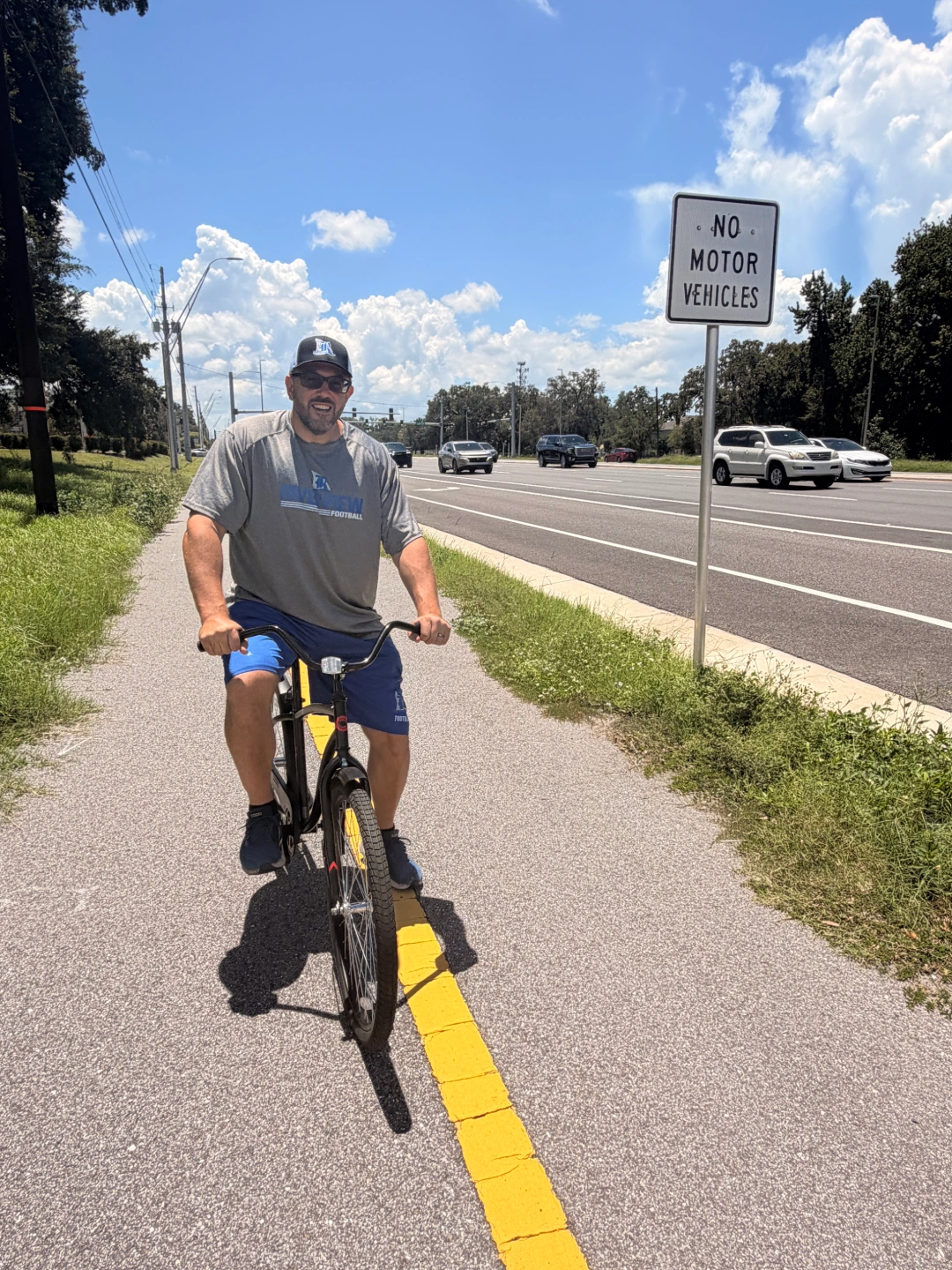
Florida e-bike accident lawyer Frank Santini on a Florida bike path. Santini Research, the public-safety research division of Santini Personal Injury & Car Accident Law, analyzes Florida bicycle and e-bike crash trends to better understand the legal, insurance, and safety issues facing injured riders.
Santini Personal Injury & Car Accident Law represents injured e-bike riders across Florida, backed by original e-bike crash-data research, in-depth Florida insurance analysis, and real case investigation experience.
Attorney Frank Santini leads Santini Personal Injury & Car Accident Law’s representation of injured e-bike riders throughout Florida and has directed significant original research into Florida e-bike law, crash data, insurance coverage, and the local safety rules that affect riders. Through the firm’s public-safety research division, Santini Research, Attorney Santini has published data analysis on Florida’s post-COVID bicycle and e-bike injury and fatality trends.
In the wake of Governor DeSantis’s June 25, 2026 veto of Florida’s proposed e-bike safety bill, SB 382, reliable statewide data on e-bike accidents remains limited. Vice Mayor and Orange County Commissioner Kelly Martinez Semrad met with Attorney Santini to discuss local e-bike and micromobility regulation and the crash-data research Attorney Santini has compiled. Following that meeting, Attorney Santini has been invited to present on e-bike law, e-bike accidents, and e-bike safety at Orange County District 5’s Neighborhood Advisory Council meeting on August 26, 2026.
Attorney Santini has also appeared in media discussions on e-bike safety with Beyond Florida and has been recognized as a partner by e-bike insurer Velosurance for his advocacy on behalf of injured e-bike riders.
If you or your child was injured in a Florida e-bike crash, call Santini Law for a free consultation.
Free Consultation: (813) 576-3209
Santini Personal Injury & Car Accident Law has offices in Tampa and Riverview, representing injured e-bike riders throughout Florida, including Hillsborough County communities such as Brandon, Gibsonton, and Apollo Beach
Quick Answers About Florida E-Bike Accident Claims
Will insurance pay for my Florida e-bike accident?
Which insurance applies depends on who was hurt and who was at fault: auto insurance coverages like bodily injury liability, PIP, MedPay, UM/UIM may apply. Your homeowners/renters and umbrella coverage can potentially apply, too. The two most common situations, an injured child or an injured adult when the other driver of the vehicle was at fault, are covered specifically below.
My child was hurt in a Florida e-bike accident with another vehicle and it wasn’t the child’s fault – what insurance can help pay for it?
Start with bodily injury liability, the coverage on the at-fault driver’s own auto insurance policy that pays for injuries they cause. PIP (personal injury protection no-fault coverage that can pay medical bills regardless of who caused the crash) usually runs through a parent’s or another household member’s policy as a resident relative. Uninsured/underinsured motorist (UM/UIM) coverage in the household can also apply if the other driver doesn’t have enough insurance. See the full insurance section below for how these layer together.
I was hurt in a Florida e-bike accident and the other driver was at fault – what insurance covers me?
Start with bodily injury liability: the coverage on the at-fault driver’s own auto policy that pays for injuries they cause. PIP (personal injury protection / no-fault coverage that can pay medical bills regardless of who caused the crash) should also be checked, first through your own auto policy, then a resident relative’s, and potentially the other vehicle’s PIP as a fallback. Uninsured/underinsured motorist (UM/UIM) coverage can fill the gap if the driver doesn’t have enough insurance. See the full insurance section below for how these layers work together.
What if it’s not clear who was at fault, or my child did something wrong too?
Florida reduces recovery by the injured person’s percentage of fault, but only bars it entirely if they’re found more than 50% at fault; shared fault and no recovery are very different outcomes. A child’s fault is judged against a reasonably careful child of similar age and experience, not an adult standard. Insurers can also sometimes try to shift blame to a parent instead; see the comparative fault section below for how that works.
My child caused an e-bike accident and someone else got hurt – am I financially liable as a parent, and what insurance protects me?
Florida doesn’t automatically make parents liable simply because their child was riding, but parents can face exposure through negligent entrustment (allowing a child to use an inappropriate or dangerous e-bike) or negligent supervision. Homeowners, renters, or umbrella liability insurance coverage is typically the practical protection for parents in this situation.
Why E-Bike Accident Cases Are Different in Florida
Florida e-bike claims are different because the “bike” is only one part of the legal analysis.
Florida law defines electric bicycles by class, motor wattage, pedals, seat or saddle, and top assisted speed. Florida Statute § 316.003 recognizes Class 1, Class 2, and Class 3 e-bikes. Florida law generally gives e-bike riders the rights and duties of bicycle riders, while also allowing cities, counties, and agencies to regulate e-bike use in certain places such as sidewalks, paths, beaches, dunes, and trail networks. See Florida Statute § 316.20655.
That matters after a crash. An insurance company and defense attorney will closely examine local ordinances and try to find ways the e-bike rider may have violated them. For example, if a local ordinance sets a 10 mph sidewalk speed limit and the evidence shows the rider was traveling 20 mph, that will hurt, though not necessarily destroy the rider’s case. The insurer won’t stop there: e-bikes must carry a label identifying their Class 1, 2, or 3 status, and insurers will investigate whether that label was present, and whether the bike was modified to travel faster than designed or faster than Florida law allows. These are just a few of the ways insurance companies and defense attorneys try to poke holes in an injured Florida e-bike rider’s case.
Santini Research, the public-safety research division of Santini Personal Injury & Car Accident Law, shows why this issue has become urgent. Florida’s bicycle crash data shows a sharp post-COVID change in frequency and severity. Compared to the 2017–2019 baseline, statewide average annual bicycle injuries rose about 32% (to roughly 8,233 per year) in 2022–2025, while average annual fatalities rose nearly 47% (from about 148 to 217 per year).
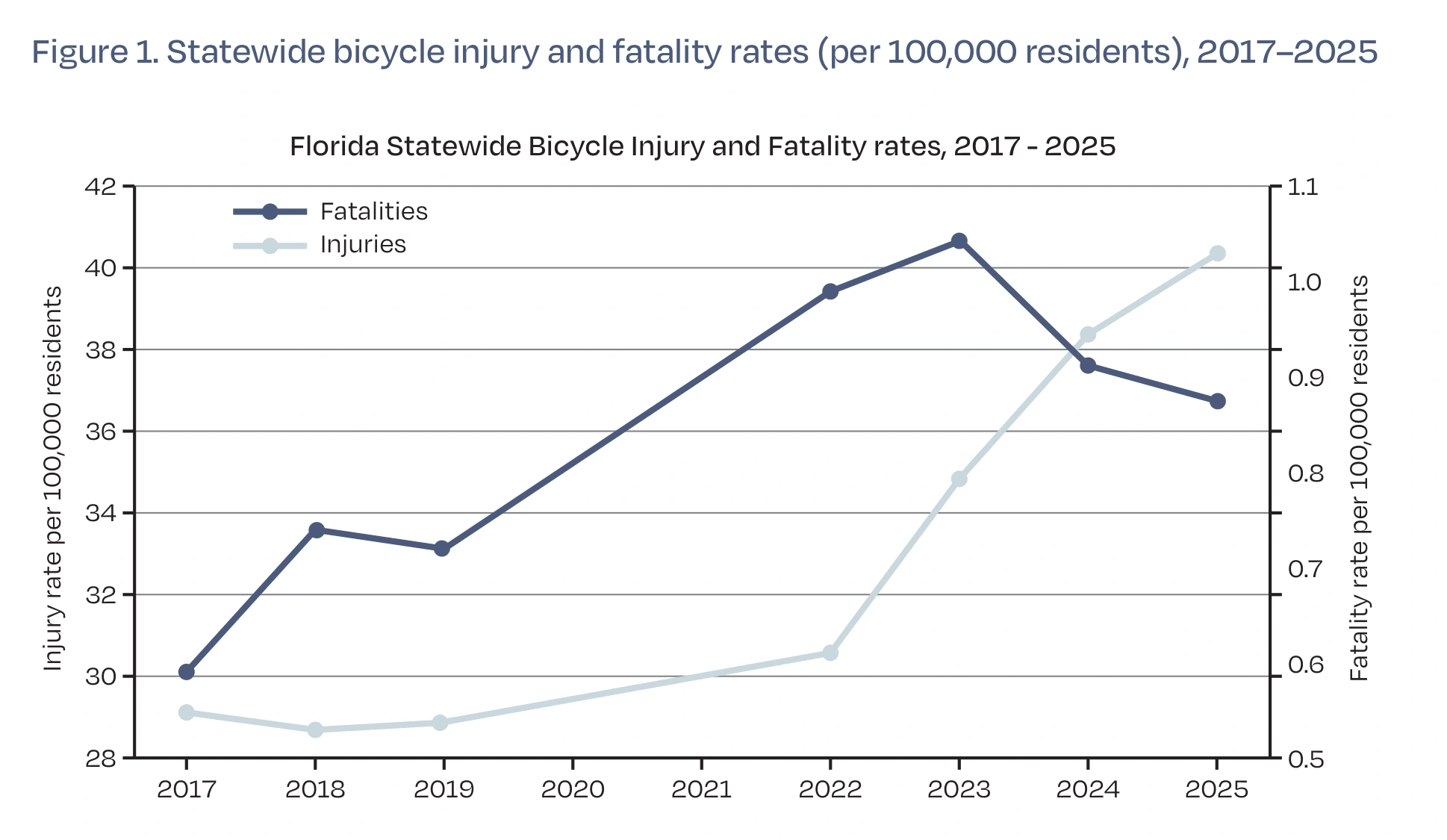
Caption: Santini Research found that Florida bicycle injury and fatality rates rose sharply after the pre-COVID baseline. Because Florida crash data has historically grouped many e-bike crashes within broader bicycle categories, this trend helps explain why electric bicycle injury claims now require separate legal analysis.
| Metric | 2017–2019 avg | 2022–2025 avg | Change |
| Statewide injuries per year | 6,226.7 | 8,233.3 | +32.2% |
| Injury rate per 100,000 | 29.67 | 36.00 | +21.4% |
| Statewide fatalities per year | 147.7 | 216.5 | +46.6% |
| Fatality rate per 100,000 | 0.703 | 0.949 | +35.1% |
| Fatal share of injuries | 2.37% | 2.63% | +0.26 pts |
Source: Santini Research, FLHSMV crash-data analysis (2026).
Will Insurance Cover My Florida E-Bike Accident?
Insurance is one of the most complicated and misunderstood parts of an e-bike injury claim, and getting it wrong can cost you thousands of dollars. Multiple policies may come into play depending on how the crash happened:
If the e-bike itself was damaged: Your own auto insurance won’t cover damage to the e-bike itself. If another vehicle hits you, look at the driver’s property damage liability, the part of their auto policy that pays for damage they cause. Your homeowners or renters policy may also provide some recourse. Some insurers also sell standalone e-bike policies, which are relatively inexpensive and can cover damage to the bike directly.
If the rider was injured: Start with the at-fault driver’s bodily injury liability: the part of their auto policy that pays for injuries they cause. From there, PIP and uninsured/underinsured motorist coverage are usually the next most important sources, and both are explained in detail below.
If the e-bike rider caused injury to someone else: If your e-bike caused injury to someone else, standard auto liability won’t apply, since the e-bike isn’t treated as a covered vehicle under it. Your homeowners or renters policy is typically the first place to look for liability protection, sometimes with an umbrella policy adding coverage on top. Some standalone e-bike policies include this kind of liability coverage too.
Personal Injury Protection (PIP)
Personal Injury Protection (PIP) is a coverage required on nearly every Florida auto insurance policy. Insurers must offer at least $10,000 of it. It’s designed to pay medical bills and lost wages after a crash, regardless of who was at fault, which is why you may hear Florida referred to as a “no-fault state.”
Many Floridians are surprised to learn that PIP coverage can apply to bicycle riders struck by a motor vehicle. That’s because PIP protection isn’t limited to people inside a motor vehicle. It also extends to pedestrians, bicyclists, and riders of certain other qualifying devices struck by a motor vehicle. Some devices, however, are excluded from PIP coverage. Motorcycles and mopeds, for example, are treated in the law as “self-propelled vehicles” rather than bicycles, and their riders don’t qualify for PIP, regardless of whether they were struck by a motor vehicle.
Because Florida law classifies legal e-bikes as bicycles, not “self-propelled vehicles”, a rider on a legal e-bike will likely qualify for PIP under Florida’s PIP statute,Fla. Stat. § 627.736.
Your household’s PIP coverage may come from:
- You own a car with a Florida PIP policy and are struck by a motor vehicle while riding your e-bike.
- A parent, spouse, or other household member’s auto PIP; as a resident relative, their policy may extend to you.
- A family member’s auto policy that includes resident-relative PIP coverage.
What can bar PIP coverage regardless of which policy applies:
- The crash didn’t involve a motor vehicle (a pothole, a collision with another bicycle/e-bike, or a defective sidewalk).
- You waited more than 14 days after the crash to seek treatment. Florida law requires initial treatment within 14 days or PIP eligibility is forfeited entirely.
- Your injury is classified “non-emergency” at the first visit, capping PIP at $2,500 instead of $10,000.
- Your policy specifically excludes the incident or classifies your e-bike in a way that removes coverage.
If none of your household’s own policies have PIP, that doesn’t end the analysis. The policy covering the vehicle that struck you may still provide coverage, explained below
PIP order of benefits. If a Florida resident e-bike rider is struck by a motor vehicle and has no PIP through their own policy or a resident-relative household policy, the policy covering the vehicle that struck them may provide PIP benefits under Fla. Stat. § 627.736(4)(e), as long as the rider was not occupying a “self-propelled vehicle” and the statutory conditions are met. One of the statutory conditions required to access the PIP benefits of the motor vehicle that was involved in the e-bike accident is physical contact with the motor vehicle itself.
Florida courts don’t fully agree on how much physical contact is required. In Lumbermens Mutual Casualty Co. v. Castagna, the Florida Supreme Court held that actual contact with the injured person isn’t always required, but mere involvement of a motor vehicle isn’t enough either; there must be a real causal link between the injury and contact with the vehicle. The practical takeaway is that for an e-bike rider who swerves to avoid a car and crashes with no contact at all, PIP is not automatic and may well be denied, though a real argument exists under AMICA Mutual Insurance Co. v. Cherwin if the car’s movement directly caused the crash.
Do not assume PIP covers you, and do not assume it doesn’t. Policy wording, crash circumstances, e-bike classification, treatment timing, and the statute all need to be reviewed by an experienced Florida e-bike accident lawyer before you take any position with an insurer.
Uninsured/Underinsured Motorist (UM/UIM) Coverage
UM/UIM protects you when the driver who hit you has no bodily injury coverage, or not enough to cover your injuries. In Florida, UM/UIM is optional, so many riders don’t realize they have it, or rejected it years ago. It also surprises people who assume they have “full coverage” on their auto policy. In Florida, standard mandatory coverage is only PIP and property damage liability, and “full coverage” doesn’t automatically include bodily injury liability or UM/UIM unless it was specifically added.
UM/UIM likely applies when:
- The at-fault driver carries no auto insurance at all.
- The at-fault driver has auto insurance but doesn’t carry bodily injury liability coverage, which is common, since Florida doesn’t require most drivers to carry it (only PIP and property damage liability are mandatory for standard registration).
- The at-fault driver does have bodily injury coverage, but the limit is too low to cover your actual damages.
- It was a hit-and-run and the driver was never identified.
- You have stacked UM coverage across multiple vehicles on your policy.
- You don’t own a car but live with a household member who carries UM/UIM.
UM/UIM may not apply when:
- You signed a written rejection of UM/UIM coverage.
- The at-fault driver had sufficient bodily injury coverage to fully compensate for your
- No one in your household carries a policy with UM/UIM.
- A policy exclusion applies; for example, some policies exclude injuries during commercial delivery activity, which can affect gig-work e-bike riders delivering for services like Uber Eats, DoorDash, Grubhub, or Instacart.
When the e-bike itself is modified or overpowered, the insurer may argue it qualifies as a self-propelled vehicle under Florida law instead of a bicycle. If that is the case, UM/UIM analysis gets harder. Unlike PIP, Florida’s UM statute, Fla. Stat. § 627.727, doesn’t explicitly exclude “self-propelled vehicles.” Instead, the outcome depends on the specific policy language, who qualifies as an “insured,” and whether the policy excludes owned-but-uninsured vehicles, mopeds, scooters, or other motorized devices.
At Santini Law, we investigate every potential UM/UIM source available to injured e-bike riders, including household policies, resident-relative coverage, umbrella policies, and stacked coverage. Many riders don’t realize a family member’s policy could be a significant source of recovery until someone looks for it.
Medical Bills, Liens, and Subrogation
E-bike crashes often produce serious injuries with substantial medical bills, and those bills follow you into your settlement. Health insurers, Medicare, Medicaid, ERISA plans, medical providers, and disability insurers may all assert a right to reimbursement from any recovery.
Fla. Stat. § 768.0427 changes what medical-bill evidence can be presented at trial. For past medical expenses that have already been satisfied, evidence is generally limited to the amount actually paid. For unpaid bills, letters of protection, Medicare/Medicaid situations, and future medical care, the statute uses different categories of admissible evidence. That affects case value and lien strategy.
A Florida e-bike settlement isn’t finished when the check arrives; it’s finished when every lien and reimbursement claim has been resolved. That’s why identifying and resolving liens is treated as a core part of the settlement process at Santini Law, not a last step. Before recommending you accept any settlement, we work to identify every health insurer, Medicare, Medicaid, ERISA, or provider lien that could attach to your recovery and negotiate them down where possible, so you know your real, final net recovery before you agree to anything, instead of being surprised by a lien afterward.
What If the Insurance Company Blames the E-Bike Rider, or Your Child?
After a Florida e-bike crash, the insurance company isn’t only asking “did the driver do something wrong?” It’s also asking “can we put some of the blame on the e-bike rider?” That’s comparative fault.
You may be hearing something like this from the insurance company, directly or through the police report.
Under Florida’s modified comparative fault law, Fla. Stat. § 768.81, an injured person’s damages are reduced by their percentage of fault. If a jury awarded $100,000 and found the rider 20% at fault, the recovery drops to $80,000. If the rider is found more than 50% at fault, recovery may be barred entirely.
These arguments don’t automatically win. Drivers still have duties under Florida law: to stop when required, yield when required, turn safely, pass bicycles and e-bikes safely, and keep a proper lookout. A traffic citation against the driver supports the claim, but doesn’t end the dispute; the insurer may still argue the rider was partly at fault, that some treatment was unnecessary, or that coverage is limited.
In child e-bike cases, the analysis is different. Florida’s child-negligence jury instruction (Fla. Std. Jury Instr. (Civ.) 401.5) evaluates a child’s conduct against a reasonably careful child of the same age, intelligence, training, and experience, not an adult standard.
Common insurance arguments in Florida e-bike cases:
You might hear that the e-bike rider “came out of nowhere,” or that the insurance company says your child contributed to the crash. Here are the specific arguments insurers commonly make, and why none of them automatically wins:
| What you might hear | Why it doesn’t automatically win |
| “The insurance company says the e-bike was going too fast.” | Speed must be tied to an actual applicable limit and proven, not assumed |
| “They say my kid shouldn’t have been on the sidewalk.” | Local ordinances vary; some sidewalks/paths are lawful for e-bikes |
| “They say the e-bike was modified.” | Modification affects analysis and potentially whether the e-bike is treated like an e-bike or bicycle under Florida law, but doesn’t erase driver negligence. |
| “They say there was no helmet.” | Florida law says helmet non-use may not be treated as evidence of negligence for e-bike riders. |
| “They say there were no lights or you weren’t visible.” | Visibility is fact-specific and must be proven, not assumed. |
| “They say you were in the crosswalk.” | Right-of-way and crosswalk rules depend on the specific intersection. |
The best way to fight comparative fault is to preserve evidence early: the e-bike, helmet, photos, video, app/GPS data, the police report, photos of the vehicle damage, witness statements, and sight lines can all matter. The goal is to stop the insurance company from turning a driver’s mistake into blame for the e-bike rider.
What About the Parents: Can My Own Conduct as a Parent Be Used Against My Child’s Claim?
Generally, no; a parent’s alleged negligence isn’t treated as the child’s own negligence, and Florida law keeps a child’s injury claim and a parent’s conduct legally separate. Imperfect supervision, a particular route, or lax helmet enforcement doesn’t automatically get blamed on the child.
But defendants have a separate tool: under Florida’s comparative-fault statute, Fla. Stat. § 768.81, a defendant can try to place fault on a nonparty, sometimes called a “Fabre” nonparty, by properly pleading and proving that the nonparty (here, a parent) contributed through negligent supervision or negligent entrustment, such as allowing a child to use a modified, overpowered, or age-inappropriate e-bike.
This matters because Florida no longer uses joint-and-several liability: if a jury assigns fault to a parent who isn’t a defendant and pays nothing, the driver’s insurer may only owe its own percentage. If a jury finds the driver 80% at fault and a parent 20%, the judgment against the driver can be limited to 80% of the damages, even though the parent pays nothing.
That reduction isn’t automatic. The defense must properly plead and identify the parent’s alleged fault and prove it by a preponderance of the evidence, and these arguments can be challenged when they’re speculative or just an attempt to shift blame from the negligent driver.
This is different from a parent being sued directly for a child’s e-bike injuring someone else. Here, the child is the one who was hurt, and a driver is trying to shift some of the blame to a parent who isn’t even a party to the case.
What Santini Law Does Differently in Florida E-Bike Cases
E-bike accident cases can turn on details that are easy to miss in the first few days after a crash. A police report may identify the obvious driver, but it may not answer the harder questions. Santini Law investigates immediately because evidence can disappear quickly and witnesses can move or become unreachable.
Our investigation may include:
- Public records requests under Stat. § 119.07 for materials beyond the basic crash report like recorded statements, witness statements, body-camera and dash-camera footage, 911 audio, CAD reports, and supplemental reports.
- Video preservation before it’s overwritten; voluntary preservation requests to nearby businesses, apartment buildings, homes, and camera owners, and, when needed, an attorney walking the scene and knocking on doors for Ring, Nest, dashcam, Sentry, or business footage.
- Witness outreach to residents, employees, property managers, and delivery drivers who may remember details never captured in the police report.
- Investigation beyond the listed vehicles such as delivery routes, commercial truck routes, loading zones, nearby construction sites to locate witnesses or video sources.
- Direct communication with the investigating officer or detective, since a recorded statement or supplemental note can sometimes explain why the crash happened.
The goal isn’t just to prove that the crash happened. It’s to prove why it happened, who is legally responsible, whether another driver, company, property owner, government entity, or product may have contributed, why the injured rider shouldn’t be unfairly blamed, what insurance coverage applies, and what damages Florida law allows.
Attorney Santini uses private investigators, but he doesn’t rely on them alone. In one recent Florida e-bike case that left a client with a catastrophic brain injury, police told the family that no surveillance footage was available. Attorney Santini didn’t take that at face value. He personally walked the streets near the crash, knocking on doors, and followed up with phone calls, emails, and letters to residents and business owners. He visited nearby storage facilities and banks, the kind of properties that often have cameras facing the street, and walked side streets to check camera angles police had never even considered. It’s the same relentless approach that led Santini Law to identify a hit-and-run trucking company law enforcement couldn’t find in a separate case. Across practice areas, Attorney Santini has built a reputation for not taking the police’s word for it when critical evidence might still be out there.”
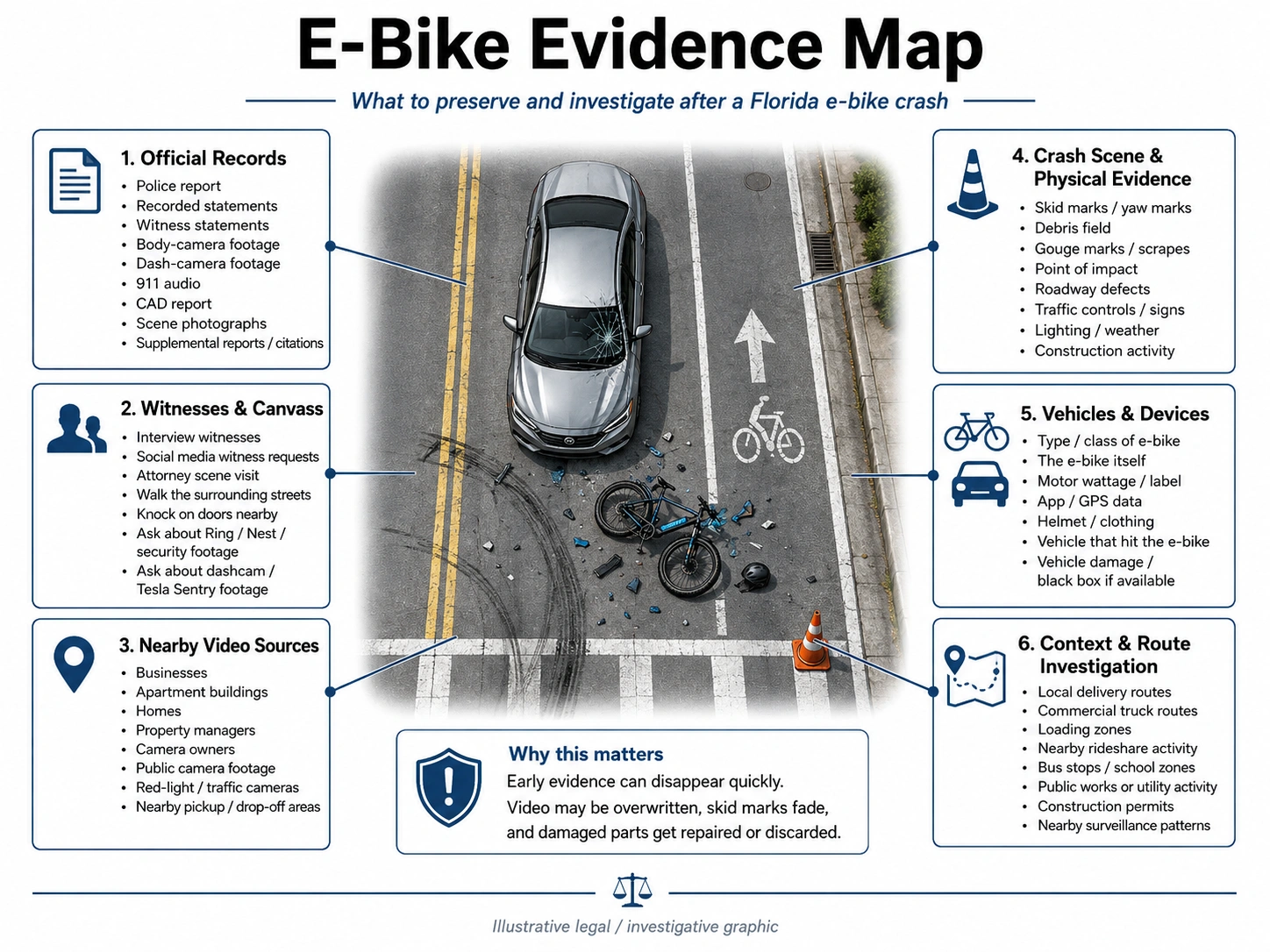
Caption: Santini Law investigates e-bike crashes by looking beyond the police report. Santini Law requests public records, conducts witness interviews, identifies possible nearby camera footage, retains vehicle and e-bike evidence, rebuilds crash-scene conditions, establishes route context, and finds evidence that may disappear quickly.
Why this is different from a typical accident lawyer:
- Santini Research, the firm’s public-safety research division, with original FLHSMV bicycle/e-bike crash-data analysis.
- A demonstrated record of finding evidence law enforcement said didn’t exist, including Florida Department of Transportation records that revealed the identity of an unknown trucking company in another case.
- Direct policy engagement such as the Orange County Commissioner meeting and invited presentation on e-bike safety.
- Media recognition, including a feature with Beyond Florida.
- Real, documented Florida e-bike case results (below).
- Insurance coverage analysis that goes beyond “the driver’s policy.”
- Experience with the minor-settlement and guardianship rules unique to child e-bike claims.
In the Community: Policy Engagement & Media
Santini Law’s e-bike work isn’t limited to individual injury claims. Attorney Frank Santini has published Santini Research studies on Florida bicycle and e-bike crash trends and met with Vice-Mayor Orange County Commissioner Kelly Martinez Semrad to discuss that research while Orange County evaluated local e-bike and micromobility regulation. Attorney Santini has since been invited to present on e-bike law, crashes, and safety at Orange County District 5’s Neighborhood Advisory Council meeting on August 26, 2026.
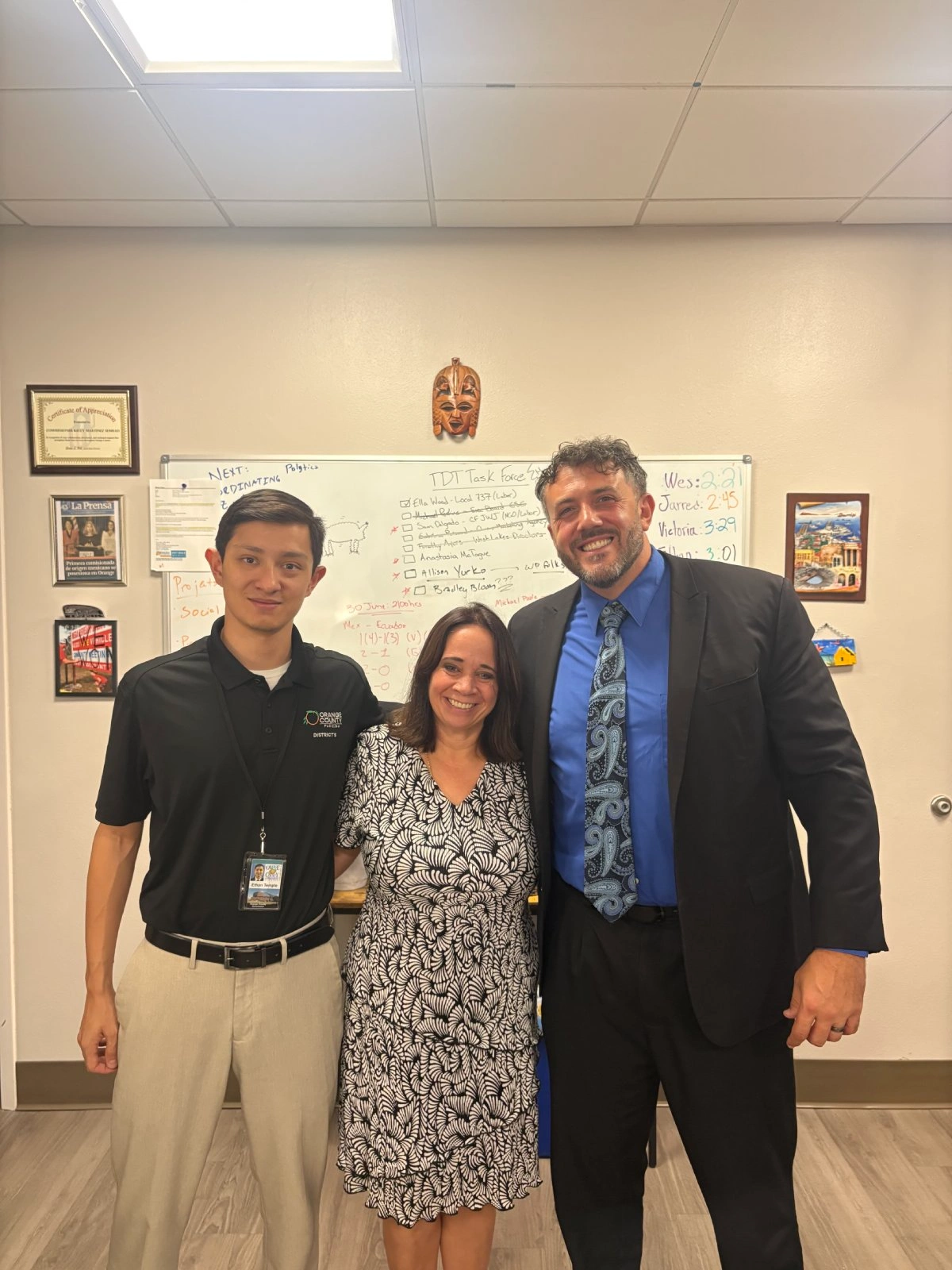
Attorney Santini with Orange County Commissioner Kelly Martinez Semrad.
View this post on Instagram
View this post on Instagram
Florida E-Bike Safety Video for Parents
Parents often ask how dangerous e-bikes really are for kids. In this video, Attorney Frank Santini discusses real-world risk factors parents should understand before letting a child ride an e-bike in Florida.
In this video, Attorney Frank Santini discusses the hidden risks of kids riding e-bikes, including helmet use, maintenance problems, phone distraction, time spent riding, city versus rural risks, vision issues, and why parents should teach young e-bike riders like they are preparing to drive.
Chapters:
- 0:00 — The Hidden Risk of Kids Riding E-Bikes
- 0:45 — Why Parents Need to Think in Terms of Risk
- 2:05 — The Explosion of E-Bike Sales
- 3:00 — Injury Statistics and What the Data Shows
- 4:00 — Why Ages 10-13 Are Most at Risk
- 4:50 — The Helmet Problem
- 6:00 — Dangerous Behaviors That Increase Crash Risk
- 7:15 — Psychology of Risky Riding
- 8:45 — How to Talk to Kids About E-Bike Safety
- 9:30 — City vs Rural Riding Risks
- 10:20 — Why Vision Matters
- 11:00 — Teaching Kids to Ride Like Drivers
Video Transcript: E-Bike Accidents Involving Kids
0:00 The Hidden Risk of Kids Riding E-Bikes
This is what riding an e-bike can feel like for your child: easy, freeing, and fun. But what many kids and parents do not realize is how quickly the whole thing can become dangerous. E-bikes are exploding in popularity. Our kids want them. We as parents want to make our kids happy. So what do we do with that conundrum? We try to take the facts and the data and make educated decisions. Even something that seems as simple as your child riding to a friend’s house can involve real risk. The goal is to make sure your child is armed with the information they need to make that trip as safely as possible.
0:45 Why Parents Need to Think in Terms of Risk
If you are a nerd like me, or into things like quantum physics, you know the world is all about probabilities: the likelihood of something happening or not happening. We cannot be with our kids every second of every day. But what we can do is identify the riskiest things they are likely to encounter, specifically with e-bikes, and try to arm them with knowledge. Arm them with the facts. Arm them with the serious stories, even the scare tactics if necessary, so they can make better decisions when we are not there. In some cases, parents may need to enforce consequences when kids are not following the rules they need to follow. The e-bike craze is intense. An enormous number of e-bikes have been purchased in the last few years. A lot of the data I found in preparing for this video is already older. Data from 2017 or 2019 can still be useful, but I do not think it fully captures the risks we are seeing now in 2026, including emergency room visits and injuries involving children on e-bikes. As an attorney, I receive calls from parents after their child has been struck by a car on an e-bike, lost control on a sidewalk, or in some cases after an e-bike battery issue or fire. Anecdotally, I am seeing more and more e-bike issues. As the data catches up, I think we are going to learn more about the dangers of e-bikes.
2:05 The Explosion of E-Bike Sales
We know that about 1.7 million e-bikes were purchased in 2024 alone, which was a 75% increase over 2023. Between 2017 and 2022, for micromobility devices in general, including e-bikes, scooters, and hoverboards, there were hundreds of thousands of emergency room visits and more than 200 reported deaths in the United States. When looking specifically at e-bikes, one national consumer safety study reported more than 50,000 e-bike-related injuries during that time period, with a significant increase between 2019 and 2022. And remember, that does not even fully capture the most recent years.
3:00 Injury Statistics and What the Data Shows
The most affected age group was kids between 10 and 13 years old, who accounted for a large share of e-bike injuries. To make things worse, helmet use is a major issue. One study found that kids use helmets less often on e-bikes than on regular bikes or mopeds. There is a real cultural problem among kids when it comes to wearing helmets.
4:00 Why Ages 10-13 Are Most at Risk
This is not just ordinary bicycle riding. Depending on the type of e-bike your child has, these devices can really move. Unfortunately, I have represented families after devastating e-bike crashes. A 10-year-old boy lost his life on an e-bike. He was not wearing a helmet. Many things in this video could have helped, but number one is wearing a helmet. I know helmets may not seem cool. Kids may call them cringe, corny, or whatever else they want to say. But if they will not wear one, that is when parents have to enforce consequences. Take away the video game console. Take away the e-bike. Take away the phone. Ground them. Whatever it takes. Being a parent is not always glamorous. Sometimes we have to be portrayed as the villain, but we are doing it for our child’s safety.
4:50 The Helmet Problem
I do not want to beat the helmet issue to death. We all get it. Helmets are critical, especially on e-bikes because of how fast they can go. But helmets are not the only issue. There are other things that can dramatically increase the risk for kids. One of those is maintenance. If there is a maintenance problem with the bike, such as a loose component or brakes that are not working properly, that can dramatically increase injury risk. Kids need to know that if something is wrong with the bike, they should not keep riding it like everything is fine. Unless they can safely fix the problem, they should take the bike home safely, avoid using the motorized portion, or walk it home. Another major risk is phone use. Kids carry phones everywhere now. But just like we try to avoid using phones while driving, kids need to avoid using phones while riding e-bikes. That includes intersections. It is common to see kids stop at an intersection and look down at their phones. But that is valuable time when they should be scanning for danger and thinking about where they are going next.
6:00 Dangerous Behaviors That Increase Crash Risk
Another issue is time spent on the bike. I understand that parents do not buy an e-bike so their child can ride it for only 10 minutes a day. That is not practical. But the data suggests that the more time a child spends on an e-bike, especially once you get into an hour or more per day, the risk rises. More time means more exposure to danger. Parents should also use practical common sense. Is the child tired? Did they just finish practice? Are there times when the child should not be riding because they may be more tired than normal? Beyond fatigue, much of this is psychological. Does the child view himself or herself as someone who takes risks, or someone who rides safely? How does the child value safety? How do they understand risk? Watch how your child rides. Are they calm, locked in, helmet on, and steady? Or are they weaving, laughing, looking at their phone, and not paying attention?
7:15 Psychology of Risky Riding
A lot of this comes down to how kids view themselves as riders. Kids want to have fun and hang out with their friends, but there are studies showing that when children have strong internal rules about being safe, it can make a meaningful difference in injury risk. These beliefs are hard to instill. You can sit a child down and lecture them, but sometimes it just becomes another adult telling them what to do. That is where parents need to be creative with storytelling. Tell them real stories. Show them age-appropriate examples. Help them understand the consequences. Before you talk to your child, take a moment and imagine what it would be like if your child were seriously injured in an e-bike accident. Get yourself into that mindset. When you talk to your child, they will see the emotion in your eyes and understand how serious it is. This is serious business. A simple lecture may not be enough. Children need more than words. They need the story, the emotion, and the seriousness behind it.
8:45 How to Talk to Kids About E-Bike Safety
Where you live also matters. If you think cities are more dangerous, you are probably right in many ways, because the biggest danger is contact with other vehicles: cars, trucks, intersections, and riders getting sideswiped on the road. But rural areas have risks too. In rural areas, there often are not bike lanes or sidewalks. Kids may have fewer safe places to ride, even though there may be fewer cars. In cities, if a child can legally and safely ride on the sidewalk, that may reduce some risk from cars. Sidewalks have their own problems. They can be bumpy, uneven, or blocked by branches and other hazards. But in my practice, the most serious injuries I have seen tend to involve children riding in the street or crossing streets, where either the child makes a mistake or a driver fails to pay attention, runs a stop sign, or makes another dangerous error.
9:30 City vs Rural Riding Risks
The takeaway is that if you live in a rural area, you still need to think carefully about safety. There may be fewer dedicated bike lanes, sidewalks, or safe riding areas. In cities, there may be more traffic conflicts. In rural areas, there may be fewer safe riding spaces. Either way, parents need to look at the actual route their child is riding.
10:20 Why Vision Matters
Vision is another issue that sounds obvious but matters. Get your child’s vision checked every year. Kids may not realize they are squinting or that their vision is no longer 20/20. Good vision is especially important when a child is riding at higher speeds on an e-bike. There are many kids, and adults too, riding around with poor vision when they really need glasses or contacts.
11:00 Teaching Kids to Ride Like Drivers
Your child does not know what your child does not know. When we think about teaching kids to drive, we imagine taking them to an empty parking lot at 16, teaching them how to park, and then taking them driving a few times before they get their license. But if your child is 10 or 11 years old and riding an e-bike, they may already be using a device that can travel at significant speeds. In some cases, an e-bike can go about half as fast as a car in normal traffic. So we need to rethink how we teach kids about roads and traffic. If they have an e-bike, we should be teaching them about traffic safety, stop lights, stop signs, yield signs, dangerous intersections, rough road areas, and places where drivers tend not to look. As adults, we have been driving for years. We understand traffic patterns almost automatically. Children do not. They do not know what they do not know. If your child is going to ride an e-bike, treat the training almost like they are preparing to get a driver’s license. Take them out riding. Ask them questions. Make them identify hazards. Teach them how to scan intersections and think ahead. If you do that, you will know you did what you could to lower the probability of risk and help keep your child safe.
Florida E-Bike Rules Parents Should Know
Before a child rides an e-bike in Florida, parents should understand three things: what the bike legally is, where the child is riding, and what insurance would apply if someone gets hurt.
Classes of e-bikes. Class 1 e-bikes provide motor assistance only while pedaling and stop assisting at 20 mph. Class 2 e-bikes may use a motor to propel the bike without pedaling and also stop assisting at 20 mph. Class 3 e-bikes provide motor assistance only while pedaling and stop assisting at 28 mph.
How to tell which class your child’s e-bike is. Florida law requires every e-bike sold or assembled in the state to carry a permanent manufacturer’s label, usually on the frame near the pedals or seat post, stating the classification number (1, 2, or 3), top assisted speed, and motor wattage (Fla. Stat. § 316.20655(3)). If that label is missing, painted over, or doesn’t match how the bike actually performs, that’s worth knowing before your child rides it, and it can become important evidence if a crash happens.
Helmets. Under Fla. Stat. § 316.2065(3)(d), bicycle and e-bike riders and passengers under 16 must wear a properly fitted, fastened helmet meeting federal safety standards.
Minimum age and ID requirements. Florida does not set one statewide minimum age to operate a legal e-bike, motorized scooter, or micromobility device. Instead, Fla. Stat. § 316.20655(8) and Fla. Stat. § 316.2128(7) allow local governments to adopt their own minimum-age and photo-ID requirements. Palm Coast’s ordinance, for example, sets a minimum rider age of 11 for e-bikes on any city street, sidewalk, or path, and requires riders to carry government-issued photo ID, a school ID counts, along with a driver’s license, passport, or military ID. That means the answer can change depending on whether a child is riding in Tampa, Orlando, Palm Coast, a beach community, or another local jurisdiction. Always check the applicable local ordinance where the child actually rides.
License, registration, and insurance. A legal Florida e-bike is not subject to motor-vehicle financial responsibility, driver’s license, registration, title, or off-highway vehicle laws, but only as long as it stays within Florida’s e-bike definition (see below).
Where children can ride. Florida generally allows e-bikes wherever bicycles are allowed, streets, highways, roadways, shoulders, bicycle lanes, and multiuse paths, but local governments and certain agencies can restrict or prohibit e-bikes on specific sidewalks, paths, trail networks, beaches, and dunes. Winter Garden, for instance, allows Class 1 and Class 2 e-bikes on the West Orange Trail, but prohibits Class 3 e-bikes and motorized scooters on that trail.
Download: a free, printable “Florida Parent E-Bike Safety Checklist for Kids,” covering age/maturity, route auditing, helmet rules, and high-risk behaviors to ban, drawn from Santini Research’s parent safety guide.
Florida_Parent_E-Bike_Safety_Checklist_for_Kids
When Does a Modified E-Bike Stop Being a Legal E-Bike?
This is one of the most practical issues in a Florida e-bike injury case, and one of the most common problems for parents, since many bikes are sold as “e-bikes” and later modified.
A legal Florida e-bike must stay within the statutory framework: fully operable pedals, a motor within Florida’s wattage and speed limits for its class, a motor that disengages when the rider stops pedaling or brakes, and an accurate permanent label showing the classification number, top assisted speed, and motor wattage. Fla. Stat. § 316.20655(4) makes it unlawful to tamper with or modify an e-bike to change its motor-powered speed capability or engagement unless the label is replaced to match.
A device starts falling outside that framework when:
- A throttle (a hand-operated lever or twist-grip control that moves the bike under motor power alone, without the rider needing to pedal) keeps propelling the bike above 20 mph
- Pedal assist keeps engaging above 28 mph (Class 3 limit).
- The motor exceeds the legal wattage limit.
- The bike no longer has working pedals.
- The label is missing, inaccurate, or was never updated after a modification.
- The motor doesn’t disengage when required.
What it can become instead. Once a device is pushed past Florida’s e-bike limits, the next legal question isn’t just “is this illegal?”, it’s “what category does Florida law put this in now?” That classification affects licensing, registration, insurance, where it can be ridden, and how an injury claim is evaluated.
| If the device has… | It may be reclassified as… | Practical Florida requirement |
| Pedals, a seat, a motor ≤ 2 brake horsepower, top speed ≤ 30 mph | A moped | Registration + Class E license required; no title; no sidewalks/bicycle paths. |
| Motor-powered device, with or without a seat/saddle, ≤ 3 wheels, top speed ≤ 20 mph, and not an e-bike | A motorized scooter | No driver’s license, registration, or insurance required; local rules may apply |
| Motor power/speed beyond moped range, minimal or no usable pedals | A motorcycle | License, registration, title, and insurance generally required |
| High-powered, closer to a small off-road electric dirt bike | An off-highway motorcycle/vehicle | Not street-legal in the same way as a bicycle or e-bike |
Note: This chart follows the current Florida statutory definition. FLHSMV’s public motorized-scooter page still describes a motorized scooter as having no seat or saddle, but current Fla. Stat. § 316.003(48) defines a motorized scooter as motor-powered “with or without a seat or saddle” and capped at 20 mph. Borderline devices should be classified by the current statute and the device’s actual pedals, seat/saddle, motor power, top speed, and design.
Why this matters after a crash. If a modified device no longer qualifies as a legal e-bike, insurers can use that reclassification against you in two specific ways: for PIP, they may argue the rider was occupying a “self-propelled vehicle” rather than riding a bicycle-type device, defeating the pedestrian/bicyclist PIP argument discussed above; for UM/UIM, the policy’s exclusions for mopeds, scooters, or motorcycles may apply instead of its e-bike or bicycle coverage. It can also feed into the comparative-fault and parental-liability arguments covered earlier in this article.
That does not automatically mean an injured rider has no case, but it does mean the e-bike’s label, motor wattage, top assisted speed, throttle and pedal-assist settings, and any modifications need to be preserved and reviewed before the bike is repaired, sold, or discarded.
Santini Research: Florida’s E-Bike Data Gap
One of the biggest problems in Florida e-bike cases is that the data has lagged behind reality. The standard Florida crash report has never separated e-bike crashes from traditional bicycle crashes, without reading the narrative of individual crash reports one at a time, there is no way to know which “bicycle” crashes in Florida’s statewide data actually involved e-bikes.
Santini Research’s FLHSMV crash-data analysis addresses that gap directly. Florida’s “bicycle” category is not a catch-all for every micromobility device: scooters are tracked separately, while traditional bicycles and legal e-bikes are grouped together within the broader bicycle crash category.
| What the “bicycle” data clearly includes | What it clearly does not include |
| Human-powered bicycles and pedalcycles | Scooters or similar devices (explicitly excluded by FLHSMV’s glossary) |
| Riders coded as “Bicyclist” or “Other Cyclist” | Occupants of non-motor-vehicle devices other than a bicycle (coded “Other Non-Motorist”) |
| Legal e-bikes, since local enforcement guidance treats e-bikes as bicycles on roads and trails | — |
Caption: Florida’s bicycle crash data has historically made it difficult to isolate e-bike-specific crashes, which is why Santini Research analyzed severity trends, geography, and device-blending issues together.
That distinction matters in litigation. If an insurance company tries to dismiss an e-bike crash as an isolated, unusual event, statewide data says otherwise: Florida is seeing a broader shift in bicycle and e-bike injury patterns, and it is not evenly spread across the state.
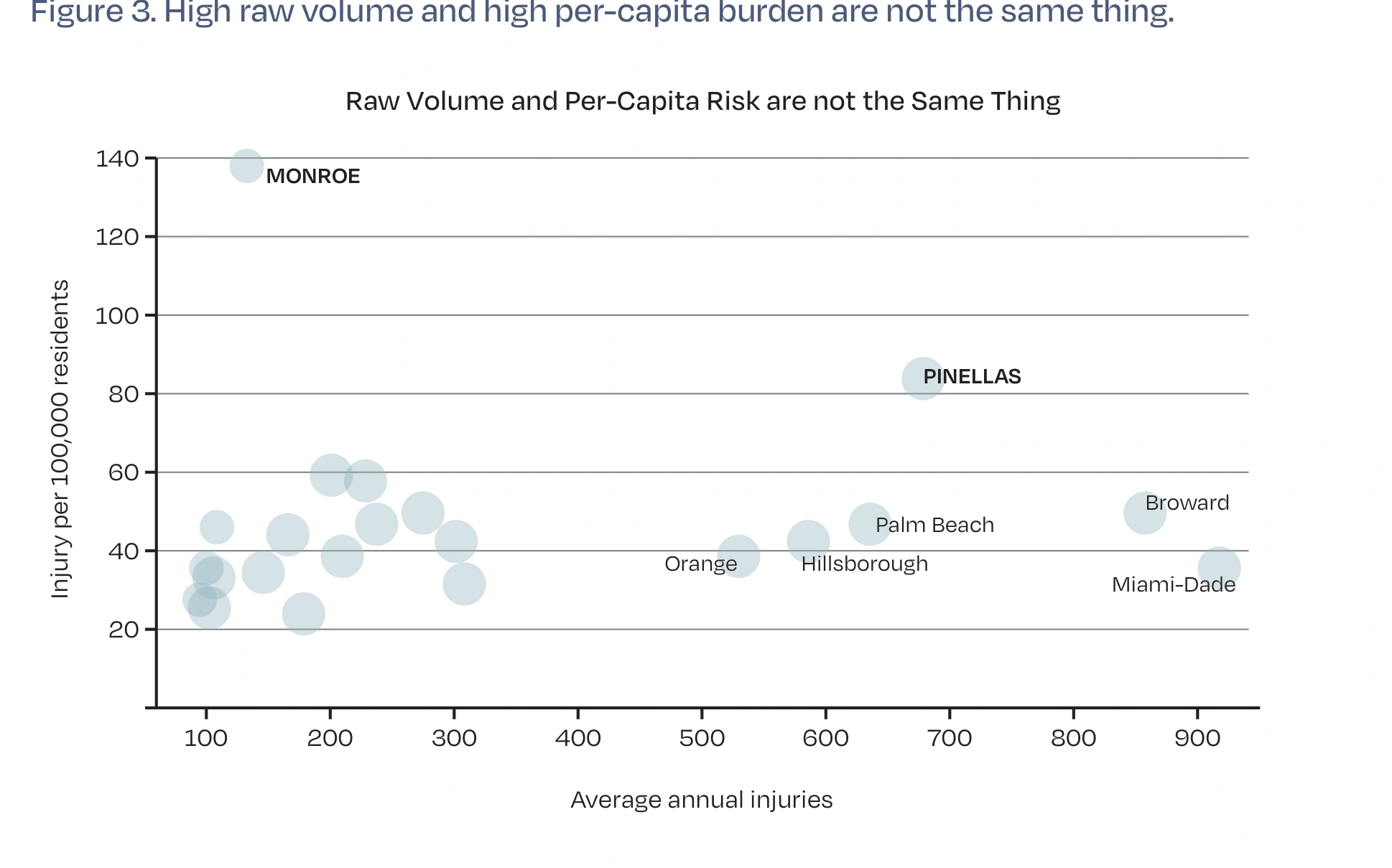
Caption: Large counties may have high raw crash totals, but Santini Research found that per-capita bicycle injury burden tells a different story. This matters when evaluating e-bike exposure in trail-heavy, visitor-heavy, or coastal communities.
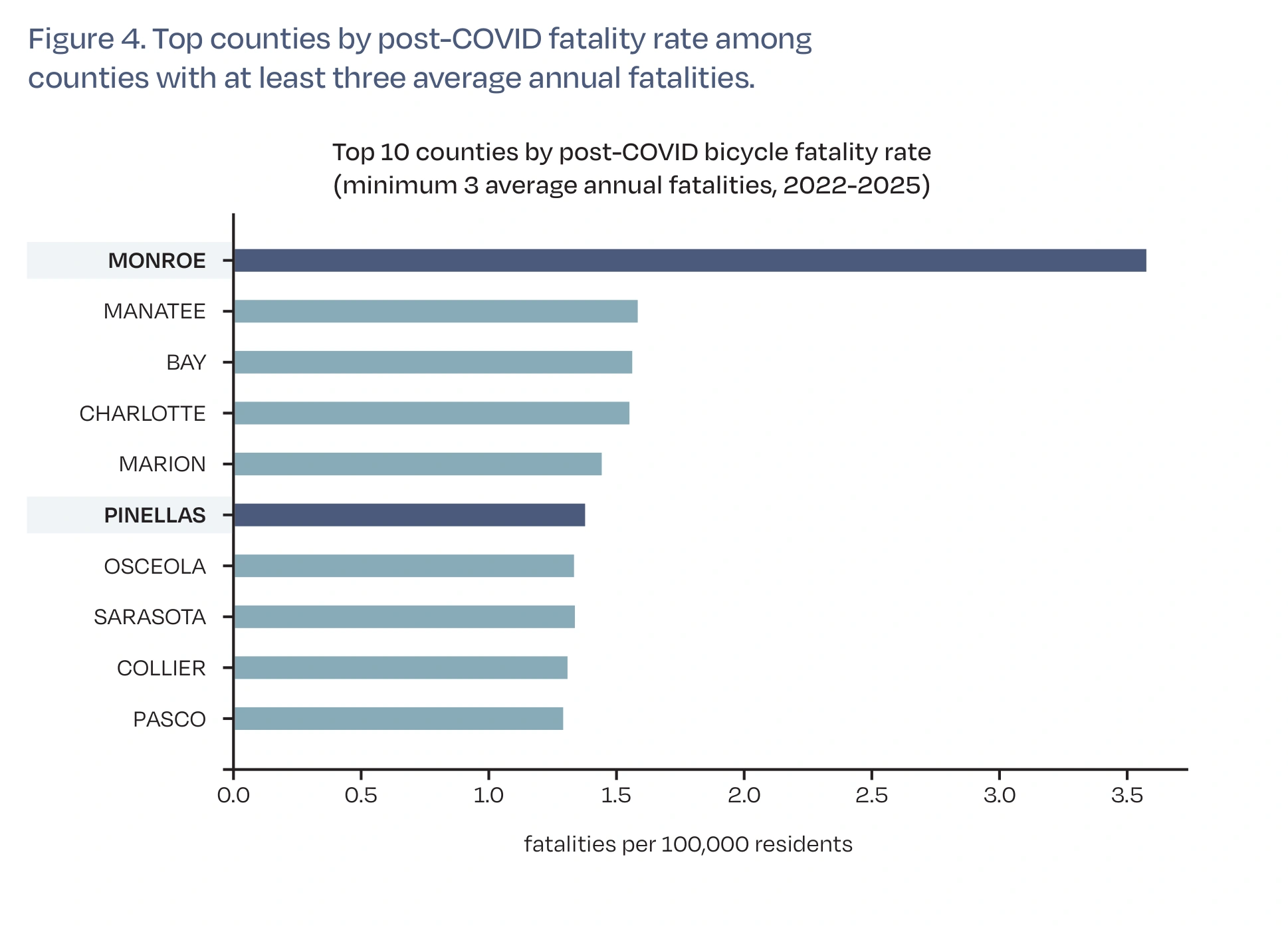
Caption: Santini Research found that fatality patterns sharpen the e-bike safety concern. Among counties with meaningful bicycle-crash volume, several Florida counties, led by Monroe and Pinellas, show elevated bicycle fatality rates in the post-COVID period.
Hillsborough County, home to Santini Law’s Tampa and Riverview offices, is among the higher-volume Florida counties Santini Research identified with elevated post-COVID bicycle fatality concerns, alongside coastal counties such as Monroe, Pinellas, Manatee, Collier, and Sarasota. That doesn’t mean every Hillsborough e-bike crash is catastrophic. It reinforces that e-bike and bicycle injury risk isn’t limited to beach towns or tourist trails.
- Full Santini Research white paper — FLHSMV Data Analysis: Bicycle Deaths Up Nearly 50% in Florida Since COVID
- Florida’s E-Bike Law and What Parents Should Know
Real Florida E-Bike Case Studies
Case Study: 13-Year-Old Apollo Beach E-Bike Rider Hit by a Rental Vehicle at a Stop-Sign Intersection
A spring afternoon after school should have ended with fishing, flag football, and a normal neighborhood ride. Instead, a 13-year-old Apollo Beach student and competitive flag-football quarterback was transported by ambulance after being struck while riding her e-bike. Her concerned parents called Santini Law.
The child was riding westbound on Milestone Drive in Apollo Beach, Hillsborough County, carrying a fishing rod. As she approached Triton Lane, a Hyundai Kona rental vehicle came from her left at a stop-sign-controlled intersection. The child had the right of way; the driver entered the intersection and struck the left side of her body and e-bike. Law enforcement cited the driver for failure to yield and did not assign fault to the child. EMS transported her to St. Joseph’s Hospital South in Riverview with left wrist and left-rib pain; imaging showed no fractures, and she was referred to an orthopedic doctor.
This case illustrates why child e-bike claims require a different legal review:
- Right-of-way statutes. Fla. Stat. § 316.123 and § 316.121 address a driver’s duty to stop and yield at intersections. A citation supports negligence, but the insurer may still investigate further, and the driver may challenge the citation in traffic court.
- Child-negligence standard. Because the rider was a minor, her fault (if any) is analyzed under Florida’s child-negligence jury instruction, comparing her to a reasonably careful child of the same age and experience, not to an adult.
- The helmet statute protects the family, without exception. Fla. Stat. § 316.2065(18) bars the insurer from using a missing helmet as evidence of negligence or contributory negligence, even in cases involving a serious head injury. That’s a stronger, unconditional protection than the “failure to mitigate” arguments insurers can raise in some other states.
- Rental-car ownership rules work differently than you’d expect. Under Florida’s “dangerous instrumentality” doctrine, the owner of a car can be held legally responsible for a crash caused by someone they let drive it, even though the owner wasn’t behind the wheel. That rule made sense for an individual owner lending a car to a friend, but it made much less sense applied to a rental company handing keys to thousands of strangers a year, so in 2005 Congress passed the Graves Amendment, a federal law that overrides Florida’s ownership-liability rule for rental and leasing companies in most situations. Fla. Stat. § 324.021 still applies to the extent it isn’t preempted – for example, if the rental company itself failed to maintain the vehicle’s brakes. Practically, that means a rental-car crash requires looking at several sources of coverage at once: the driver’s own personal auto policy, any supplemental insurance purchased at the rental counter, the rental agreement itself, and, if the driver was on the job, their employer’s insurance.
- Minor-settlement rules apply. Because the injured rider was a minor, her settlement is subject to Florida’s guardianship and court-approval requirements; see the Florida Child E-Bike Accident Claims section below for the full breakdown of thresholds and process.
Case Study: Brandon E-Bike Rider Hit by a Left-Turning Driver
A man was riding a motorized e-bicycle northbound on Bryan Road in Brandon, Hillsborough County, during the early evening. As he approached Overhill Drive, a southbound Honda Civic made a left turn onto Overhill Drive; the driver did not see the e-bike rider and struck him, knocking him to the ground and destroying the e-bike.
The rider felt immediate pain in his back, right knee, and neck. An ambulance transported him to Brandon Regional Hospital; X-rays showed no fractures. He was treated with prescription medication, and later sought physical therapy and chiropractic care. A left-turn crash like this typically implicates Fla. Stat. § 316.122, which requires a left-turning driver to yield to approaching traffic that is in the intersection or close enough to create an immediate hazard.
This case also shows why Hillsborough County belongs in the e-bike conversation: Santini Research’s fatality-rate analysis identified Hillsborough among higher-volume Florida counties with elevated post-COVID bicycle fatality concerns, a reminder that e-bike risk isn’t confined to beach towns or tourist trails.
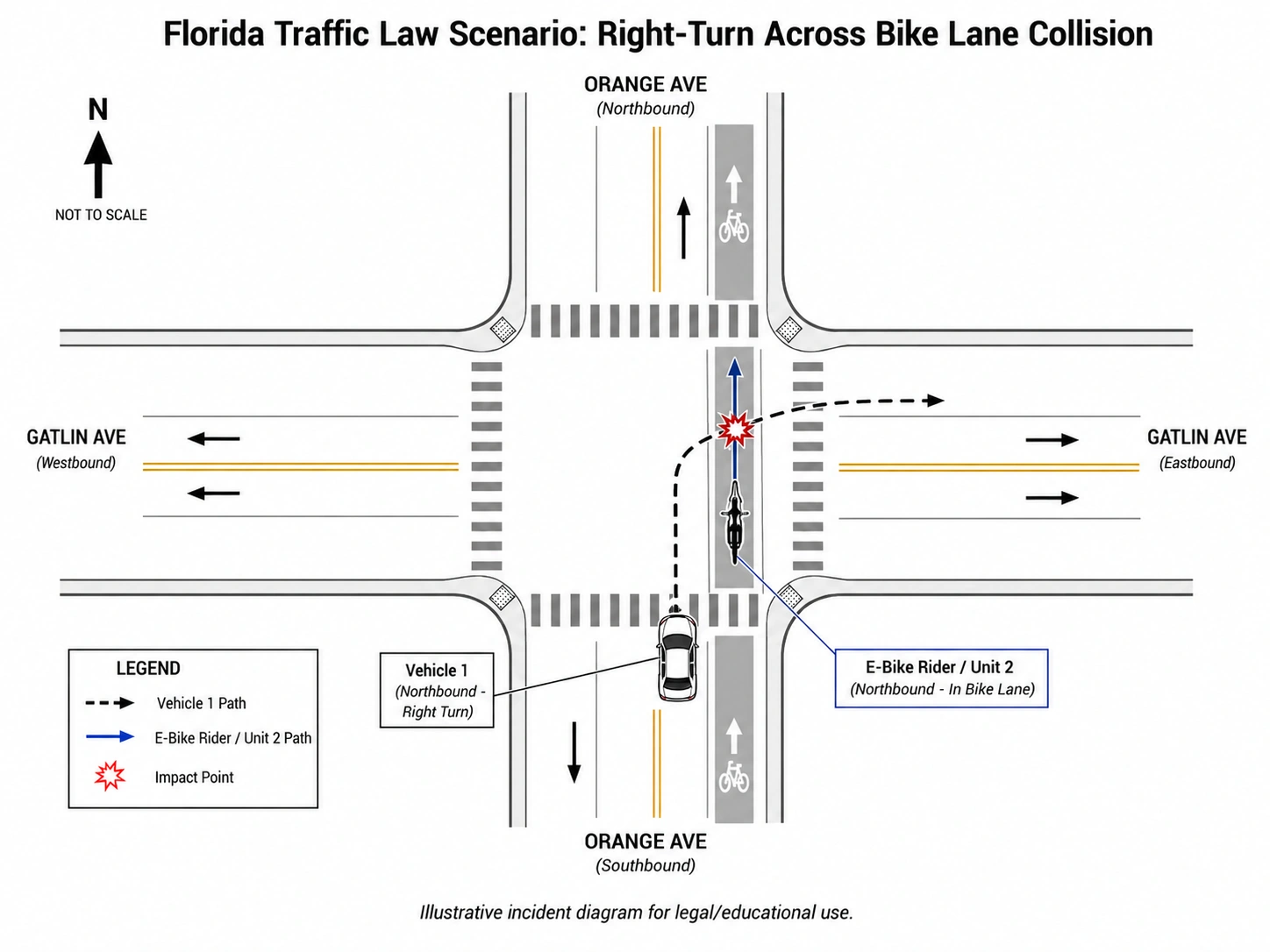
Illustration of a common Florida e-bike crash scenario at S Orange Avenue/FL-527 and Gatlin Avenue in Orlando: a northbound driver turns right across a marked bike lane while an e-bike rider continues straight through the intersection — a “right hook” collision that can raise issues of right-of-way, bike-lane safety, driver lookout, and e-bike accident liability.
Florida’s 2026 E-Bike Safety Bill: SB 382 and the Veto
Florida’s House and Senate passed bipartisan e-bike legislation, SB 382, and sent it to Governor DeSantis in June 2026. The bill would have created Florida’s first statewide micromobility crash-tracking framework, requiring law enforcement to record e-bike classification, operator age, driver’s-license status, and crash date/time for every micromobility crash investigated, even minor incidents that wouldn’t otherwise trigger a long-form crash report. It also would have required e-bike riders on certain shared pathways to yield to pedestrians, give an audible signal before passing, and cap speed at 10 mph on a sidewalk or pedestrian area when a pedestrian is within 50 feet.
On June 25, 2026, Governor DeSantis vetoed SB 382, citing concerns that the bill’s tracking and monitoring requirements amounted to government overreach, despite the bill’s unanimous support in both legislative chambers.
Because SB 382 was vetoed, Florida still has no statewide e-bike crash-tracking system and no statewide sidewalk/shared-path speed or yield rule. Local governments are left to regulate e-bikes county by county and city by city. Following his research and the Orange County Commissioner meeting described above, Attorney Santini has been closely monitoring Orange County’s proposed e-bike ordinance, originally drafted by the Sheriff’s Office, as a potential bellwether for other Florida e-bike ordinances.
- Blog: Florida E-Bike Accident Lawyer Meets with Orange County Commissioner’s Office After SB 382 Veto
- Blog: Florida’s New E-Bike Law Vetoed
This is exactly the gap Santini Research’s data analysis anticipated: Florida’s bicycle and e-bike injury and fatality rates rose sharply post-COVID before the state had any dedicated e-bike crash-tracking system, and, with SB 382 vetoed, that data gap remains open today.
E-Bike Accidents Caused by Bad Sidewalks, Trails, Roads, and Bike Paths
Not every crack in a sidewalk or bump in a bike path creates a Florida e-bike injury claim. These cases are harder to win than a typical crash claim against another driver. When a car hits you, the question is usually just who was at fault. When a broken sidewalk, pothole, or trail defect causes the crash, you’re often suing a government agency or property owner instead of a driver, and Florida law puts extra hurdles in the way before you even get to the question of fault.
To win one of these cases, the rider generally has to prove:
- Who was responsible: which government agency, property owner, or contractor actually owned or maintained that specific stretch of sidewalk, trail, or road.
- That it was genuinely dangerous: not just an eyesore, but a hazard serious enough to create a real risk of injury.
- How long the problem existed: a defect that appeared five minutes before the crash is treated very differently than one that sat there for months.
- Whether they knew, or should have known: whether the responsible party was actually aware of the hazard or should have caught it through routine inspection.
- Whether the government is even allowed to be sued: certain government decisions are legally off-limits to challenge. That’s sovereign immunity, explained below.
- Whether the rider’s own actions contributed: speed, distraction, or riding at night without lights can reduce what the rider can recover.
E-bikes raise the stakes. Because e-bikes travel faster and weigh more than traditional bicycles, the same defect that might cause a minor bicycle wobble can produce a much more serious e-bike crash. Santini Research’s data shows Florida’s post-COVID bicycle-crash increase is tied to exposure, where and how people are riding has changed, which matters because many e-bike crashes happen in exactly the high-exposure areas these defect cases involve: coastal communities, shared-use paths, trail networks, and neighborhood sidewalks.
Where e-bikes can legally ride. Fla. Stat. § 316.20655 generally gives e-bikes the rights and duties of bicycles, including on streets, shoulders, bike lanes, and multiuse paths, but, as discussed above, local governments and certain agencies may still restrict e-bikes on specific sidewalks, trails, beaches, and dunes. A sidewalk or trail crash claim often requires a local-ordinance review, not just a statewide statute review. Fla. Stat. § 316.2065 also allows a bicycle/e-bike rider to leave the bike lane or right-of-way position when reasonably necessary to avoid a hazard, which can help explain a rider’s evasive move, though insurers may argue the reaction was unsafe or too late.
Sovereign immunity is the old legal rule that the government can’t be sued without its permission. Florida has given up part of that protection in Fla. Stat. § 768.28, which allows certain lawsuits against its public entities like municipalities. But these Florida sovereign immunity lawsuits have strict limits on notice, timing, and how much can be recovered.
Even where a lawsuit is allowed, Florida courts draw a line between two kinds of government decisions. Planning-level decisions, broad choices about how to design or fund a road or trail system, generally stay immune, because courts don’t want to second-guess how the government spends limited money. Operational-level negligence, failing to maintain something that already exists, or failing to warn about a known danger, is different, and can support a claim.
Two Florida Supreme Court cases help define that boundary. In Commercial Carrier Corp. v. Indian River County, the Court treated the failure to maintain existing traffic-control signs, pavement markings, and signals as operational-level conduct, meaning a lawsuit may be allowed. In City of St. Petersburg v. Collom, the Court recognized that when the government creates or knows about a dangerous condition that is not readily apparent, it may have an operational-level duty to correct it, warn about it, or protect the public. Put simply for Florida e-bike riders: you usually cannot sue the government just because it made a broad policy or design choice you disagree with. But if the government failed to maintain something it already built, or failed to warn about a known hidden danger, then lawsuits are typically permitted.
What experts look for. The defects that cause these crashes are usually easy to picture: a sidewalk slab that’s popped up higher than the one next to it, a pothole or crumbling edge on a bike path, a broken storm-drain grate, an unmarked obstruction, or a gap where a trail meets a road. There’s no automatic “one-inch rule” that decides a case, but engineers and roadway-safety experts look for measurable proof: the height difference at a raised slab’s edge, the width and depth of a gap or hole, surface slope, lighting and visibility at the time of the crash, prior complaints, prior repairs, drainage problems, and whether the defect violated a maintenance or accessibility standard. Public-right-of-way guidance generally allows a vertical edge up to ¼ inch, requires beveling (a sloped transition) between ¼ and ½ inch, and requires a ramp above ½ inch, useful reference points, but not automatically enough to win a case on their own.
Evidence to preserve immediately, before the defect is repaired and the case is lost: photos and video from the rider’s direction of travel and multiple angles; a measured height difference or hole depth; lighting and shadow conditions; the exact GPS location; and the e-bike, helmet, app/route data, and damaged parts.
Who may be responsible often isn’t obvious. The same stretch of trail can cross property controlled by a city, a county, the Florida Department of Transportation, a special taxing district, a homeowners’ association, an apartment complex, a utility company, or a private contractor, sometimes changing hands every few hundred feet. Public records requests, permit searches, maintenance logs, and past complaint records are usually how we figure out which one is actually on the hook.
The bottom line: these are some of the hardest cases in e-bike injury law, and most potential claims don’t survive once we dig into the facts. Sovereign immunity, strict notice deadlines, and the burden of proving the government knew about a hazard knock out a lot of cases before they’re ever filed.
A pothole reported to the city three times over two years, photographed and measured after the crash, with a serious injury attached, that’s worth pursuing. A crack in the pavement nobody ever complained about, with no evidence anyone knew it was there, and a minor scrape, that usually isn’t, no matter how bad the sidewalk looked. The strongest cases combine a serious, measurable hazard; clear proof of who owned or controlled it; evidence the responsible party knew or should have known; no warning sign or barrier; and an injury serious enough to justify the fight.
What Compensation Can Be Recovered in a Florida E-Bike Accident Case?
Case value depends on what happened, how badly the rider was hurt, how clearly the other party was at fault, what insurance is available, and how the crash changed the rider’s life.
Fault matters because the claim is stronger when the driver clearly violated a rule of the road, ran a stop sign, turned left across the rider’s path, cut across a bike lane, opened a door into the rider, passed too closely, or failed to yield.
Comparative fault reduces recovery; see the Comparative Fault section above for how Florida’s 51% bar and nonparty-fault rules can affect what’s ultimately collectible.
Injury severity ranges from bruises to fractures, concussion, spine and knee injuries, surgery, and permanent impairment. A negative X-ray doesn’t always mean the person is fine, some injuries only become clear after follow-up orthopedic evaluation, MRI, or continued symptoms.
Insurance coverage limits even a strong claim; see the insurance section above for how bodily injury liability, PIP, MedPay, UM/UIM, umbrella coverage, and health insurance interact.
Life impact extends beyond medical bills. A teenager recovering from a fractured wrist might miss an entire club soccer season and a shot at a travel-team tryout. A parent might burn through two weeks of PTO driving a child to follow-up appointments and physical therapy instead of working. And for many kids, the hardest cost to put a number on is psychological, refusing to get back on a bike, flinching at passing cars, or losing sleep for months after the crash.
If a case goes to trial, Florida law recognizes several categories of damages a jury can award: the cost of medical care and lost income (the “economic” damages), plus categories aimed at everything money can’t undo such as pain and suffering, permanent disability or physical impairment, disfigurement, mental anguish, and the loss of the ability to enjoy life the way you did before the crash. There’s a catch specific to Florida’s no-fault system, though: in a claim against an at-fault driver, those pain-and-suffering-type damages aren’t automatically available. Fla. Stat. § 627.737(2) requires proof the injury cleared a specific threshold: a significant and permanent loss of an important bodily function, a permanent injury, or significant permanent scarring. In practice, a rider with a sprain that heals completely may be limited to medical bills and lost wages, while a rider with a lasting injury like a hip fracture that never fully heals, or permanent nerve damage, both common in serious e-bike crashes may have a claim for the full range of damages. (A death from an e-bike accident gives rise to a separate wrongful death claim under Florida law, not this threshold.)
Santini Research’s data shows Florida’s post-COVID bicycle fatalities rose faster than injuries, evidence that the problem isn’t just more crashes, but more severe ones, and one more reason e-bike injury cases deserve careful review instead of being dismissed as “just a bike accident.”
Florida Child E-Bike Accident Claims
Child e-bike cases require extra care because children are not small adults. A crash can affect a child’s body, confidence, school, sports, sleep, and friendships. Likewise, parents are thrust into suddenly managing medical appointments, insurance calls, and decisions about whether a settlement truly serves the child’s interests.
Parents should first understand the child’s medical picture: ambulance transport, ER visit, imaging, orthopedic/concussion/therapy referrals, ongoing pain, sleep changes, or fear of riding again. A quick ER discharge doesn’t always tell the whole story.
Parents should also understand the legal differences from an adult claim. A child cannot sign a binding release, file a lawsuit, or settle a claim the same way an adult can. A parent or guardian acts on the child’s behalf, but the money belongs to the child, and Florida law adds protections:
Florida has extra rules to protect a child’s settlement money. The bigger the child’s e-bike settlement amount, the more oversight kicks in.
For smaller settlements, parents don’t need to do anything special. As the child’s “natural guardian,” a parent can typically sign the release and manage the money without going to court first. (Fla. Stat. § 744.301)
Once the minor’s net settlement passes $15,000, a parent generally has to become the child’s formal guardian through the court, meaning a judge oversees how the money is handled to make sure it’s used for the child. If a lawsuit has been filed, a judge also has to approve the settlement itself. (Fla. Stat. § 744.387)
Once a gross settlement reaches $50,000, the court will usually also appoint a guardian ad litem, who is an independent person with no connection to the family’s own lawyer, whose only job is to look out for the child and confirm to the judge that the deal is genuinely fair before it’s approved. (Fla. Stat. § 744.3025)
None of this means the family did anything wrong. This process is simply Florida’s way of making sure a child’s money is protected the same way it would be for any minor who can’t yet manage it themselves.
Once a formal guardian is appointed, the court decides how the child’s share is actually held until they turn 18. This could mean the settlement monies are placed into a restricted (or “guardianship”) account, which is a bank account that can’t be touched without a judge’s specific order, like a locked savings account. Alternatively, the settlement funds could be deposited into a structured settlement, where instead of one lump sum, the money is paid out over time, often timed to milestones like turning 18 or starting college. Neither option is about making things difficult; both exist to make sure the money is still there, and used for the child, years down the road.
What Happens If an E-Bike Case Has to Be Filed in Court?
Most Florida injury cases settle before trial, but serious e-bike cases are prepared from day one as if they may need to go to court.
Once a case is filed, your attorney should handle the great majority of the litigation like drafting and responding to court filings, managing deadlines, and communicating directly with the defense. Your own involvement is typically limited to a few specific discovery tasks, like sitting for a deposition or answering written questions called interrogatories, at the points where your first-hand account is actually needed.
Filing a lawsuit doesn’t mean a case is automatically headed to trial. The lawsuit aspect simply moves the parties into a formal process where both sides can require information, documents, testimony, and inspections. Under Florida Rule of Civil Procedure 1.280, the parties exchange early information: witnesses, photographs, videos, medical providers, and insurance policies. Under Rule 1.350, a lawyer can request documents and inspection of physical evidence such as a damaged e-bike, helmet, app/GPS data, body-camera and dash-camera footage, rental-car records, and scene measurements.
The damaged e-bike, helmet, and component parts should not be repaired, sold, or thrown away too quickly.
If the injured person’s medical condition is disputed, Rule 1.360 may allow a defense medical examination, not treatment, but an evaluation for litigation purposes. Depositions often follow, where the driver, e-bike rider, parents (in a child’s case), witnesses, officers, treating doctors, and reconstruction experts answer questions under oath. Most Florida injury cases, including e-bike claims, are then required to go to mediation before trial.
Very few personal injury cases actually reach a trial verdict. National state-court data from the Bureau of Justice Statistics found bench and jury trials account for roughly 4% of tort case dispositions. That doesn’t mean every other case simply settles; some are dismissed or resolved another way. Even so, thorough trial preparation drives settlement value: when an insurer sees that evidence has been preserved, medical proof developed, coverage identified, and witnesses prepared, settlement becomes more realistic.
What to Do After a Florida E-Bike Accident
The steps you take in the first hours and days after a crash can affect your case significantly. Here’s what matters most, in order:
- Get medical care first. Even if you feel okay, some injuries, especially concussions and internal injuries, don’t show symptoms right away, and a medical record created close to the crash date becomes important evidence later.
- Report the crash. Call 911 or file a report with local police so there’s an official record of what happened.
- Preserve the e-bike and helmet exactly as they are. Don’t clean them, repair them, or hand them over to an insurance company. The physical damage is often key evidence.
- Photograph everything at the scene. The bike, the road or trail surface, skid marks, the other vehicle, your injuries, and the surrounding area, from multiple angles.
- Save your app or GPS data. Many e-bikes and fitness apps log speed, route, and time. This data can get overwritten, so back it up right away.
- Identify witnesses and nearby cameras. Get names and phone numbers of anyone who saw what happened, and note any businesses, homes, or traffic cameras nearby. Footage is often deleted within days or weeks.
- Avoid giving a recorded statement to any insurance company, including your own, before speaking with a lawyer. Insurers are trained to ask questions that can be used to minimize your claim later.
- Talk to a lawyer as soon as possible. Camera footage and other evidence disappear fast, and an attorney can send preservation letters and start investigating before it’s gone.
If your child was involved, also hold onto: school absence records, sports or activity restrictions from a doctor, prescription receipts, therapy bills, discharge instructions, and contact information for every provider involved. These details matter later for proving how the injury affected your child’s life, calculating damages, resolving medical liens, and getting a settlement approved by the court.
Florida E-Bike Accident FAQs
Talk to a Florida E-Bike Accident Lawyer
Florida e-bike accident cases are moving faster than Florida’s crash data, insurance playbooks, and local ordinances can keep up.
Santini Law has studied the problem, handled real e-bike injury claims, and understands how to investigate the legal, medical, insurance, and child-safety issues that decide these cases.
If you or your child was injured in a Florida e-bike crash, call Santini Personal Injury & Car Accident Law for a free consultation.
Call: (813) 576-3209
Contact: Schedule A Consultation.
No fee unless we recover money for you.
Related Florida Bicycle & E-Bike Resources
Bicycle & Car Accident Lawyer pages:
- Tampa Bicycle Accident Lawyer
- Gibsonton Bicycle Accident Lawyer
- Apollo Beach Bicycle Accident Lawyer
- Riverview Bicycle Accident Lawyer
- Brandon Car Accident Lawyer
Santini Research reports:
- Florida’s E-Bike Law and What Parents Should Know
- FLHSMV Data Analysis: Bicycle Deaths Up Nearly 50% in Florida Since COVID
Florida e-bike blog articles:
Schedule A Consultation
Fields marked with an * are required
Let Us Get You Started In The
Right Direction
Fields marked with an * are required
Riverview Office
7269 Bucks Ford Dr.
Riverview, FL 33578

Call Us Today 813-445-6121
Tampa Office
9270 Bay Plaza Blvd Suite 618
Tampa, FL 33619
© Copyright 2026 Santini Personal Injury & Car Accident Law. All Rights Reserved.
Disclaimer | Site Map | Privacy Policy
*Images are obtained under license from Canva and other third-party stock image providers, with attribution included where required.
Digital Marketing By 