
Gibsonton Bicycle & E-Bike Accident Lawyer

Last Updated: August 19, 2026
Our Commitment To Excellence






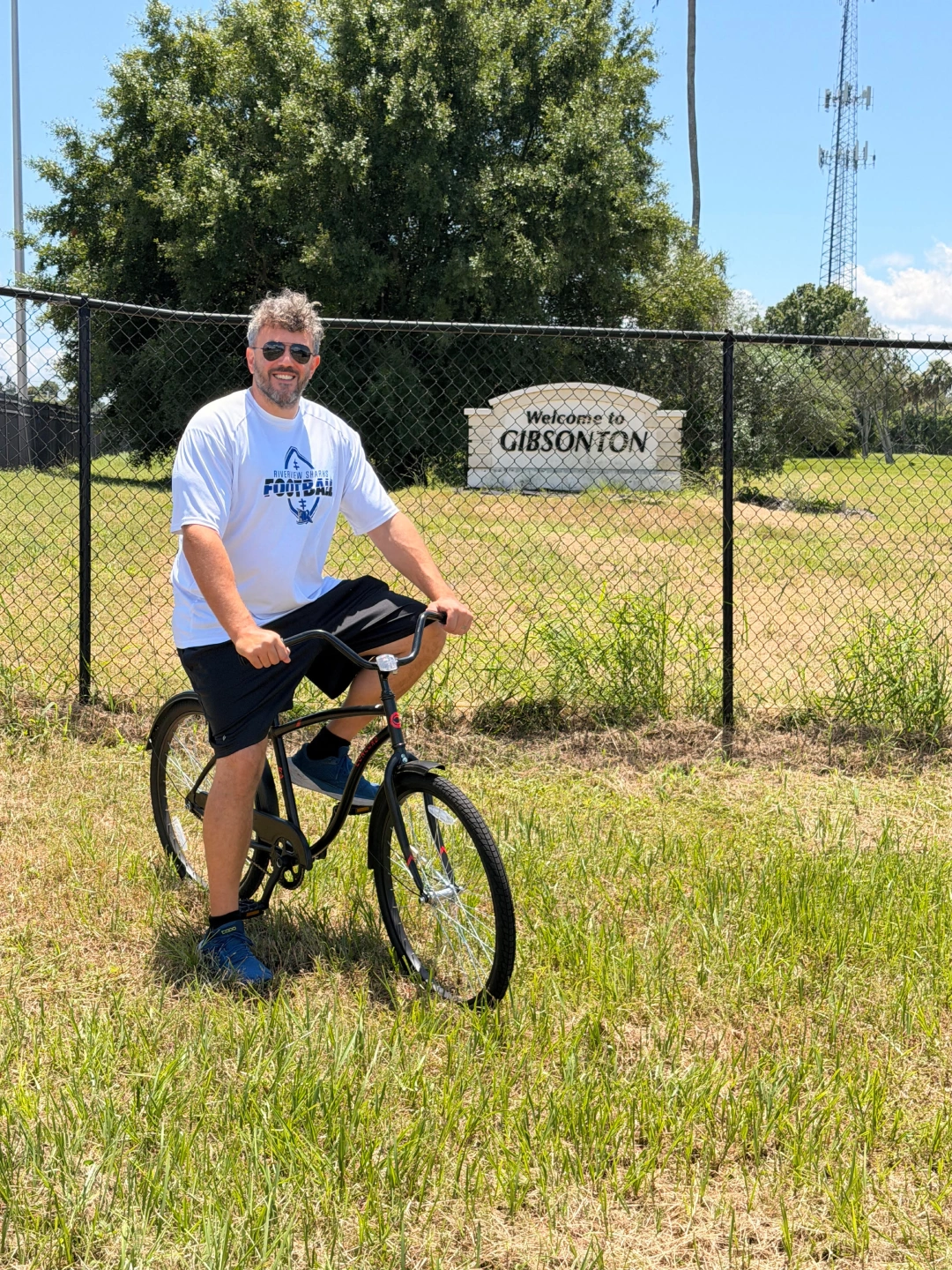
Frank Santini along U.S. 41 near Lula Street in Gibsonton. This section of U.S. 41 does not currently have a bicycle lane, but FDOT’s planned corridor improvements call for new bicycle facilities, including bike lanes and portions of the future South Coast Greenway.
Santini Personal Injury & Car Accident Law represents people injured in bicycle and e-bike crashes in Gibsonton and throughout South Hillsborough County. Attorney Frank Santini investigates the driver’s actions, the exact roadway and bicycle facility involved, available video and GPS evidence, the legal classification of an e-bike, and every potentially applicable insurance policy.
Through Santini Research, the firm’s public-safety research division, Santini has also analyzed Florida bicycle and e-bike crash trends. That research found that average annual bicycle injuries increased approximately 32% and fatalities nearly 47% when the 2022–2025 period was compared with the 2017–2019 pre-COVID baseline. Hillsborough County was among the larger counties showing an elevated or sharply rising fatality rate relative to its earlier baseline.
- Florida E-Bike Accident Lawyer — Florida e-bike classifications, riding laws, insurance and accident claims.
- Santini Research: FLHSMV Data Analysis — Bicycle Deaths Up Nearly 50% in Florida Since COVID
- Santini Research: Small Riders, Fast Machines — A Parent’s Guide to E-Bike Risks and Safer Riding
Two Gibsonton Corridors Identified for Bicycle and Pedestrian Crash Enforcement
Hillsborough County Sheriff’s Office (HCSO) has specifically identified portions of Gibsonton Road and U.S. 41 for enhanced bicycle and pedestrian enforcement.
In September 2023, HCSO announced that it was placing additional deputies on corridors with a “high occurrence of pedestrian and bicyclist crashes.” Two of the selected locations were Gibsonton Road from Massachusetts Street to Gloria Street and U.S. Highway 41 from Ohio Street to Gibsonton Drive. The same segments remained part of HCSO’s High Visibility Enforcement operation in 2024.
HCSO said deputies were watching motorists for speeding, improper turns, signal violations and handheld-device use, while also addressing bicycle violations such as wrong-way riding and inadequate nighttime lighting.
The fact that HCSO selected a corridor for enforcement does not establish fault in a particular crash. It does, however, provide meaningful local context. Following a serious bicycle or e-bike collision on one of these roads, the investigation should consider the exact intersection or driveway involved, vehicle and rider movements, sight lines, lighting, signal operation, prior crash information and any available surveillance footage.
U.S. 41 Through Gibsonton Is Being Redesigned for Bicycle and Pedestrian Travel
U.S. 41 is one of Gibsonton’s principal north-south roads, and its bicycle environment may change substantially in the coming years.
FDOT currently lists its approximately seven-mile U.S. 41 Project Development and Environment Study from Kracker Avenue to south of Causeway Boulevard as an active study. FDOT presented updated plans in January 2026 that include widening portions of U.S. 41 from four to six lanes, replacing the bridges over the Alafia River and Bullfrog Creek, making intersection improvements, and adding bicycle and pedestrian facilities.
FDOT’s 2026 draft engineering documents call for bicycle lanes and six-foot sidewalks throughout the preferred alternative. They also propose replacing the sidewalk with a shared-use path on portions of the west side of U.S. 41 from Symmes Road to Beach Avenue and from Lula Street to Old U.S. 41 to accommodate the future South Coast Greenway. The proposed Alafia River and Bullfrog Creek bridges would include a 12-foot shared-use path.
FDOT’s January 2026 South Coast Greenway map specifically identifies Gibsonton as one of the communities the proposed trail would connect and shows the trail interacting with U.S. 41 near the Alafia River/Williams Park Boat Ramp and Bullfrog Creek.
Gibsonton Roads Targeted for Bicycle and Pedestrian Safety Enforcement
The Hillsborough County Sheriff’s Office has repeatedly included portions of U.S. 41 and Gibsonton Drive in its High Visibility Enforcement program aimed at improving pedestrian and bicycle safety. Recent enforcement locations include U.S. 41 from Ohio Street to Gibsonton Drive and Gibsonton Drive from U.S. 41 to New East Bay Road.
A Proposed Bike Path Is Not the Same as the Road That Existed on the Crash Date
The FDOT plans are important, but they are proposed improvements. They should not be used to assume that a bike lane, shared-use path or particular crossing treatment existed when an earlier crash occurred.
That distinction can matter in an injury case. U.S. 41 is undergoing long-term planning and may eventually move through design and construction stages. Photographs taken months or years after a collision may show different pavement markings, signs, sidewalks, barriers or bicycle facilities. After a serious crash on a changing corridor, evidence should be preserved showing what actually existed on the date of the crash, including roadway photographs and video, construction or work-zone conditions, temporary striping and signs, GPS or ride-app data, traffic-control plans and the applicable FDOT project drawings.
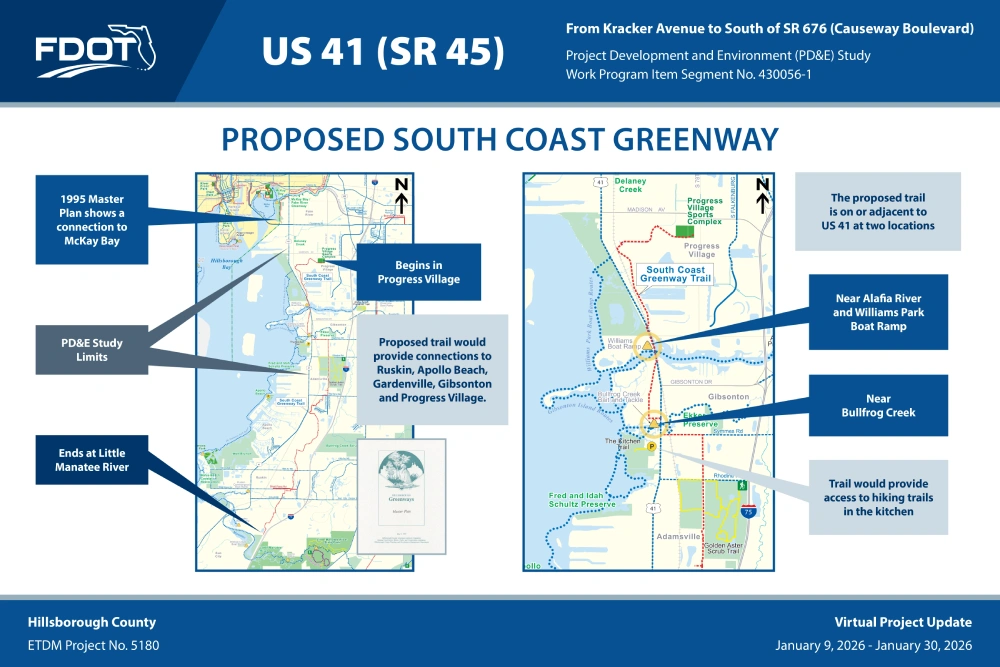
FDOT’s January 2026 U.S. 41 project materials show the proposed South Coast Greenway through Gibsonton, including planned connections near the Alafia River/Williams Park Boat Ramp and Bullfrog Creek.
When Is an E-Bike Legally a Bicycle in Gibsonton?
A bike being sold or advertised as an “e-bike” does not necessarily answer how Florida law classifies it.
Under Florida law, an electric bicycle must have fully operable pedals, a seat or saddle, and an electric motor of less than 750 watts. Class 1 provides pedal assistance up to 20 mph; Class 2 can propel the bike without pedaling but motor assistance must end at 20 mph; and Class 3 provides pedal assistance up to 28 mph.
A qualifying e-bike generally receives the rights and duties of a bicycle under Florida law and may be operated where bicycles are allowed, subject to particular local or agency restrictions. Florida law also requires the manufacturer’s label to identify the class, top assisted speed and motor wattage.
Classification becomes especially important after a crash involving a modified or high-powered device. Motor wattage, throttle operation, assisted speed, working pedals, the manufacturer’s label and any modifications should be documented before the bike is repaired, altered or discarded.
For a more detailed analysis of device classification, local riding rules and insurance coverage, see our Florida E-Bike Accident Lawyer guide.
Gibsonton E-Bike Rules Are Not the Same as Tampa City Rules
Gibsonton is part of unincorporated Hillsborough County, so a City of Tampa bicycle ordinance should not automatically be applied to a ride or crash simply because Gibsonton is part of the greater Tampa Bay area. The starting point is Florida traffic law, followed by any Hillsborough County or other agency rule governing the particular road, trail or property.
Those rules can also depend on where the bike is being ridden. For example, Hillsborough County’s Conservation & Environmental Lands Management Department currently permits Class 1 pedal-assist e-bikes in County parks but prohibits Class 2 and Class 3 e-bikes there. That is a rule for the County park system; it should not be misread as a countywide prohibition on Class 2 or Class 3 e-bikes on ordinary public roads.
Does PIP Cover a Gibsonton Bicycle or E-Bike Rider Hit by a Car?
PIP can cover a bicyclist who is struck by a motor vehicle in Florida. Florida’s Personal Injury Protection statute, Fla. Stat. § 627.736, expressly provides PIP benefits in certain circumstances to people injured by physical contact with a motor vehicle while they are not occupying a self-propelled vehicle.
Depending on the facts, coverage may come through the bicyclist’s own auto policy, a qualifying resident-relative household policy, or potentially the policy covering the vehicle that struck the bicyclist.
E-bike cases require an additional classification analysis. A qualifying Florida electric bicycle is treated as a bicycle under Chapter 316, but a modified or overpowered device may present a different PIP issue. The bike and all available policy documents should be reviewed before assuming that PIP either applies or does not apply.
FAQs About Gibsonton, FL Bicycle Accident Laws
Who Is Usually at Fault if a Bicycle Is Involved in an Accident?
In bicycle accidents, fault can depend on various factors, including the circumstances of the accident and the actions of both the cyclist and the motorist. If a driver fails to yield to a cyclist, runs a red light, or engages in reckless driving, they may be considered at fault. Cyclists also have responsibilities, such as following traffic laws and using designated bike lanes when available. Each accident is assessed on a case-by-case basis to determine liability.
What Is the Bicycle Law in Florida?
In Florida, bicycle laws require cyclists to adhere to the same traffic rules as motor vehicles. This includes obeying traffic signals, riding in the same direction as traffic, and using hand signals when turning. Cyclists must also wear helmets if they are under 16 years old. Florida law mandates that drivers maintain a safe distance of at least three feet when passing a cyclist.
What Happens if You Hit a Cyclist in Florida?
If you hit a cyclist in Florida, you must stop and provide assistance to the injured party, which may include calling for emergency services. Failing to do so can result in serious legal consequences. The incident should be reported to law enforcement, and an investigation will typically follow to determine liability. Depending on the circumstances, you may be subject to civil lawsuits or criminal charges, especially if negligence is involved.
Does PIP Cover Bicycle Accidents in Florida?
In Florida, personal injury protection (PIP) insurance generally covers medical expenses and lost wages for insured individuals involved in motor vehicle accidents, but it typically does not cover injuries sustained by cyclists.
If the cyclist has PIP coverage through their own auto insurance policy, they may be able to use it for their medical expenses following an accident. Cyclists should consider additional coverage options to protect themselves in the event of an accident.
Do I Always Have to Stay in a Bike Lane in Florida?
Florida law generally requires a bicyclist traveling slower than normal traffic to use an available bicycle lane, but the statute contains important exceptions. Fla. Stat. § 316.2065(5)(a) allows a rider to leave the bicycle lane when passing, preparing for a left turn, or when reasonably necessary to avoid a condition or potential conflict that makes remaining in the lane unsafe. The statute specifically identifies parked or moving vehicles, pedestrians, surface hazards, turn lanes and substandard-width lanes among the conditions that can make continued bike-lane travel unsafe.
That can become important after a crash if an insurer argues that the bicyclist was automatically negligent simply because the rider was outside the bike lane.
Schedule A Consultation
Fields marked with an * are required
Let Us Get You Started In The
Right Direction
Fields marked with an * are required
Riverview Office
7269 Bucks Ford Dr.
Riverview, FL 33578

Call Us Today 813-576-3209
Tampa Office
9270 Bay Plaza Blvd Suite 618
Tampa, FL 33619
© Copyright 2026 Santini Personal Injury & Car Accident Law. All Rights Reserved.
Disclaimer | Site Map | Privacy Policy
*Images are obtained under license from Canva and other third-party stock image providers, with attribution included where required.
Digital Marketing By 