
Small Riders, Fast Machines: A Parent’s Guide to E-Bike Risks and Safer Riding
Our Commitment To Excellence






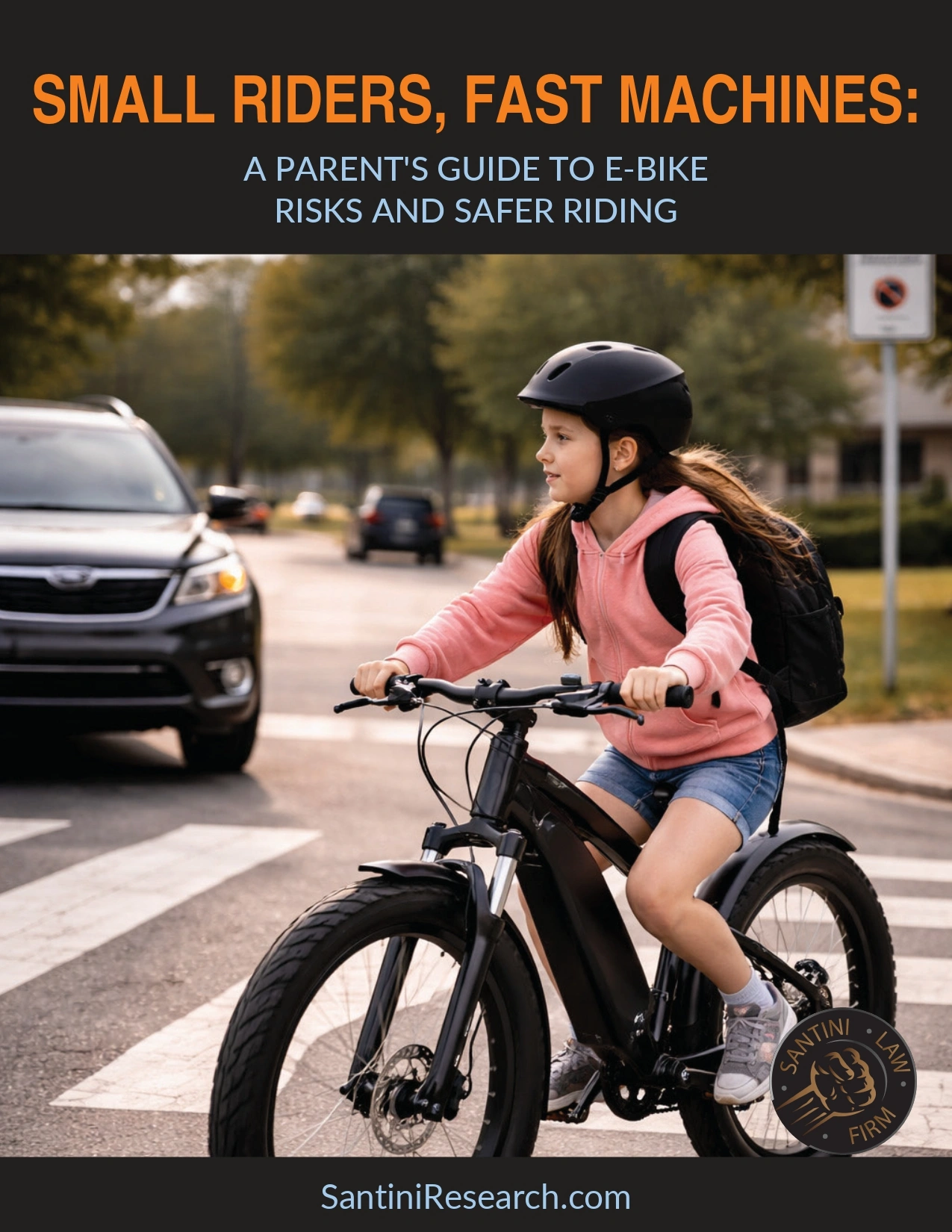
E-bikes are giving children and teenagers a new level of mobility, but the available safety data shows that the risks are not evenly distributed. Certain ages, behaviors, riding environments, and route choices repeatedly appear in the research as factors associated with greater injury risk.
Small Riders, Fast Machines reviews national injury tracking and published e-bike safety research to identify where those risks concentrate and, more importantly, what parents can do about them before a child rides.
The report examines injury trends, the heightened risk seen among younger riders, helmet use, distraction, risky group riding, mechanical problems, time spent riding, high-speed roads, poor pavement, intersections, and other conditions that can turn an ordinary neighborhood trip into a serious crash.
What the Available Data Says About E-Bike Injuries
E-bike use has expanded rapidly in the United States. A 2025 congressional safety briefing cited more than 1.7 million e-bikes sold in the United States in 2024, nearly a 75% increase from the prior year.
The injury trend has moved in the same direction.
U.S. Consumer Product Safety Commission tracking estimated approximately 360,800 emergency-department visits and 233 deaths involving micromobility products from 2017 through 2022. That broader category includes e-bikes, e-scooters, hoverboards, and related devices, so those totals should not be interpreted as e-bike injuries alone.
Looking specifically at e-bikes, the research reviewed by Santini Research identified more than 53,000 e-bike-related injuries between 2017 and 2022, with reported e-bike injuries increasing sharply between 2019 and 2022.
The national data is still incomplete, particularly as device types change faster than many crash-reporting systems. But there is already enough information to identify recurring patterns parents should understand.
Younger Riders Deserve Particular Attention
One of the clearest signals in the research is age.
Pediatric sources cited in the report identify ages 10 through 13 as an especially important injury group, with one source reporting that more than 44% of the e-bike injuries it examined occurred within that age range.
Broader Consumer Product Safety Commission micromobility data likewise found that children age 14 and younger accounted for approximately 36% of reported injuries while representing only about 18% of the U.S. population.
That does not create a universal age at which every child is or is not capable of riding an e-bike. It does mean parents should evaluate more than whether a child can physically operate the bike.
Traffic judgment, maturity, helmet habits, willingness to follow rules, ability to recognize vehicle conflicts, and the actual route the child will ride should all be part of the decision.
Some of the Biggest E-Bike Risks Are Behaviors Parents Can Influence
A major theme in the research is that injury risk is not determined by the machine alone.
The studies reviewed in Small Riders, Fast Machines identify several behaviors associated with sharply greater risk, including:
- Chasing other riders or playing around while riding
- Riding an e-bike with known mechanical problems
- Using a phone while riding
- Riding against traffic
- Running red lights or ignoring traffic controls
- Riding without a helmet
- Spending extended periods riding each day
One case-control study cited in the report found particularly large associations for behaviors such as playful or competitive riding, riding a mechanically compromised e-bike, phone use, and prolonged daily riding.
The practical message for parents is straightforward: some of the most dangerous variables are also among the most controllable.
Rules about helmets, phones, bike maintenance, group riding, traffic direction, and where a child may ride can materially change the environment in which that child is operating.
Where a Child Rides Can Matter as Much as How They Ride
The safest rider can still be placed in a dangerous situation by a bad route.
The research reviewed in the report points to recurring environmental concerns including:
- Higher-speed multi-lane roads
- Busy intersections
- Roads without meaningful separation for bicycle traffic
- Narrow shoulders
- Missing bicycle lanes
- Potholes and uneven pavement
- Poor visibility
- Routes that force children to mix closely with cars and trucks
A route that looks short on a map may be a poor choice for a young rider if it requires crossing a major arterial road, navigating several lanes of traffic, riding beside vehicles traveling 40 or 45 mph, or repeatedly entering conflict points at driveways and intersections.
Parents should evaluate the actual route, not just the destination.
Walking or riding that route with a child before allowing independent trips is one of the simplest ways to identify hazards that are easy to miss from inside a car.
The Sidewalk Is Not Automatically the Safe Answer
E-bike sidewalk laws vary by state and municipality, and parents should check the rules where their child actually rides.
But the safety problem exists regardless of the local legal framework.
A sidewalk may separate a child from fast-moving vehicles, but it also introduces pedestrians, driveways, intersections, limited sight distance, and other conflict points. Young riders should slow around pedestrians, yield, remain prepared to stop, and understand that drivers entering or leaving driveways may not expect a faster-moving bicycle.
If the only choices for a particular trip are weaving around pedestrians on a crowded sidewalk or riding beside 45-mph traffic on a multi-lane road, the better solution may be to change the route or the trip altogether.
The Five-Part Parent E-Bike Safety Check
Before a child rides independently, Santini Research recommends that parents evaluate five areas.
1. Age and Maturity
Do not base the decision solely on whether friends already have e-bikes. Consider whether the child consistently follows crossing rules, understands traffic, recognizes dangerous situations, and can be trusted to follow riding restrictions when an adult is not present.
2. The Actual Route
Walk, drive, or ride the route first. Look specifically for high-speed roads, multi-lane crossings, blind intersections, rough pavement, missing bicycle facilities, difficult driveways, and places where the rider must suddenly merge with vehicle traffic.
3. Helmet Use
Make helmet use a condition of riding rather than a suggestion.
A helmet cannot prevent every crash, but consistent helmet use removes one preventable variable from a situation in which young riders are already exposed to speed, traffic, and falls.
4. Screens, Stunts, and Group Behavior
Phones, racing, chasing, tricks, riding the wrong way, and similar behavior should be treated as violations of the family’s riding rules rather than harmless play.
5. Responsible-Rider Habits
Talk about the type of rider you expect the child to become.
The behavioral research reviewed in the report suggests that young riders’ attitudes toward risk and their own identity as responsible or irresponsible riders can influence the choices they make when adults are not watching.
What This Report Does, and Does Not, Measure
Small Riders, Fast Machines is a synthesis of existing injury tracking, safety reporting, pediatric information, and published e-bike and riding-behavior research. Santini Research did not create a new national e-bike crash database for this report.
That distinction matters because current e-bike safety data has limitations.
Some national datasets group e-bikes with other micromobility devices. Other studies examine particular hospitals, age groups, communities, or rider populations rather than every e-bike rider in the United States.
The purpose of this report is therefore not to claim a precise nationwide probability that a particular child will be injured. It is to identify recurring risk factors in the available evidence and translate those findings into practical decisions parents can make now.
Local and state e-bike laws also vary. This report addresses safety rather than providing a fifty-state statement of e-bike law.
Sources Used in the Report
- S. Consumer Product Safety Commission. (2023). Micromobility Products-Related Deaths,
Injuries, and Hazard Patterns, 2017–2022. https://www.cpsc.gov/s3fs-public/Micromobility-Products-Related-Deaths-Injuries-and-Hazard-Patterns_2017-2023.pdf
- Gottheimer, J. (2025). RELEASE: Gottheimer Announces New E-Bike Safety Plan to Protect
Children from Rise in E-Bike Accidents. U.S. House of Representatives. https://gottheimer.house.gov/posts/release-gottheimer-announces-new-e-bike-safety-plan-to-protect-children-from-rise-in-e-bike-accidents - Yang, H., Borhan, M. N., Ibrahim, A. N. H., & Ali, F. (2025). The Determinants of Two-Wheeled
Vehicle Riders’ Riding Behavior and Their Consequences: A Literature Review, Conceptual
E-TPB Model, and Research Agenda. https://www.researchgate.net/publication/393737391_The_Determinants_of_Two-wheeled_Vehicle_Riders’_Riding_Behaviour_and_Their_Consequences_A_Literature_Review_Conceptual_E-TPB_Model_and_Research_Agenda - Zhong, Z., Lin, Z., Li, L., & Wang, X. (2022). Risk Factors for Road-Traffic Injuries Associated
- with E-Bike: Case-Control and Case-Crossover Study. International Journal of Environmental
- Research and Public Health, 19, 5186. https://pubmed.ncbi.nlm.nih.gov/35564582/
- (2026). Common Causes Behind E-bike Fatalities According to US Statistics.
https://speedwaymedia.com/2026/01/21/common-causes-behind-e-bike-fatalities-according-to-us-statistics/ - Miller Children’s & Women’s Hospital. (2026). E-Bike Popularity and Safety Concerns for
Children and Teenagers. https://www.millerchildrens.memorialcare.org/blog/e-bike-popularity-and-safety-concerns-children-and-teenagers - Cherry, C. R., & MacArthur, J. H. (2019). E-bike safety: A review of empirical European and
North American studies. https://ipmba.org/images/uploads/EbikeSafety-VFinal.pdf
Related E-Bike Research and State-Specific Information
Related Santini Research
FLHSMV Data Analysis: Bicycle Deaths Up Nearly 50% in Florida Since COVID
For a Florida-specific data analysis, Santini Research examined FLHSMV bicycle injury and fatality records before and after COVID, finding statewide injuries up approximately 32% and fatalities up nearly 50%, with substantial differences among counties.
Florida E-Bike Law & Accident Resources
Florida E-Bike Law, Insurance and Accident Claims
Florida law treats e-bikes differently depending on the device’s specifications and legal classification. Santini Personal Injury & Car Accident Law’s Florida e-bike resource explains current e-bike classifications, riding rules, insurance issues, and accident claims, including situations where a device marketed as an “e-bike” may not legally qualify as one.
New Jersey E-Bike Law & Accident Resources
NJ E-Bike Law: What Parents and Riders Need to Know
New Jersey now regulates e-bikes far more strictly than many states. Under a law enacted in January 2026 and that took effect in July 2026, riders must be at least 15 and hold either an e-bike license or a valid driver’s license, and all e-bikes must be registered with the New Jersey Motor Vehicle Commission. E-bikes classified as “motorized bicycles” under New Jersey law also require insurance. Parents and riders should review New Jersey’s current requirements separately rather than assuming the rules that apply in another state will carry over.

Subscribe for Santini Research Reports

Call Us Today 888-645-3055
Riverview Office
7269 Bucks Ford Dr.
Riverview, FL 33578
Lehigh Valley Office
New Jersey & Pennsylvania
9 Hanover Street
Phillipsburg, NJ 08865
Tampa Office
9270 Bay Plaza Blvd Suite 618
Tampa, FL 33619
© Copyright 2026 Santini Personal Injury & Car Accident Law. All Rights Reserved.
Disclaimer | Site Map | Privacy Policy
*Images are obtained under license from Canva and other third-party stock image providers, with attribution included where required.
Digital Marketing By 