
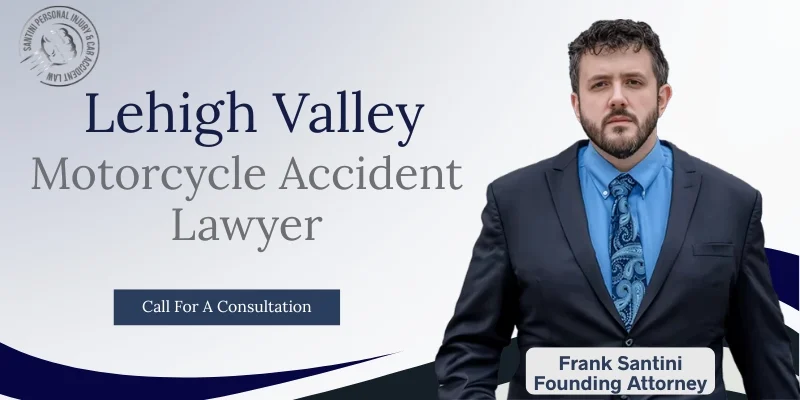
Lehigh Valley Motorcycle Accident Lawyer
Our Commitment To Excellence



Motorcycle Accident Attorneys Serving the Entire Lehigh Valley
Every spring, the first warm weekend brings thousands of motorcycles out onto the winding roads of the Lehigh Valley, through Wind Gap, along the Delaware River on Route 611, over Blue Mountain on Route 33, and down the busy commercial corridors of Route 22 and Route 248.
Riders know this region’s landscape by feel: the tight curves on River Road in Easton, the merge madness on I-78 near the Route 33 interchange, the unpredictable intersections along Nazareth Pike, and the stop-light gauntlet of William Penn Highway through Palmer Township and Bethlehem Township.
At Santini Personal Injury & Car Accident Law, we represent injured motorcyclists throughout Northampton County, Lehigh County, and across the Delaware River in Warren County and Hunterdon County, New Jersey. Our offices are situated just a bridge-crossing from Easton, in Phillipsburg, NJ, putting us at the heart of the PA/NJ border community that so many Lehigh Valley riders call home.
We are licensed to practice in both Pennsylvania and New Jersey, which matters enormously when your accident happened near the border or when the at-fault driver holds NJ insurance.
Motorcyclists are among the most vulnerable people on the road. You face the same risks as every other motorist, but you have none of the structural protection of a car or truck surrounding you. When a driver fails to see you, pulls out in front of you, cuts you off, or opens a door into your path, the results can be devastating: shattered bones, traumatic brain injuries, road rash that strips layers of skin, spinal cord damage, and worse. The at-fault driver’s insurance company will immediately begin working to minimize what they pay you. You need a lawyer who understands motorcycle dynamics, Pennsylvania and New Jersey accident law, and the unique bias that injured motorcyclists sometimes face from insurance adjusters who assume, wrongly, that riders are always ‘asking for it.’
It is important to recognize that not every minor motorcycle accident will need the involvement of an attorney. The critical question a motorcycle rider must ask himself or herself is whether the injuries sustained require medical treatment.
If medical treatment is needed, even if relatively trivial, a motorcyclist should at least seek a free consultation to understand their legal rights.
We are not a billboard law firm. We are a hands-on personal injury practice committed to knowing every detail of your case where you deal with the attorney directly, not some case manager.
If you or a loved one has been hurt in a motorcycle crash anywhere in the Lehigh Valley, whether it’s on Route 22, I-78, Route 309, Route 33, Route 191, or any back road in Northampton or Lehigh County, call SSantini Personal Injury & Car Accident Law today for a free, no-obligation consultation.
Motorcycle Accident Statistics: The Lehigh Valley & Pennsylvania
3,452
Motorcycle crashes in Pennsylvania in 2023 (PennDOT)
238
Motorcyclist fatalities in Pennsylvania in 2023 (PennDOT)
3×
Fatal weekend crashes in the Lehigh Valley in a single August 2024 weekend
These numbers are not abstractions. Behind each statistic is a rider who left the house looking forward to a day on the road, and returned to the hospital, or did not return at all. The Lehigh Valley has unique geography.
We have a dense urban and suburban core sandwiched between mountain ridges and the Delaware River. This geography creates a high concentration of traffic mixing large commercial vehicles, commuters, recreational riders, and pedestrians.
Route 22, which serves as the region’s commercial spine from Easton through Bethlehem and Allentown, is particularly dangerous for motorcyclists because this road alternates between limited-access highway and signalized surface arterial, causing driver confusion, aggressive lane changes, and rear-end crashes. Interstate 78 is obviously a hazardous major freight corridor with above-average truck volumes.
Tragically, a fatal crash involving a motorcyclist on I-78 in Lehigh County was reported as recently as late 2024. Route 33 between Easton and the Poconos is a high-speed corridor with curves and elevation changes that contribute to serious crashes, including those involving motorcycles.
If you were injured in a motorcycle crash on Route 22, I-78, or anywhere in the Lehigh Valley, call Santini Personal Injury & Car Accident Law today.
The Lehigh Valley Motorcycle Community
The Lehigh Valley is home to one of the most passionate motorcycle communities in the Mid-Atlantic. Every year, riders from Easton, Allentown, Bethlehem, Whitehall, Coopersburg, and across the Delaware in Phillipsburg, Washington, Belvidere, and Hackettstown converge for rides, rallies, and everything in between. This is a community built on camaraderie, freedom, and a love of the open road.
This is a community deserving of legal representation that truly understands and respects the riding culture.
Lehigh Valley Bike Fest at Keystone Harley-Davidson
One of the premier annual motorcycle events in eastern Pennsylvania, the Lehigh Valley Bike Fest is hosted by Keystone Harley-Davidson at 2800 Eberhart Road in Whitehall, PA. This free, multi-day celebration draws thousands of riders from across the Lehigh Valley and beyond, featuring professional stunt shows, live music, vendor booths, demo rides, food, and the unmistakable energy of the regional biker community. While Harleys are popular, Riders of every brand are welcome.
This event serves as a kickoff to the riding season each year. Beyond the Bike Fest, Keystone Harley-Davidson hosts weekly Bike Nights and seasonal events throughout the year.
Favorite Rider Gathering Spots
The Delaware River corridor offers well-known stops where riders gather before, during, and after a day’s ride. Riverside Barr & Grill on the banks of the Delaware in Easton is a longtime local landmark. It holds a special place in Attorney Santini’s heart as a place he frequented with friends and family over the years.
Motorcycles fill its parking lot on warm weekends, and the riverside atmosphere has made it a natural gathering point for riders crossing between Pennsylvania and New Jersey. The stretch of Route 611 heading north from Easton along the Delaware toward the Delaware Water Gap has long been a favorite Sunday morning cruise route.
Popular Motorcycle Routes Near Easton and the Lehigh Valley
- Delaware River Route (PA Route 611 North from Easton): This is a 55-mile corridor following the Delaware River north to the Delaware Water Gap. Riders pass through Riegelsville, Durham, and Kintnersville with river views, gentle curves, and relatively light traffic.
- Delaware Water Gap Loop (150 miles): Starting in Easton, this full-day loop takes riders through the Delaware Water Gap National Recreation Area, Worthington State Forest, and back through Milford. It is one of the most scenic rides in the region.
- Warren County Back Roads (NJ Side): From Phillipsburg, on Route 57 or Route 519 into the rolling hills of Warren County; these lightly traveled two-lane roads through farmland and small communities make for a beautiful ride.
A Note to Our Fellow Riders:
At Santini Personal Injury & Car Accident Law, we understand the Lehigh Valley riding community because we are part of it. We know these roads. We know these routes. We know the risks riders take every day, not because they are reckless, but because they love the ride. When an inattentive driver takes that away from you, we fight back.
Pennsylvania Motorcycle Law: What Every Lehigh Valley Rider Must Know
Pennsylvania motorcycle law is governed by Title 75 of the Pennsylvania Consolidated Statutes (the Vehicle Code) and a body of regulatory law codified at 67 Pa. Code.
Understanding these laws is critical because, in the aftermath of a crash, insurance companies and defense lawyers will use any violation of traffic law to argue that you were at fault.
Helmet Law Pennsylvania’s Partial Requirement
Pennsylvania has one of the most nuanced helmet laws in the nation. Under 75 Pa.C.S. § 3525, all riders under 21 years of age must wear a DOT-approved helmet at all times.
For riders aged 21 and older, helmet use is optional if the rider has held a valid motorcycle license for at least two years.
A rider can also avoid a helmet if he or she successfully completes a motorcycle safety course approved by PennDOT or the Motorcycle Safety Foundation (MSF). Riders who do not meet those criteria are still legally required to wear a helmet.
The helmet must meet U.S. Department of Transportation (DOT) standards and bear the DOT certification mark. Novelty helmets that look like helmets but lack structural protection do not satisfy the legal requirement.
Lane Splitting: Prohibited in Pennsylvania
Some riders enjoy lane splitting. For inexperienced riders reading this, lane splitting means riding between lanes of slow-moving or stopped traffic. But do not do it in Pennsylvania. It is illegal in Pennsylvania.
Pennsylvania’s Vehicle Code does not authorize motorcycles to travel between lanes. This prohibition applies on all roads including I-78, Route 22, and local streets. Lane splitting can be used by insurance companies to assign comparative fault to the motorcyclist in a crash. Pennsylvania does permit two motorcycles to share a lane (‘lane sharing’), but that is the limit.
Insurance Requirements: Motorcycles Are Excluded from PIP Benefits
Pennsylvania is a choice no-fault state for standard auto insurance, but motorcycles are explicitly excluded from the no-fault (Personal Injury Protection, or PIP) system. The term “no fault” is confusing and does not mean motorcycle riders cannot bring a claim against the other driver for their personal injury. It means that, If you are in a motorcycle accident, you cannot turn to your own auto insurance PIP coverage for medical bills.
You must pursue the at-fault driver’s liability insurance in a third-party claim. Of course, you would naturally want to bring a claim against the at-fault driver. Not having access to “no fault” / PIP just means motorcyclists won’t have the benefit of assistance with their initial medical bills immediately following an accident.
Pennsylvania requires minimum liability insurance of $15,000 per person / $30,000 per accident for bodily injury, and $5,000 for property damage. These minimums are often woefully inadequate for serious accidents. We strongly recommend all motorcyclists carry Underinsured/Uninsured Motorist (UM/UIM) coverage. This UM/UIM coverage protects you if the at-fault driver carries inadequate insurance or none at all.
Comparative Negligence in Pennsylvania
Pennsylvania follows a modified comparative negligence rule under 42 Pa.C.S. § 7102. This sounds complicated but, in basic language this means if you are found partially at fault, your damages (money recovered) are reduced proportionally.
You can still recover compensation as long as your share of fault does not exceed 50%.
But, if you are found to be 51% or more at fault, you are barred from recovering anything. Insurance adjusters routinely argue that riders share blame to reduce their payout. Our job as lawyers investigating motorcycle accidents is to investigate the facts, preserve evidence, and counter those arguments.
Right-of-Way and the Duty of Other Drivers
Under 75 Pa.C.S. § 3501, motorcycles have the same rights and are subject to the same duties as other vehicles on the road. Drivers of cars, trucks, and SUVs owe motorcyclists the same duty of care as other motorists. Failing to see a motorcycle is not a legal defense.
As discussed in more detail below, crashes where the at-fault drivers allegedly ‘Looked but failed to see’ a motorcycle are among the most common and devastating motorcycle accidents in the Lehigh Valley.
Pennsylvania vs. New Jersey Motorcycle Law: Key Differences
Because Santini Personal Injury & Car Accident Law is licensed in both Pennsylvania and New Jersey, we regularly handle motorcycle accident cases that cross state lines.
This includes accidents on the Easton-Phillipsburg bridges, on NJ Route 57 or Route 519 in Warren County, or anywhere in the Delaware Water Gap corridor. Knowing which state’s law applies and how those laws differ can make a significant difference in your case.
The most visible difference between the two states is the helmet law.
Pennsylvania takes the approach described above: riders 21 and older may ride without a helmet if they have held a valid motorcycle license for at least two full calendar years or have completed a PennDOT or Motorcycle Safety Foundation approved safety course.
New Jersey has no such graduated system. Every motorcycle operator and passenger in New Jersey must wear a DOT-approved helmet at all times, full stop, regardless of age, experience, or any other factor.
On insurance and fault, both states agree on one critical point: motorcycles are excluded from the no-fault Personal Injury Protection system that applies to standard automobiles. In other words, in both Pennsylvania and New Jersey, an injured motorcyclist cannot tap their own insurer’s PIP coverage for medical bills.
This makes having strong Uninsured/Underinsured Motorist coverage on your motorcycle policy especially important in both states.
Where the states diverge on insurance is in their required minimums. Pennsylvania mandates only $15,000 per person / $30,000 per accident in bodily injury liability, with $5,000 for property damage.
New Jersey’s minimums are substantially higher: $25,000 per person / $50,000 per accident in bodily injury, and $25,000 for property damage. For an injured rider, this means that an at-fault NJ driver’s policy is more likely to have meaningful coverage available.
Both Pennsylvania and New Jersey use the same modified comparative negligence standard. Under Pennsylvania’s 42 Pa.C.S. § 7102 and New Jersey’s N.J.S.A. 2A:15-5.1, a plaintiff can recover damages as long as their negligence was not greater than the negligence of the defendant. In practical terms, if a rider is found exactly 50% at fault, he or she can still recover. Compensation would be reduced by half. Recovery is only barred when the motorcyclist is more than half (51% or more) at fault.
Where the two states do differ meaningfully is in how aggressively insurance companies deploy comparative fault arguments against motorcyclists.
The difference between New Jersey and Pennsylvania is not just the presence of a helmet law, it’s how that law interacts with broader liability and damages rules. In New Jersey, the universal helmet requirement under N.J.S.A. 39:3-76.7 creates a clear legal duty for every rider to wear a helmet. Moreover, if a rider suffers head or brain injuries and was not wearing a helmet, courts and insurers will closely examine whether the lack of a helmet contributed to the severity of those injuries. This often involves expert analysis of how the crash occurred and whether a helmet would have reduced or prevented the injury. Examples of types of expert analysis include biomechanical and medical causation experts retained by the defense.
If so, a jury may reduce the rider’s damages proportionally, even if the rider was not at fault at all for causing the accident. In practice, this turns helmet non-use into a powerful defense tool, particularly in cases involving head or brain injuries. This law gives insurers a credible, expert-supported argument to cut down the value of a claim.
By contrast, Pennsylvania takes a more limited approach. While Pennsylvania has its own helmet law under 75 Pa.C.S. § 3525 and follows a similar modified comparative negligence rule under 42 Pa.C.S. § 7102, helmet non-use is generally not used in the same way to reduce damages.
That removes a major line of attack available in New Jersey and confines most disputes to how the crash occurred.
This means the motorcyclist can be attacked on issues like speed, lane position, and reaction time, but can’t be attacked as easily on the helmet issue. The result is a meaningful practical difference: in New Jersey, insurers have multiple, overlapping ways to reduce a motorcyclist’s recovery, while in Pennsylvania, their arguments are more constrained and focused on fault for the collision itself.
Both states set the same two-year statute of limitations for motorcycle accident personal injury claims, which is two years from the date of the accident under 42 Pa.C.S. § 5524 in Pennsylvania and N.J.S.A. 2A:14-2 in New Jersey.
Cross-Border Note:
If your accident happened on the Easton-Phillipsburg bridge, on the NJ approach to the Delaware River crossings, or anywhere in Warren County, NJ, we can handle your case. You do not need separate lawyers for each state. Santini Personal Injury & Car Accident Law is admitted to the state bar in both Pennsylvania and New Jersey.
A Real Case: Gas Station Pull-Out on a Major Lehigh Valley Arterial Road
SANTINI PERSONAL INJURY & CAR ACCIDENT LAW CLIENT CASE
Our client, an experienced motorcyclist, was traveling along a major arterial roadway on a clear afternoon. He was riding at the posted speed limit, properly licensed, wearing protective gear, and operating his motorcycle in full compliance with the law.
Without warning, a driver who had been parked at a gas station along the road pulled out of the gas station driveway and cut directly across our client’s lane of travel. The driver made no attempt to yield and apparently never looked for oncoming traffic. Our client had a fraction of a second to react. With no time to brake safely and with the car blocking the road ahead of him, he made the split-second decision to dump his motorcycle. For our reader who are not familiar with this term, “dumping” means deliberately laying the bike down on its side in order to avoid a direct high-speed collision. It was the right call in a desperate moment.
The motorcycle went down. Our client’s leg caught beneath the bike and was twisted violently as it skidded along the pavement. He was transported by ambulance to an area hospital, where imaging revealed significant damage to his knee, a complex injury requiring surgical intervention. He underwent knee surgery, followed by months of rehabilitation, physical therapy, and a long and painful return to normal activity. He missed substantial time from work as a construction worker and incurred significant medical bills.
Santini Personal Injury & Car Accident Law, working in tandem with another law firm, retained an accident reconstruction expert, gathered surveillance footage, obtained witness statements, and documented every aspect of our client’s medical treatment, recovery, and financial losses. The result: a confidential settlement was obtained against the at-fault driver, providing meaningful compensation for his medical expenses, lost wages, pain and suffering, and the lasting impact on his quality of life.
This case illustrates one of the most common and deadly motorcycle crash patterns in the Lehigh Valley: the driveway or intersection pull-out. The Lehigh Valley’s commercial corridors include Route 22 through Palmer Township, Lehigh Street through Allentown, Easton Avenue in Bethlehem, Route 248 through Tatamy and Nazareth, and William Penn Highway through Forks Township. These corridors are lined with gas stations, shopping centers, fast food restaurants, and commercial properties whose driveways are constant sources of hazard for motorcycle riders fearful of distracted drivers.
Drivers pulling out of these driveways are often focused on oncoming car traffic and simply do not see a motorcycle, or do not register it as a threat until it is too late. The ‘looked but failed to see’ phenomenon is well-documented in traffic safety research: drivers’ brains may literally not process the motorcycle as a vehicle threat even when it is in their direct line of sight. This cognitive failure has devastating real-world consequences for Lehigh Valley motorcyclists every riding season.
Hypothetical Motorcycle Accident Scenarios in the Lehigh Valley
Understanding how motorcycle accident cases actually develop as they progress from crash to compensation can help injured riders know what to expect. The following scenarios are hypothetical illustrations based on common crash patterns in the Lehigh Valley. They are not descriptions of specific past clients.
Scenario 1: Left-Turn Crash at a Nazareth Intersection
A motorcyclist is heading north on Route 191 through Nazareth on a Saturday afternoon, traveling at the speed limit in clear, dry conditions. As she approaches a signalized intersection near Nazareth Borough, an SUV driver heading southbound begins a left turn across traffic into a side street. The driver later states he ‘didn’t see’ the motorcycle. The rider has less than a second to react; she brakes hard but cannot stop in time and strikes the left side of the SUV at approximately 25 mph. She is thrown from the motorcycle, suffering a fractured collarbone, fractured wrist, and severe road rash. She is airlifted to Lehigh Valley Hospital Cedar Crest.
Legal Analysis: The turning driver has an absolute duty to yield to oncoming traffic before completing a left turn (75 Pa.C.S. § 3322). ‘I didn’t see her’ is not a defense. Accident reconstruction focuses on the motorcycle’s speed (was the motorcyclist within the limit? What does the GPS data show?), the driver’s sight lines, and approach duration. Damages, meaning the total compensation that can be recovered by the motorcycle rider, include reimbursement for the cost of the emergency transport, surgery, hospitalization, months of physical therapy, lost wages, and, most importantly, pain and suffering.
Scenario 2: Highway Merge Crash on Route 22 Near Easton
A motorcyclist is traveling westbound on Route 22 through Williams Township, approaching the interchange with Route 33. A pickup truck driver, merging from the Route 33 on-ramp, accelerates aggressively and changes lanes without checking his mirror. He moves directly into the lane occupied by the motorcyclist. The motorcyclist has no room to swerve left (concrete median barrier) and brakes hard, but the truck clips the front of the motorcycle. The bike crashes. The rider slides 80 feet across the asphalt, suffering a traumatic brain injury, multiple broken ribs, a punctured lung, and a severely lacerated right arm requiring surgery.
Legal Analysis: Under 75 Pa.C.S. § 3313, no driver may move from one lane to another unless it can be done safely. The motorcyclist has no fault. The case involves detailed crash reconstruction, ECM data from the pickup truck, witness statements, and cell phone records. Given the TBI (traumatic brain injury) severity, damages include future medical costs, future lost earning capacity, and substantial pain and suffering, typically requiring litigation to achieve full value.
Scenario 3: Door Prize on a Bethlehem City Street
A motorcyclist is riding through South Bethlehem, near Lehigh University. A driver parallel-parked along the right side of the street opens his door suddenly without checking for traffic. The rider, traveling at approximately 20 mph, cannot stop in time. The door catches the handlebars and throws the rider forward and to the right. He suffers a dislocated shoulder, a concussion, and multiple abrasions. His motorcycle sustains significant damage to the fairing, forks, and handlebars.
Legal Analysis: Under 75 Pa.C.S. § 3705, no person shall open any door of a motor vehicle unless it is reasonably safe and will not interfere with traffic. The dooring driver is clearly liable. Challenges include the driver’s low property damage limits and potential disputes over medical coverage. Documentation of emergency care, concussion symptoms, shoulder treatment, and economic impact (motorcyclist is a contractor unable to work for three months) is essential to maximizing recovery.
Scenario 4: Rear-End Crash at a Light on William Penn Highway
A motorcyclist is stopped at a red light on William Penn Highway in Palmer Township. A distracted driver in a sedan who is looking at his phone fails to notice that traffic has stopped. He strikes the motorcycle from behind at approximately 35 mph without braking. The impact launches the rider into the intersection where she is struck by a second vehicle. She suffers bilateral femur fractures, a fractured pelvis, severe spinal contusion, and is intubated at the scene.
Legal Analysis: Cell phone records subpoenaed from the carrier showing active phone use at impact, dash cam footage, and ECM data (showing absence of pre-impact braking) prove distracted driving. Given the catastrophic injuries, a life care plan prepared by a medical expert calculates future care needs. This case illustrates why UM/UIM coverage is critical: when a driver causes catastrophic harm with minimum insurance, your own policy may bridge the gap to adequate compensation.
Scenario 5: Drunk Driver Crash on Route 611 North of Easton
Two motorcyclists are riding northbound on Route 611 along the Delaware River, returning to Easton after a scenic afternoon ride. A driver heading southbound with a blood alcohol content of .14%, which is nearly twice the legal limit, crosses the center line on a curve just north of Riegelsville. One of the motorcyclists is struck head-on. He sustains catastrophic injuries including a ruptured spleen, severe traumatic brain injury, multiple fractures, and internal bleeding. He is comatose for eleven days and requires care for the rest of his life.
Legal Analysis: In addition to the drunk driver’s liability insurance, this case potentially involves a dram shop claim under Pennsylvania’s Dram Shop Act (47 P.S. § 4-497) against any licensed establishment that served the driver when visibly intoxicated. Punitive damages may be available given the egregious nature of drunk driving. The life care plan for a catastrophically brain-injured rider can project millions of dollars in future care. Every available source of recovery is pursued aggressively.
Scenario 6: Defective Road Condition: Pothole Crash in Northampton County
A motorcyclist is riding on a Northampton County secondary road in spring. She strikes a large, unmarked pothole at approximately 40 mph. The front wheel drops into the hole, the handlebars are ripped from her grip, and she is thrown over the front of the motorcycle. She suffers a broken nose, fractured orbital bone, shoulder injuries, and road rash. The pothole had reportedly been reported to the county on multiple prior occasions without repair.
Legal Analysis: This case involves governmental liability under Pennsylvania’s Political Subdivision Tort Claims Act (42 Pa.C.S. §§ 8541-8542). A successful pothole claim requires proving the government entity had notice of the defect and failed to remedy it in a reasonable time. Documentation of prior complaints, work orders, and maintenance records, which would be obtained through court-ordered discovery, is critical. The driver’s attorney must immediately obtain scene documentation (GPS coordinates, photos before the pothole is patched).
What to Do After a Motorcycle Accident in the Lehigh Valley
The minutes and hours after a motorcycle crash can be chaotic, painful, and frightening. Taking the right steps in these difficult times can make an enormous difference in the strength of your legal case. Here is what we advise every motorcyclist to do, to the extent their injuries allow:
- Call 911 immediately. Even if you believe your injuries are minor, call police. A police report creates an official record, records the other driver’s information, and documents evidence (skid marks, vehicle positions, witness statements) before they disappear. Never leave the scene before police arrive.
- Get medical attention right away even if you ‘feel okay.’ Adrenaline masks pain. Concussions, internal injuries, and soft tissue damage may not be immediately apparent. Going to the ER or urgent care immediately creates a medical record linking your injuries to the crash. Delays give insurance companies ammunition to argue you were not actually hurt.
- Document the scene. Photograph crash location, vehicle positions, road conditions, skid marks, debris, vehicle damage, and visible injuries. Get names and contact information for witnesses. Note traffic camera locations because footage is often overwritten within days.
- Exchange information. Obtain the other driver’s name, address, driver’s license number, vehicle registration, and insurance information. Do not apologize, discuss fault, or give statements about how the accident happened.
- Report to your insurer, but be careful what you say. You are generally contractually obligated to notify your insurer. However, you are NOT required to give a recorded statement to the other driver’s insurance company, and you should not do so before speaking with a lawyer.
- Contact a motorcycle accident attorney as soon as possible. Evidence disappears quickly. Surveillance footage is erased. Witnesses forget. Vehicles are repaired. The sooner you engage an attorney, the sooner we can preserve the evidence you need.
- Do not post about the accident on social media. Insurance companies and defense lawyers routinely monitor social media for photos, statements, or check-ins that can be used to dispute your injuries or undermine your credibility.
What Compensation Can You Recover?
Economic Damages
Economic damages are those that can be documented and calculated with relative precision. In a serious motorcycle accident, these often include:
- Past medical expenses: Emergency room care, ambulance transport, hospitalization, surgery, ICU care, imaging, prescription medications, and medical equipment.
- Future medical expenses: Follow-up surgeries, long-term physical therapy, pain management, future medications, and in catastrophic cases, lifetime nursing or attendant care, calculated through a Life Care Plan.
- Lost wages: Income lost while unable to work during recovery, whether days, weeks, or months.
- Lost earning capacity: If injuries permanently diminish your ability to work at the same level or in the same occupation, an economic expert calculates the present value of that future lost income.
- Motorcycle damage and property losses: Cost to repair or replace your motorcycle, riding gear (helmet, jacket, boots, gloves), and other personal property damaged in the crash.
Non-Economic Damages
- Pain and suffering: Physical pain during and after the crash, through surgery and recovery, and any chronic pain that persists.
- Emotional distress: Anxiety, depression, PTSD, and other psychological consequences of a traumatic crash.
- Loss of enjoyment of life: Inability to engage in activities and hobbies you loved before the accident, including riding itself.
- Scarring and disfigurement: Road rash can leave significant, permanent scarring. Surgical scars, amputations, and other disfiguring injuries carry additional non-economic value.
- Loss of consortium: A spouse of a seriously injured person may have a claim for loss of companionship, support, and intimacy.
Punitive Damages
In cases involving outrageous or reckless conduct such as drunk driving, street racing, or an employer who knowingly put an unqualified driver on the road, then punitive damages may be available under both Pennsylvania and New Jersey law. These damages are designed to punish the wrongdoer and deter future conduct; they are awarded in addition to compensatory damages and can be substantial.
Common Causes of Motorcycle Accidents in the Lehigh Valley
Distracted Driving
Distracted driving is now the leading cause of motor vehicle accidents in Pennsylvania and New Jersey. Smartphones are the primary reason for distracted driving. Motorcycles are particularly vulnerable to distracted drivers who are not scanning the full roadway. A driver texting or scrolling at 45 mph on Route 248 or William Penn Highway may travel the length of a football field without eyes on the road.
Failure to Yield at Intersections and Driveways
Left-turn crashes at intersections and pull-out crashes from driveways, parking lots, and gas stations are among the most common and most deadly motorcycle accident types in the Lehigh Valley. Drivers often look for cars but fail to register motorcycles.
Speeding and Aggressive Driving
Route 22 and Interstate 78 are notorious for aggressive driving and speeding, with commercial truck traffic adding to the hazard. Excessive speed dramatically increases the severity of impact when crashes occur and reduces reaction time for all parties.
Impaired Driving
Drunk and drugged driving remains a significant cause of serious motorcycle accidents, particularly on weekends and evenings along Route 611, Route 22, and the entertainment corridors of Allentown’s Hamilton Street, South Bethlehem, and Third Street in Easton.
Poor Road Conditions
Pennsylvania’s roads are notoriously affected by freeze-thaw cycle damage each winter and spring. Potholes, frost heaves, sand and gravel at intersections, and railroad crossings can destabilize a motorcycle. Road debris from commercial traffic (blown truck tires, cargo spills, loose gravel from dump trucks) on Route 22 and I-78 is a serious hazard at highway speed.
Dooring in Urban Areas
In Allentown, Bethlehem, and Easton’s urban cores on streets like Hamilton Street, Third and Northampton Streets in Easton, and New Street in Bethlehem, motorcyclists traveling near parallel-parked vehicles face the risk of a door being opened into their path without warning. Pennsylvania law (75 Pa.C.S. § 3705) prohibits this conduct, but it remains a common cause of crashes.
Frequently Asked Questions
How long do I have to file a motorcycle accident lawsuit in Pennsylvania?
Pennsylvania’s statute of limitations for personal injury claims is two years from the date of the accident (42 Pa.C.S. § 5524). In New Jersey, the same two-year period applies (N.J.S.A. 2A:14-2). Missing this deadline almost always means losing your right to sue forever. Contact Santini Personal Injury & Car Accident Law as soon as possible to protect your rights.
What if I wasn’t wearing a helmet? Does that bar my claim?
In Pennsylvania, if you were legally permitted to ride without a helmet, your helmet-free status does not automatically reduce your damages for injuries that were not head-related. Even for head injuries, Pennsylvania law does not automatically bar a helmetless rider’s claim. It may be raised as a comparative negligence argument, but it is not an automatic bar. In New Jersey, the analysis differs because NJ requires all riders to wear helmets. In either state, we will develop the best possible argument to protect your recovery.
The other driver’s insurance company contacted me. Should I give a recorded statement?
No. You are not legally required to give a recorded statement to the at-fault driver’s insurance company, and doing so before retaining a lawyer is almost always a mistake. Insurance adjusters are trained to ask questions designed to minimize your claim. Contact us before speaking to any insurance adjuster other than your own.
What if the at-fault driver was uninsured?
Recovery depends on whether you carry Uninsured Motorist (UM) coverage on your motorcycle policy. If you do, your own insurance steps in to compensate you up to your policy limits as if it were the at-fault driver’s insurance. If you carry Underinsured Motorist (UIM) coverage, it can bridge the gap when the at-fault driver’s limits are insufficient. We strongly recommend all motorcyclists carry UM/UIM coverage.
Do I need a lawyer if the accident was clearly the other driver’s fault?
Yes. Even in cases where liability seems obvious, insurance companies have teams of adjusters and lawyers whose job is to minimize what they pay. They argue pre-existing conditions, excessive treatment, inflated non-economic damages, and more. Without an experienced attorney who knows how to value motorcycle cases, you are almost certainly going to receive less than you deserve.
Why Choose Santini Personal Injury & Car Accident Law?
Licensed in Both Pennsylvania and New Jersey
Many personal injury firms in the Lehigh Valley are licensed only in Pennsylvania. Because our practice is licensed in both PA and NJ, we can represent you regardless of which side of the Delaware River your accident occurred on. This is particularly important for Lehigh Valley riders who frequently cross into Warren County or Hunterdon County for recreational riding or commuting.
Conveniently Located Near Easton and Phillipsburg
Our offices are located in Phillipsburg, NJ, just across the Delaware River from Easton. This places us at the center of the PA/NJ border community. We serve clients throughout Northampton County (Easton, Bethlehem Township, Palmer Township, Forks Township, Nazareth, Bath, Wind Gap, Bangor, Portland, Delaware Water Gap), Lehigh County (Allentown, Bethlehem, Whitehall, Emmaus, Macungie, Coopersburg, Slatington), Warren County, NJ (Phillipsburg, Washington, Belvidere, Hackettstown), and beyond.
No Fee Unless We Win
We handle all motorcycle accident cases on a contingency fee basis. You pay absolutely nothing unless and until we recover compensation for you. There is no retainer, no hourly billing, and no out-of-pocket cost for our legal fees. If we do not win, you owe us nothing.
Hands-On, Personal Representation
We are not a billboard law firm. When you hire Santini Personal Injury & Car Accident Law, you get personal, hands-on representation from attorneys who know your case. We investigate crashes thoroughly, retain qualified experts (accident reconstructionists, medical experts, economic experts, life care planners), and communicate with you regularly throughout the process. We prepare every case for trial because insurance companies know which firms are willing to go to a jury, and those are the firms that achieve the best settlements.
Understanding of Motorcycle Dynamics and Rider Perspective
We understand the mechanics of motorcycle crashes. We examine details like how bikes respond to emergency braking, what causes low-side and high-side falls, what ‘dumping the bike’ means and why it is sometimes the best choice, how road surface conditions affect motorcycle stability differently than automobiles. We fight the bias that injured motorcyclists sometimes face from insurance adjusters with facts, expert testimony, and thorough knowledge of PA and NJ motor vehicle law.
Injured in a Lehigh Valley Motorcycle Accident? We Are Ready to Fight for You.
Santini Personal Injury & Car Accident Law represents injured motorcyclists throughout Northampton County, Lehigh County, and Warren County, NJ. Call or contact us today for your free, confidential consultation. Licensed in PA and NJ. No fee unless we win.
Call for a Free Consultation | (610) 462-6507
The information on this page is for general informational purposes only and does not constitute legal advice. Reading this document does not create an attorney-client relationship. Past results do not guarantee future outcomes. Every case is different. © 2026 Santini Personal Injury & Car Accident Law. All rights reserved.
Schedule A Consultation
Fields marked with an * are required
Let Us Get You Started In The
Right Direction
Fields marked with an * are required
Santini Personal Injury
& Car Accident Law
7269 Bucks Ford Dr.
Riverview, FL 33578

Call Us Today 908-329-2003
Santini Personal Injury
& Car Accident Law
9 Hanover Street
Phillipsburg, NJ 08865
© Copyright 2026 Santini Personal Injury & Car Accident Law. All Rights Reserved.
Disclaimer | Site Map | Privacy Policy
*Images are obtained under license from Canva and other third-party stock image providers, with attribution included where required.
Digital Marketing By 