
$225,000 Recovery After Abbottstown Crash Caused Complex Forearm Fractures and Career Losses

Last Updated: July 31, 2026
Our Commitment To Excellence






Two northbound vehicles had stopped on Abbottstown Pike to allow our client to pass. Instead of waiting behind them, a teenage driver pulled around the stopped traffic, crossed the double yellow lines, and attempted to turn left across our client’s lane.
Within seconds, both bones of our client’s right forearm had been fractured at three distinct locations. One fracture occurred beside a plate implanted during an unrelated surgery more than a decade earlier. He required revision surgery and multiple plates and screws at Penn State Health Milton S. Hershey Medical Center, developed painful clear and blood-filled fracture blisters, endured difficult physical therapy, and ultimately had to leave the hands-on hospital security position he had once loved.
The at-fault driver had only $25,000 in bodily injury liability coverage. Fortunately, our client had purchased $200,000 in underinsured motorist coverage before the collision.
Santini Personal Injury & Car Accident Law recovered both available policy limits for a total settlement of $225,000.
Case Result at a Glance
Total recovery: $225,000
At-fault liability coverage: $25,000 policy limit
Underinsured motorist recovery: $200,000 policy limit
Crash location: Abbottstown Pike near Racetrack Road, Berwick Township, Adams County, Pennsylvania
Crash type: Left-turn and improper lane-movement collision
Primary injuries: Displaced peri-implant radius fracture and displaced, comminuted segmental ulna fracture
Surgery: Revision ORIF of the distal radius and ORIF of the segmental ulna using plates and screws
Hospital: Penn State Health Milton S. Hershey Medical Center
Employment impact: Short-term disability, depleted paid leave, reassignment from security officer to security dispatch monitor, reduced compensation, and diminished advancement opportunities
Attorney: Frank Santini
Case-specific result: This recovery reflects the unique facts, injuries, insurance coverage, and collectible assets available in this matter. Past results do not guarantee a similar result.
A Teenage Driver Moved Around Stopped Traffic and Turned Across Our Client’s Lane
The collision occurred on a clear Saturday afternoon near Abbottstown, along the York–Gettysburg corridor in Adams County.
Our client was traveling south on Abbottstown Pike near Racetrack Road in Berwick Township. The weather was clear, the roadway was dry, and the crash occurred in daylight. There was no road defect, mechanical failure, or poor weather condition that caused the collision.
Northbound traffic had stopped to yield to our client because he had the right of way.
The teenage driver told the investigating Pennsylvania State Police trooper that two vehicles ahead of him had turned left onto Racetrack Road and that he attempted to make the same turn behind them. Our client described a different and more specific sequence: northbound traffic had stopped to yield to him, but the teenage driver pulled around a stationary vehicle, crossed the double yellow lines, and attempted to turn left directly across his southbound lane.
Our client reported that the young driver pulled from behind a stopped vehicle, crossed the double yellow lines, overtook the traffic that was yielding, and continued into the left turn directly across his path.
Our client had no meaningful opportunity to avoid the collision.
The vehicles collided at an angle that was effectively nearly head-on. Both sustained disabling front-end damage and had to be towed from the scene. The Pennsylvania State Police identified the young driver’s action as careless passing or lane changing, listed driver action as the primary cause, and recorded no contributing action by our client. The other driver was cited under Pennsylvania’s lane-movement statute.
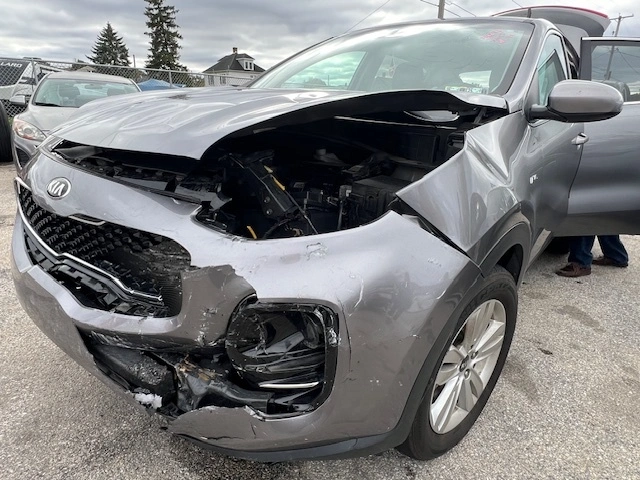
Our client’s vehicle after the Abbottstown Pike collision. Pennsylvania State Police documented disabling damage to both vehicles.
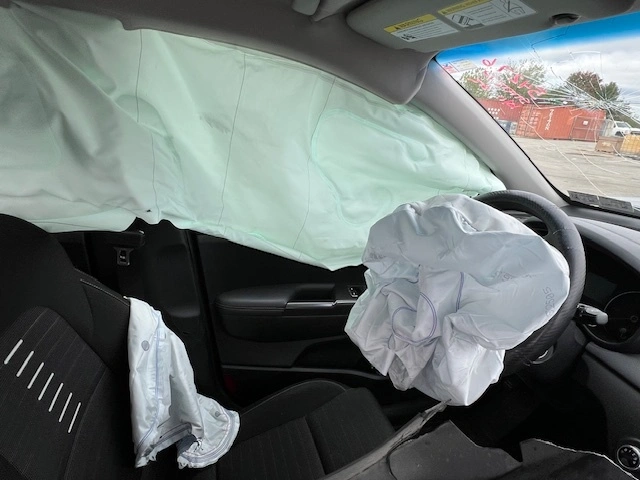
Deployed airbags inside our client’s vehicle after the Abbottstown Pike collision. The crash caused disabling damage to both vehicles and serious fractures of the client’s right forearm.
The Pennsylvania State Police Diagram Shows the Collision Sequence
The crash diagram helps explain why our client could not avoid the impact. It depicts our client traveling south on Abbottstown Pike while the other vehicle moved from the northbound side of the road toward the left turn onto Racetrack Road.
The accompanying police narrative records that the other driver moved around stationary traffic, crossed the center lines, and entered our client’s path.
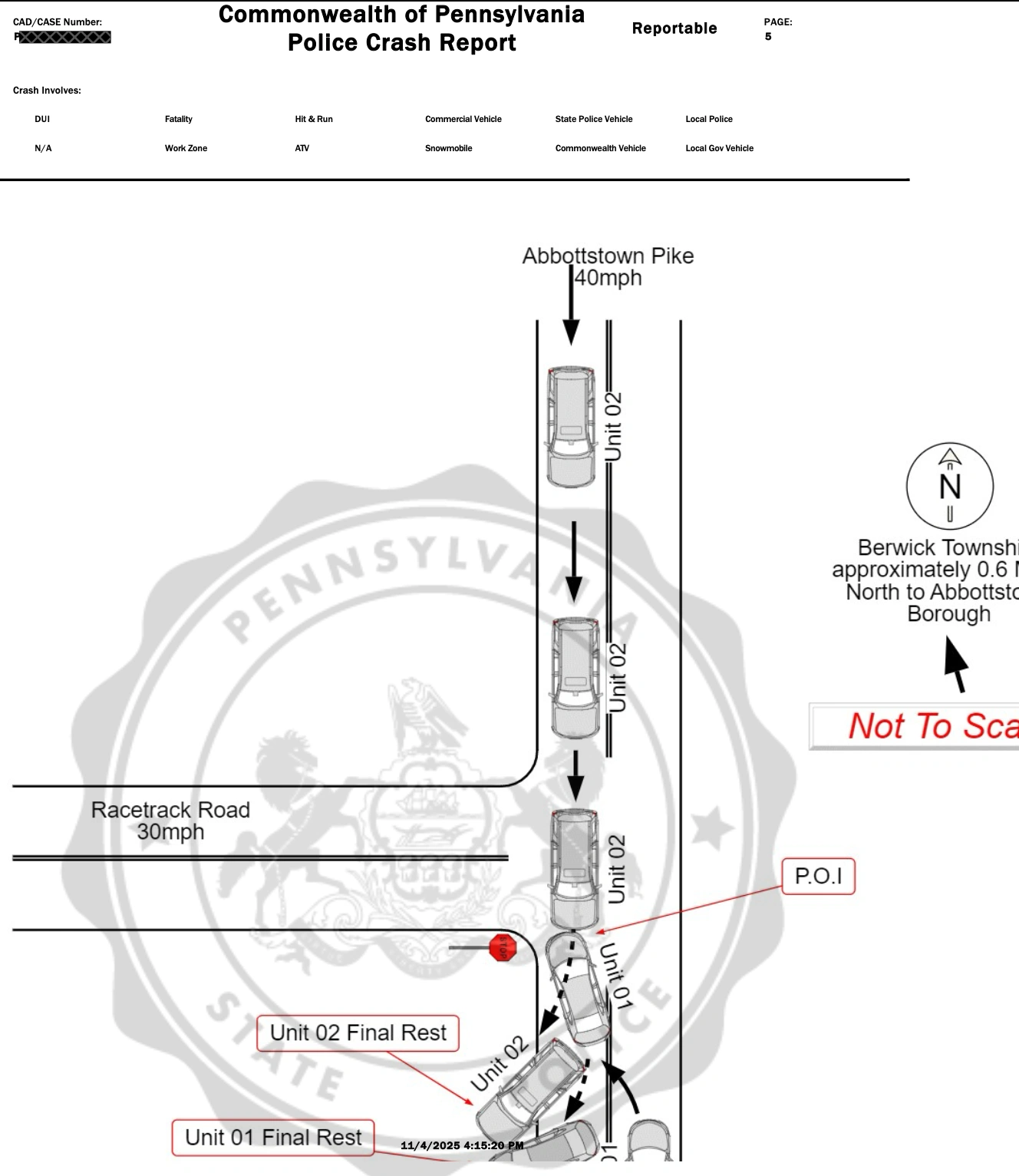
The redacted Pennsylvania State Police crash diagram shows our client traveling south on Abbottstown Pike as the other driver attempted to turn left onto Racetrack Road across his path.
The Initial “Minor Injury” Classification Did Not Reflect the Actual Damage
Adams Regional EMS transported our client to Hanover Hospital. The crash report initially classified his condition as a “suspected minor injury.”
That preliminary police classification did not come close to describing what diagnostic imaging ultimately revealed.
Police officers must complete crash reports before the full course of hospital imaging, orthopedic evaluation, surgery, and rehabilitation is known. In this case, the medical evidence established that the collision had caused complex fractures of both bones of our client’s right forearm.
He had not suffered an ordinary broken wrist or a simple fracture that could be treated with a cast and several weeks of rest.
He had suffered:
- a displaced fracture of the radius immediately beside preexisting surgical hardware;
- a displaced, comminuted fracture of the ulna in its proximal third; and
- another displaced, comminuted fracture of the ulna in its distal third.
The ulna was therefore broken at two separated levels, creating what the radiologist described as a segmental ulnar fracture.
In ordinary language, both bones of the forearm were broken at three distinct fracture sites, and parts of the ulna had broken into multiple fragments and shifted out of alignment.
The Radius Broke Beside Hardware From an Unrelated Surgery More Than Ten Years Earlier
Our client had undergone surgery on the same arm following an unrelated accident more than a decade before this collision.
That earlier operation had left fixation hardware along the distal radius.
The new crash caused the radius to fracture at the proximal margin of the old plate, the end of the plate closer to the elbow. The radiologist diagnosed a displaced peri-implant fracture of the distal radius.
“Peri-implant” is important. The fracture did not occur in untouched bone. It developed directly beside an existing fixation construct.
The prior history created both medical and legal complexity. The orthopedic surgeons had to address a new traumatic fracture adjacent to old hardware. The insurance carriers also had to be shown which injuries and limitations were newly caused by this collision rather than simply attributed to the client’s remote medical history.
Our client did not claim that his arm had never been injured before. The evidence instead demonstrated a clear new event:
- a new displaced radius fracture beside the old plate;
- two newly displaced and comminuted ulna fracture sites;
- revision surgery;
- additional implanted hardware;
- fracture blisters;
- renewed physical therapy;
- new work restrictions and fears;
- wage loss; and
- a permanent change in his employment trajectory.
The earlier surgery did not cause these acute fractures. It made the new injuries and surgical repair more complicated.
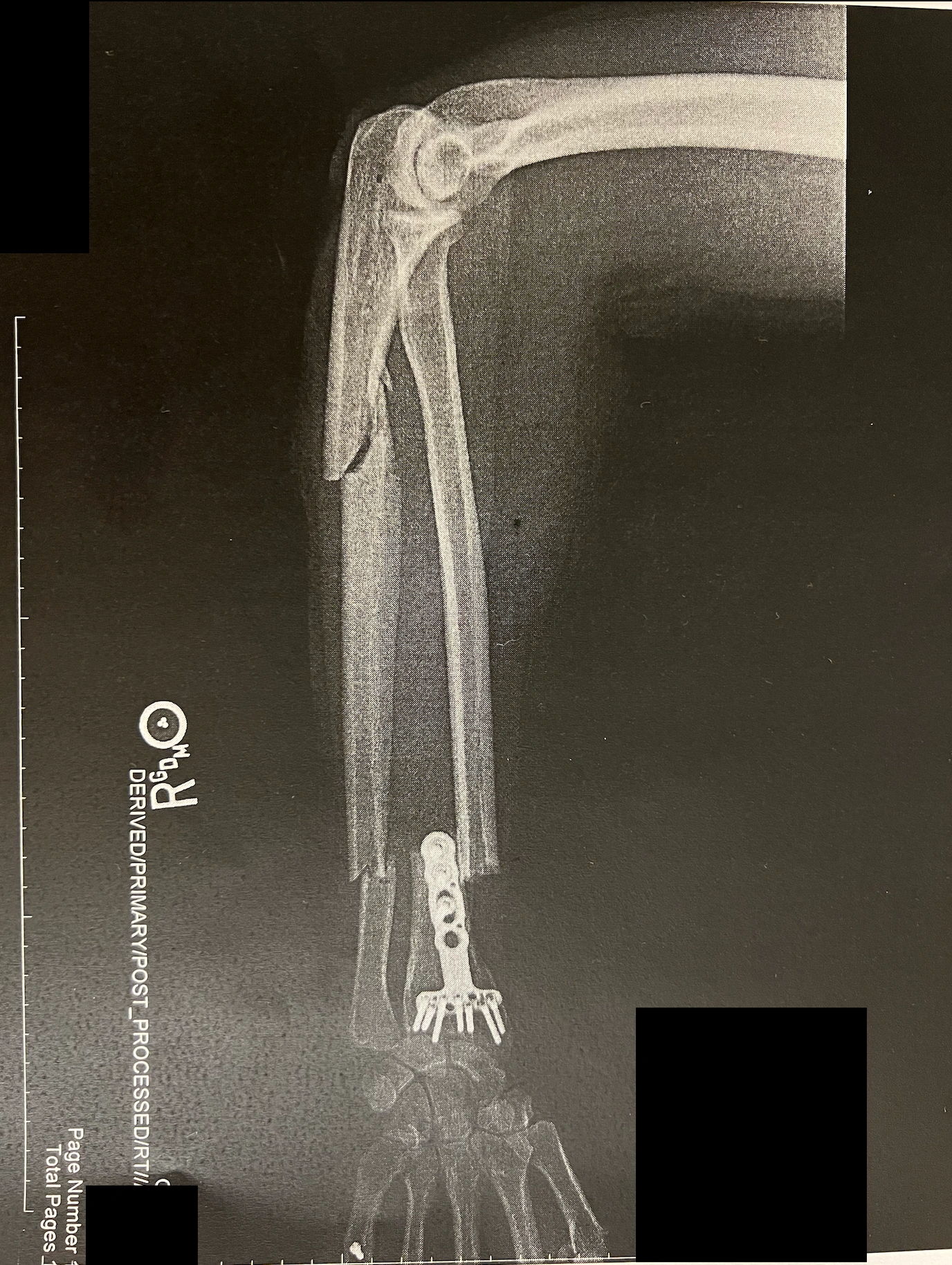
Preoperative imaging documented a displaced radius fracture at the end of the client’s prior fixation plate and displaced, comminuted ulna fractures at two separate levels.
Revision ORIF and Separate Ulna Surgery Were Required
Our client underwent major orthopedic surgery at Penn State Health Milton S. Hershey Medical Center.
Surgeons performed a revision open reduction and internal fixation of the right distal radius.
“Open reduction” means that the fracture was surgically accessed and the bone was restored to proper alignment. “Internal fixation” means that implanted hardware was used to hold the fractured bone in position while it healed.
The procedure was a revision because the new radius fracture occurred at the margin of the hardware from the client’s earlier surgery. The surgeons had to revise the preexisting fixation construct while stabilizing the newly fractured radius.
They also performed a separate open reduction and internal fixation of the segmental ulnar fracture. The two displaced and comminuted fracture regions of the ulna were realigned and secured with plates and screws.
The postoperative imaging documented:
- revision of the distal-radius fixation;
- ORIF of the segmental ulna fracture;
- plate-and-screw constructs;
- reduction of the acute fractures into improved alignment;
- intact postoperative hardware; and
- no immediate postsurgical complication identified on imaging.
Painful Clear and Blood-Filled Fracture Blisters Developed During Recovery
Our client’s early recovery was further complicated by extensive fracture blisters.
These were not ordinary blisters caused by friction.
The force of the trauma and the resulting swelling placed substantial pressure on the soft tissues surrounding the fractured forearm. Layers of skin separated and filled with clear fluid and blood.
Medical literature describes fracture blisters as tense, fluid-filled bullae that may be clear, hemorrhagic, or a combination of both. The blood-filled variety generally reflects deeper tissue separation than a clear blister.
Our client developed both types.
The clear blisters could take approximately seven to ten days to resolve. The blood-filled blisters could remain for two to three weeks and presented a greater risk of discoloration or scarring. The exact healing time varied by blister and by the surrounding swelling.
They were painful, visually disturbing, and another daily reminder of the severity of the collision. His skin had to recover while the fractures, incisions, muscles, and surgically repaired structures were also healing.
The photographs communicate something the phrase “broken arm” cannot. They show the significant soft-tissue response surrounding the fractures and help explain why the recovery involved far more than waiting for the bones to unite.
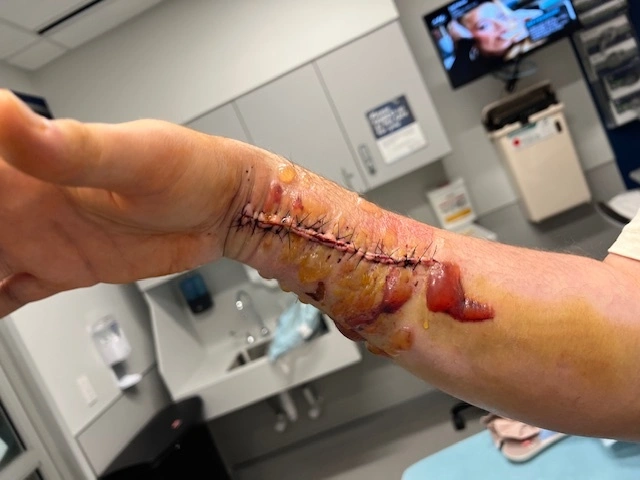
Clear fracture blisters that developed on the client’s injured right forearm during the early recovery period.
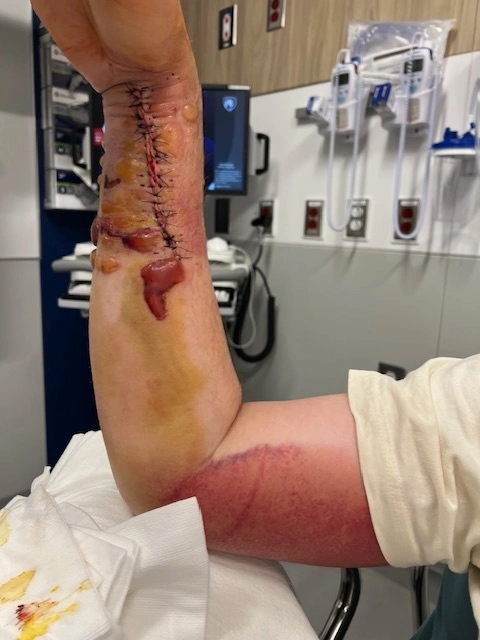
Blood-filled fracture blisters documented during the client’s recovery from the traumatic radius and ulna fractures.
Physical Therapy Was Difficult, Painful, and Slow
Surgery restored alignment and stabilized the bones. It did not immediately restore function.
Our client had to recover from:
- three acute fracture sites;
- severe swelling;
- soft-tissue trauma;
- two surgical fixation procedures;
- multiple plates and screws;
- surgical incisions;
- fracture blisters;
- weakness;
- stiffness;
- reduced range of motion; and
- persistent fear of reinjury.
Physical therapy required him to repeatedly move and load an arm that remained painful, weak, and unreliable.
Progress came in small increments. A few additional degrees of motion, a modest improvement in grip strength, or the ability to complete an activity that had previously been impossible could represent meaningful progress.
The rehabilitation followed him home. Dressing, bathing, sleeping, driving, carrying items, completing household tasks, and using the injured arm throughout an ordinary day became difficult.
The physical recovery was also emotionally challenging. The crash had fractured the same general forearm and wrist region that had required surgery years earlier. Experiencing another major injury and revision operation left him fearful that a sudden movement, fall, physical struggle, or forceful use of the arm could damage the repair.
That fear became especially significant because of his occupation.
The Injury Ended the Hands-On Security Work He Had Previously Performed
Before the collision, our client worked as a security officer.
His job involved substantially more than completing incident reports. Security work for his employer required immediate physical intervention during unpredictable and sometimes dangerous situations.
His duties included:
- responding to emergencies;
- breaking up fights;
- assisting with combative or distressed visitors;
- applying non-lethal physical holds when required;
- lifting or helping move clients;
- protecting company personnel and visitors;
- physically backing up other security officers; and
- in rare emergencies, taking a turn performing chest compressions.
Those responsibilities required strength, grip, stability, rapid reactions, and confidence that his arm would perform when another person’s safety depended on him.
After the crash, he no longer had that confidence.
He remained jumpy, hesitant, and afraid of reinjuring the repaired wrist and forearm. He worried that he might pause during a crisis, fail to secure a proper grip, or be unable to use the force necessary to control a combative person.
He also worried about his teammates. In a physical altercation, another security officer might depend on him for immediate backup. He feared that weakness, hesitation, or reinjury could leave a coworker without the assistance expected of him and could contribute to someone else being hurt.
The injury therefore affected more than the mechanics of lifting or gripping. It damaged his professional confidence and his belief that he could safely satisfy the hands-on expectations of a job he had once loved.
No one needed to tell him that protecting a surgically reconstructed arm during an altercation was inconsistent with the demands of the position. He and his manager eventually agreed that continuing in the same hands-on security role was no longer realistic.
His Employer Found a Safer Position, but It Came With a Pay Cut
Fortunately, the client’s manager worked with him to find a way for him to remain on the security team.
They agreed that a security dispatch position would allow him to use his knowledge, judgment, communication skills, and familiarity with hospital security operations without repeatedly exposing the repaired arm to physical confrontations.
That accommodation helped preserve his employment.
It did not preserve his prior compensation or career path.
The dispatch position was one pay grade lower than the Security Officer position. The reassignment caused an approximately 6% reduction in base pay.
He also lost an additional $1-per-hour differential that his employer identified in his compensation profile as “combat pay.” That differential was paid to Security Officers working at the high-volume location because of the frequency of hands-on incidents. Dispatch monitors did not receive it.
The collision therefore caused an immediate, continuing reduction in compensation:
- approximately 6% less base pay; and
- the loss of the additional $1-per-hour differential.
Our client ultimately moved into the dispatch position.
He did not make that change because he had grown tired of security work or wanted a different career. He accepted it because the collision, the fractures, the revision operation, and his continuing fear of reinjury had made the former role unsafe and emotionally untenable for him.
The Transfer Also Reduced His Opportunities for Advancement
The financial consequences were not limited to the immediate pay reduction.
The Security Officer position had a defined advancement structure that included several opportunities for advancement. The dispatch position did not have the same defined promotional pathway.
The move therefore affected more than his current hourly compensation. It placed him in a position with fewer identified opportunities to earn promotions, increased responsibility, and the future compensation associated with those positions.
This collision therefore:
- reduced his current compensation;
- eliminated a recurring hourly differential;
- moved him to a lower pay grade; and
- removed him from a defined advancement track he had previously been able to pursue.
He Received Only 60% of His Salary During Short-Term Disability
The wage loss began before the permanent reassignment.
While our client was unable to work and received short-term disability benefits, he received only approximately 60% of his regular salary.
That meant a significant reduction in household income during the same period in which he was coping with hospital care, surgery, pain, medical appointments, physical therapy, and uncertainty about whether he could return to his former job.
Before the short-term disability benefits began, he was required to use his own accrued paid leave during the employer’s waiting period.
Using Paid Leave Created an Additional Financial Loss
The fact that our client received his regular paycheck while using paid time off did not mean that the leave had no economic value.
His employer allowed employees to sell back qualifying unused paid time at their hourly rate each year.
Because the collision forced him to consume his accrued leave during the disability waiting period and recovery, he no longer had the same amount available for the annual sell-back program.
The crash therefore affected his income in several separate ways:
- He received only 60% of his salary while on short-term disability.
- He was required to use accrued paid leave before disability benefits began.
- Using that leave reduced or eliminated the amount he could sell back.
- His transfer caused an approximately 6% reduction in base pay.
- He lost the $1-per-hour security differential.
- He moved from a position with a defined advancement track into a role without the same identified promotional pathway.
These details were legally relevant even though the amount ultimately recoverable was constrained by the available insurance and assets.
The losses did not stop existing merely because the available defendants could not pay all of them.
The Police Report Initially Identified the Wrong Vehicle Owner
The initial police report identified a person other than the teenage driver’s parents as the owner of the vehicle.
That discrepancy could not be ignored.
Vehicle ownership can affect:
- which liability policy applies;
- whether another household policy may provide coverage;
- whether excess or umbrella insurance exists;
- which people may be legally responsible; and
- whose assets should be investigated.
We did not simply accept the ownership entry because it appeared in an official report.
Our investigation established that the entry was incorrect and that the teenage driver had been operating his parents’ vehicle. We then investigated the actual ownership, the applicable insurance, possible excess or umbrella policies, household coverage, and potential collectible assets.
The ownership mistake did not ultimately produce additional coverage, but identifying and resolving it was necessary before the case could be responsibly settled.
This is one reason a serious Pennsylvania car accident claim cannot be handled by merely obtaining the police report and sending a demand to the first insurer listed.
The At-Fault Side Had Only $25,000 in Liability Coverage
The at-fault driver and vehicle owner had only $25,000 in bodily injury liability coverage available for the claim.
That limit was plainly inadequate to compensate our client for:
- complex fractures of both forearm bones;
- three distinct fracture sites;
- revision radius surgery;
- separate ulna ORIF;
- multiple plates and screws;
- painful fracture blisters;
- physical therapy;
- emotional trauma and fear of reinjury;
- reduced short-term disability income;
- depleted paid leave;
- lost PTO sell-back value;
- a lower-paying job;
- loss of an hourly differential; and
- diminished advancement opportunities.
We recovered the full $25,000 liability limit from the at-fault policy.
That was only the first part of the insurance recovery.
Our Client’s $200,000 Underinsured Motorist Coverage Made the Difference
The young driver had insurance. He simply did not have enough insurance to pay the client’s losses.
Pennsylvania law defines an underinsured motor vehicle as one for which the available liability limits are insufficient to pay the losses and damages caused by the crash.
Fortunately, our client had purchased $200,000 in underinsured motorist coverage before the collision.
That decision ultimately added $200,000 to the available recovery.
We presented the UIM carrier with evidence documenting:
- the collision sequence;
- the police findings;
- the disabling vehicle damage;
- the radius fracture beside the old plate;
- the segmental and comminuted ulna fracture;
- the revision surgery;
- the separate ulna ORIF;
- the plates and screws;
- the fracture blisters;
- the physical therapy;
- the prior medical history;
- the emotional effect of reinjuring the same arm;
- the inability to confidently resume hands-on security duties;
- the short-term disability loss;
- the depleted paid leave;
- the job reassignment;
- the reduced compensation; and
- the diminished advancement pathway.
After negotiation, the UIM carrier paid the complete $200,000 policy limit.
Settlement Breakdown
$25,000
Full bodily injury liability limit from the at-fault driver’s policy
$200,000
Full underinsured motorist policy limit from our client’s coverage
$225,000
Total gross recovery
No Additional Insurance or Collectible Assets Were Available
We investigated whether any additional source could pay a judgment beyond the $225,000 in available insurance.
That investigation included the actual vehicle ownership, possible household coverage, excess or umbrella insurance, and potentially collectible assets of the driver and owner.
No additional applicable policy was identified.
The driver and vehicle owner also did not have sufficient collectible, nonexempt assets to make further litigation a realistic source of meaningful recovery.
The case therefore did not resolve for $225,000 because that amount fully measured everything the collision had taken from our client.
It resolved for $225,000 because that represented all realistically available insurance after the other possible sources of recovery had been investigated.
Had greater liability limits, additional UIM coverage, umbrella insurance, or substantial collectible assets existed, the documented injuries and economic consequences supported pursuing a larger recovery.
A Few Seconds of Impatience Changed Another Person’s Career
The young driver could have remained behind the stopped traffic and waited for our client to pass.
Instead, he moved around the vehicles, crossed the center lines, and attempted the turn.
That decision changed another person’s life.
Our client suffered three fracture sites in the same arm that had required surgery years earlier. He underwent revision fixation of the radius and separate fixation of the ulna. He lived with painful fracture blisters, difficult rehabilitation, weakness, stiffness, and fear that another physical event would damage the reconstructed forearm.
The collision affected his livelihood, his income, his future opportunities, his confidence, and his emotional well-being.
He lost the ability to perform a job he valued. He accepted a lower-paying position because it allowed him to continue working without placing himself and his teammates at the same physical risk. He also lost a clear path toward higher-level security positions that had previously been available to him.
The settlement could not restore the months devoted to surgery and rehabilitation. It could not return the career path he had been following or erase the fear that his arm might be injured again.
It did secure every dollar of insurance that was realistically available.
Quick Answers About This Pennsylvania Car Accident Result
How much did Santini Law recover?
Santini Personal Injury & Car Accident Law recovered $225,000: the at-fault driver’s $25,000 bodily injury liability limit and the client’s $200,000 underinsured motorist limit.
Where did the crash occur?
The collision occurred on Abbottstown Pike near Racetrack Road in Berwick Township, Adams County, Pennsylvania, near Abbottstown between Gettysburg and York.
What injuries did the client suffer?
The client suffered a displaced radius fracture beside prior fixation hardware and displaced, comminuted ulna fractures at two separate levels. Both bones of the right forearm were fractured at three distinct sites.
What surgery was performed?
Surgeons at Penn State Health Milton S. Hershey Medical Center performed revision open reduction and internal fixation of the radius and separate ORIF of the segmental ulna fracture using plates and screws.
Why was this an underinsured motorist claim?
The at-fault driver had insurance, but the $25,000 liability limit was insufficient to compensate the client. The client therefore pursued his own $200,000 underinsured motorist coverage.
How did the injuries affect the client’s job?
The client no longer felt able to safely and confidently perform the hands-on duties of his hospital security position. He ultimately moved into a Security Dispatch Monitor role that carried an approximately 6% base-pay reduction, eliminated a $1-per-hour differential, and did not offer the same defined advancement pathway.
Why did the recovery stop at $225,000?
The law firm recovered both available policy limits and investigated possible additional insurance and assets. No other realistic source of recovery was identified.
Records Supporting This Case Story
This case story was prepared from the Pennsylvania State Police crash report, diagnostic imaging and radiology reports, orthopedic and postoperative records, physical-therapy documentation, injury photographs, vehicle-damage photographs, employment and compensation records, insurance policies, settlement documentation, and the client’s account of the collision and recovery.
About the Attorney
Frank Santini represented the injured client in this Pennsylvania car accident and underinsured motorist claim.
Result Disclaimer
Prior results do not guarantee a similar outcome. Every case depends on its particular facts, injuries, insurance coverage, legal issues, available assets, and other circumstances. The $225,000 figure represents the gross recovery before attorney fees, costs, medical liens, reimbursement claims, and other deductions, if applicable. Client identity has been withheld.

Let Us Get You Started In The
Right Direction
Fields marked with an * are required
Santini Personal Injury
& Car Accident Law
7269 Bucks Ford Dr.
Riverview, FL 33578

Call Us Today 908-329-2003
Santini Personal Injury
& Car Accident Law
9 Hanover Street
Phillipsburg, NJ 08865
© Copyright 2026 Santini Personal Injury & Car Accident Law. All Rights Reserved.
Disclaimer | Site Map | Privacy Policy
*Images are obtained under license from Canva and other third-party stock image providers, with attribution included where required.
Digital Marketing By 